Trump escalates Cuba pressure, building case for potential military action
Published in News & Features
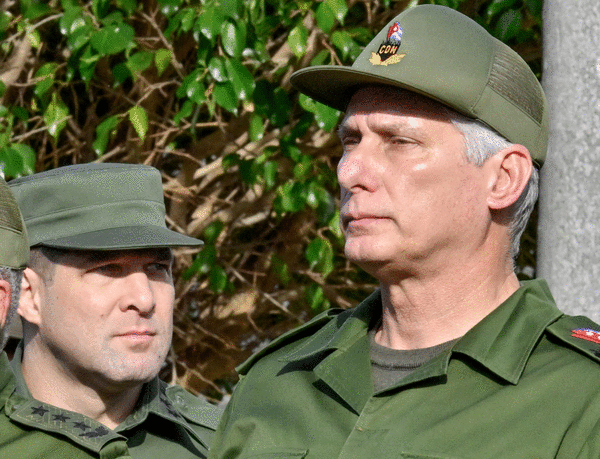
As Cuban leaders reject reforms and talks with the United States stall, the Trump administration appears to be building a case to justify potential military action in Cuba if diplomacy and sanctions don’t prompt major changes on the island, military experts and former U.S. officials told the Miami Herald.
Only a few days ago, there were few signs that military action was high on the list of U.S. policy options to try to change the trajectory of Cuba, a country President Donald Trump initially labeled a “failing nation” that would fall on its own.
The administration had threatened Cuba’s oil suppliers, leaving the island with no more fuel than what it can produce domestically, and it sanctioned the military conglomerate GAESA and its head, along with several members of the government and the military. It also engaged in talks with Raúl Castro’s grandson, Raúl Guillermo Rodriguez Castro, in the hopes he could help strike a deal.
The Trump administration would rather not use the military in Cuba, and military action does not seem imminent, experts say, but as Cuban leaders have dug in, refusing to make political concessions or enact major economic reforms at a fast pace, the administration has ramped up the pressure, signaling that it is preparing to move beyond economic coercion and diplomatic pressure.
In a rapid escalation, the Trump administration sent CIA Director John Ratcliffe to deliver a warning to Havana last week — to make changes now, to take Trump seriously, to expel foreign adversaries from the island — and indicated it was moving to indict Raull Castro for the shootout of two civilian planes of the Cuban exile organization Brothers to the Rescue.
The CIA visit and the looming indictment are part of a pressure campaign on the Cuban government to extract concessions or fracture Cuban power elites, said Bryan Fonseca, a former analyst at the U.S. Southern Command who is vice provost for defense and national security research at Florida International University. But the measures could also be seen as “the first stages in beginning to say, if things don’t change, we’re going to go kinetic,” a military term for combat. “I think it’s a signaling. It doesn’t mean that they’re going in tomorrow.”
For months now, U.S. military surveillance aircraft and drones have been flying close to the Cuban coast, likely gathering intelligence to update military plans in the event the administration makes a decision to strike. Using flight tracking data, CNN reported 25 such flights between early February and early May.
Fonseca said he has “no doubt” the Pentagon has plans for taking Cuba by force. “It doesn’t necessarily mean they’re going to take action on those plans, but the flights have to happen, and you have to have intelligence if the president says, tomorrow, ‘All right, guys, we’re going in.' ”
Imminent threat?
While several U.S. military assets remain in the Caribbean, where the administration is conducting controversial strikes on alleged drug traffickers, observers have not yet seen the kind of military buildup that predated military action in Venezuela — where U.S. special forces captured the country’s strongman, Nicolás Maduro, in a very precise operation — or Iran, where the U.S. has conducted a significant number of airstrikes.
If the U.S. were to strike Cuba, it would deploy a massive number of military assets to avoid U.S. casualties, Fonseca said, but then “they’d have to come back and answer as to what was the imminent threat, and they’re going to do that in advance of what is going to be a very difficult midterm election for the Republicans.”
While Trump repeatedly has suggested that a military attack on Cuba is an option — he has mentioned taking Cuba and sending an aircraft carrier to the island — the administration had not articulated a legal pretext or justification for why Cuba is an imminent threat to U.S. national security. Then came news of Castro’s impending indictment last week, followed by an Axios report Sunday citing classified intelligence showing that Cuba has obtained more than 300 military drones from Russia and Iran and has discussed drone warfare plans in case of a U.S. attack.
Cuba has not outright denied it has acquired drones but has pushed against the notion that it would attack U.S. interests. Axios reported that the intelligence showed Cuban officials were recently discussing plans to use drones to attack the U.S. naval base in Guantánamo and even Key West.
“Like any country, Cuba has the right to defend itself against external aggression. It is called self-defense, and it is protected by International Law and the U.N. Charter,” Cuba’s deputy foreign minister, Carlos Fernández de Cossío, said in a statement shared by the Cuban Embassy in Washington, D.C.
“Those from the U.S. who seek the submission and, in fact, the destruction of the Cuban nation through military aggression and war, do not waste a single moment fabricating pretexts, creating and spreading falsehoods, and distorting as extraordinary the logical preparation required to face a potential aggression,” he added.
On Monday, Cuban leader Miguel Díaz-Canel insisted the island is not a threat and is not planning to attack the United States, but said his country has the “absolute and legitimate right to defend itself against a military onslaught; however, this cannot logically or honestly be wielded as an excuse to wage war against the noble Cuban people.”
He warned that a U.S. military action against Cuba would lead to a “bloodbath.”
The Herald could not independently confirm the intelligence about the drones. The White House, the office of the Director of National Intelligence and the CIA did not reply to questions about Cuban drones. A White House official said in response to the Herald’s inquiry: “As the President stated, Cuba is a failed country that has been horribly run for many years and is only heading in one direction — down. Its flailing leaders should make a deal with the United States.”
Juan Gonzalez, a former National Security Council director for the Western Hemisphere under President Joe Biden, said he did not see evidence at the time of Cuba acquiring drones.
“Do they have 300 drones? Maybe,” he said. “But it’s a joke of a stockpile if the story is true, and there is zero information to support the idea that they have plans to attack GITMO. They barely have fuel for naval patrols. This is a lazy pretext for the use of force.”
‘Limited military capabilities’
Another former senior government official who served under Biden, who asked not to be identified to speak about sensitive intelligence, questioned the likelihood of Iranian attack drones being used against the U.S. naval base in Guantánamo. The person said there had been information about Russian arms sales to Cuba, but not from Iran.
“Cuba has very limited military capabilities and its preferred equipment provider has been Russia, not Iran,” the former U.S. official said. “It’s credible that Cuba has been acquiring additional capabilities, including drone-related capabilities from Russia.”
Frank Mora, a former assistant secretary of defense for the Western Hemisphere, said whatever the truth about the intelligence, its release, along with the CIA director’s Havana visit, the news on Castro’s impending indictment, and sanctions on the military conglomerate GAESA and government officials, are all intended to increase the pressure on the Cuban government.
“I don't think military action is imminent, but it is possible; it cannot be ruled out,” said Mora. “I think what happened in the last couple of weeks is all part of what the administration does, which is to try to intimidate and increase the pressure in the hope that the regime will make more concessions in the negotiations. I think it’s more about that than the pretext, but that doesn’t mean that they’re not trying at some point to build a case, a justification for military action.”
On Tuesday, Trump again said a deal with Cuba is possible.
Asked by reporters whether he is confident about a diplomatic deal with Cuba, Trump replied: “I think so. I can do that whether you change the regime or not. It has been a rough regime and they killed a lot of people. But it’s a country that really needs help. They can’t turn on the lights, they can’t eat. We don’t want to see that.”
©2026 Miami Herald. Visit at miamiherald.com. Distributed by Tribune Content Agency, LLC.






Comments