Blue crab population booms in Chesapeake Bay by 100 million, report finds
Published in News & Features
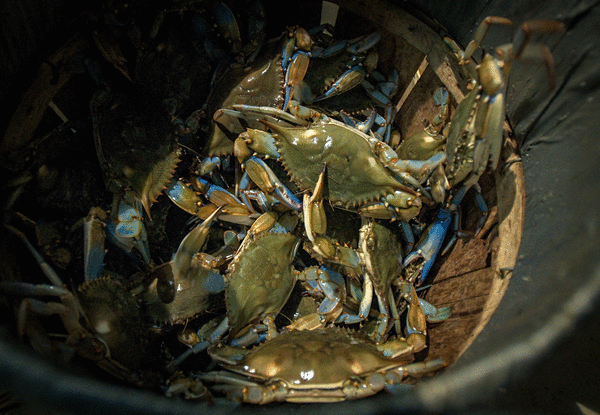
BALTIMORE — After a hit to the blue crab population last year, the numbers have grown by over 100 million in 2026.
The blue crab population is estimated at 349 million in the Chesapeake Bay, compared to the 238 million last year, according to results from this winter’s annual dredge survey of the waterway.
Blue crab populations are highly dynamic, said the Virginia Marine Resources Commission’s Director of Communications Zachary Widgeon, making it difficult to pinpoint one direct cause for the uptick.
“Blue crabs are especially affected by the environment, weather conditions, sea conditions, predator abundance,” he said. “It’s not something we can put our finger on and say, this is why the crabs were better this year. We’re still trying to wrap our heads around exactly what’s working and what’s not.”
Each winter, the Virginia Institute of Marine Science at William & Mary and the Maryland Department of Natural Resources team up to complete the dredge survey of the Chesapeake Bay to record the blue crab population count. The survey data was released Monday.
The cold months are pivotal for blue crabs, which is when the species “overwinter.” Burying themselves under mud to protect themselves from the freezing temperatures, the blue crabs will wait to emerge in the spring. However, cold enough temperatures can lead to higher mortality rates.
Regardless of the harsh winter conditions blue crabs faced, male and juvenile populations grew this year, a change from last winter. The adult male population increased by over 10 million to 37 million. Juvenile blue crabs jumped the most by 120% from 103 million to 228 million, which Widgeon said is a positive sign.
“Conditions are improving right now for juvenile recruitment, whether that’s (because) we’re having good weather patterns out in the ocean, good climates, more sub-aqueous vegetation, the sea grasses,” he said. “They’re surviving longer.”
However, adult female crabs saw a decline from 108 million to 81 million, which Widgeon said is not unexpected or out of the ordinary, but the commission is cautious about.
“We want to make sure we are looking at number of females and comparing it to previous years,” he said. “But, as the winters mild out over the next couple winters, the population swings right back. It’s not something humans are doing, it’s just the life cycle of crabs.”
The Chesapeake Bay Foundation, on the other hand, said in order to support the blue crab population, focus must remain on pollution prevention, restoration of blue crab habitats and managing blue catfish, an invasive species to the Chesapeake Bay.
“There’s still immense uncertainty surrounding the health of blue crabs in the Chesapeake Bay,” the foundation’s Executive Director Chris Moore said in a statement. “We will work with fisheries managers and jurisdictions around the region to chart a brighter course for the Bay’s most iconic species.”
The crustaceans are referred to as a keystone species of the Chesapeake Bay, providing influential insights into the status of the water.
“By that we mean we can see a lot of factors about the health of the Chesapeake Bay through the blue crab population,” Widgeon said. “Seeing what their population is doing, is it increasing, decreasing, what factors are affecting them — weather, man-made conditions, shorelines, predators. It’s kind of our canary in a coal mine.”
Blue crabs aren’t just influential from an environmental standpoint, but also economically, as it’s one of the most popular commercial species from the Chesapeake Bay.
“It’s a huge driver of industry in Hampton Roads,” Widgeon said. “The blue crab is, I would say, the mascot of Chesapeake Bay for Maryland, Virginia and the Potomac River.”
While the previous data doesn’t always implicate conditions for the following year, Widgeon is hoping the uptick in juveniles will lengthen survivability rates through the next couple years.
“Their population is so cyclical and can swing so wildly,” Widgeon said. “We look at crabs on a three- to five-year lifespan. We’re going to see those numbers continuing to look good this season into next season.”
_____
©2026 The Virginian-Pilot. Visit pilotonline.com. Distributed by Tribune Content Agency, LLC.






Comments