Kansas judge blocks law banning gender-affirming care for trans teenagers
Published in News & Features
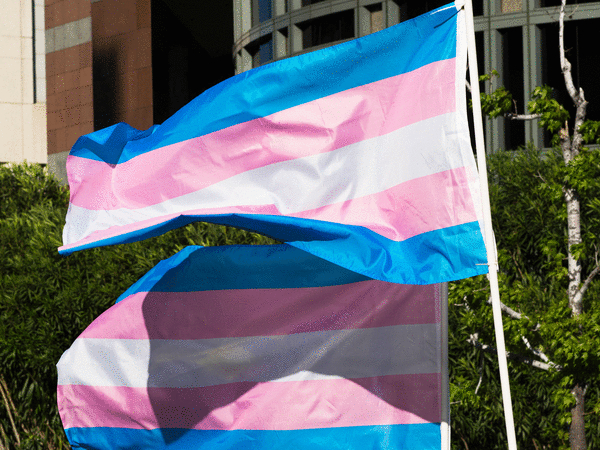
A Kansas judge has cleared the way for transgender minors to resume gender-affirming care that lawmakers banned in 2025.
Douglas County District Court Judge Carl Folsom III issued a temporary injunction blocking enforcement of key provisions of the state law in a 117-page ruling on Friday.
The decision will allow physicians to administer puberty blockers and hormone therapy for teenagers experiencing gender dysphoria with the permission of their parents.
The 2025 law also bans gender-affirming surgeries for people under 18. But because no Kansas clinics offer such surgeries for minors, that provision was not included in the motion to block enforcement of the statute while the civil lawsuit works its way through the courts.
“This is an enormous relief to our clients and families across the state of Kansas,” said Harper Seldin, a staff attorney with the American Civil Liberties Union, which sued the state on behalf of two trans minors whose treatment was interrupted by the legislation.
“The medical care unjustly banned by this law serves as the foundation of young transgender people’s entire lives and helps give them the future all young people deserve,” Seldin continued. Any decision about this medical care should be between families and their doctors.”
In his own statement, Attorney General Kris Kobach derided the injunction as “a stark example of judicial activism” and vowed to appeal the decision.
“The judge invented a new constitutional right out of whole cloth. Even though the Kansas Constitution says nothing about it, the judge created a new right of parents to obtain otherwise-illegal treatments for their children,” Kobach said.
The Attorney General’s office has argued in court that the law is intended to protect children from unsafe treatments and to uphold the integrity of the medical profession. Major U.S. medical organizations support access to gender-affirming care for minors.
Folsom’s ruling comes months after Republican lawmakers enacted another law over Gov. Laura Kelly’s veto, forcing transgender Kansans to replace any driver’s licenses and birth certificates with updated gender markers and restricting public restroom usage in government buildings based on sex assigned at birth.
In March, Douglas County District Court Judge James McCabria denied the ACLU’s motion for a temporary restraining order that would have blocked enforcement of that law.
Gender-affirming care for Kansas teens
The gender-affirming care ban lawsuit was filed last May, and Folsom’s decision to grant an injunction comes after a two-day evidentiary hearing in November, where plaintiffs shared their stories and the judge heard from both sides’ expert witnesses.
“This temporary injunction is not a final determination of any claim,” Folsom wrote. “But it is intended to prevent the plaintiffs from suffering irreparable injury during the pendency of this lawsuit while plaintiffs’ claims are being litigated.”
The plaintiffs are two transgender teens and their parents, who are all identified by pseudonyms in court filings. “Lily Loe” is a 14-year-old trans girl whose family lives in Lawrence, and “Ryan Roe” is a 16-year-old trans boy whose family lives in Overland Park.
According to their sworn testimony, the teens both knew from an early age that they did not identify with the sex they were assigned at birth. After they and their parents consulted with medical professionals at the Gender Pathways Services Clinic that operates through Children’s Mercy Hospital, the teens were diagnosed with gender dysphoria and prescribed hormonal treatments.
“Being transgender is not a mental health condition to be treated or cured,” Folsom wrote. “But transgender people may experience gender dysphoria, the medical condition marked by clinically significant distress that can arise from the incongruence between a person’s gender identity and their sex assigned at birth.
“It is harmful to transgender adolescents with gender dysphoria to remove the option of receiving gender-affirming medical care because that is the treatment with the most evidence of being helpful to treat gender dysphoria,” Folsom wrote.
Irreparable harm
After the law went into effect, Kansas physicians were given until Dec. 31, 2025 to taper their teen patients off of puberty blockers and hormones, including estrogen and testosterone treatments.
According to the court record, the parents of the two trans teens were forced to find out-of-state clinics where their children could continue their treatment — one in Minnesota and the other in Colorado. The parents, who were cross-examined during the hearing, testified that the regular trips for treatment had been costly and disruptive to their lives.
In granting the partial injunction, Folsom found that the plaintiffs succeeded in proving their arguments are likely to prevail and that the continued enforcement of the state law during the legal challenge would likely cause them to suffer irreparable harm.
“Section 1 of the Kansas Bill of Rights protects the fundamental right of parents to the care, custody, and control of their children, which includes the right to consent to medical care that their children need and desire and which is recommended by a clinician,” Folsom wrote.
He also found that the state failed to provide credible evidence that approved hormonal treatments for gender dysphoria are dangerous.
“Plaintiffs presented reliable and credible testimony … that puberty blockers are fully reversible, do not cause long-term negative effects for bone health, fertility, or cognitive function, and have side effects that are manageable, even for the more serious side effects, which are nonetheless very rare,” Folsom wrote.
Proceedings in the case will likely be halted as the Attorney General’s office petitions the Kansas Court of Appeals to overturn Folsom’s temporary injunction ruling.
©2026 The Kansas City Star. Visit at kansascity.com. Distributed by Tribune Content Agency, LLC.






Comments