DOJ announces $1.8 billion fund as part of Trump settlement with IRS
Published in News & Features
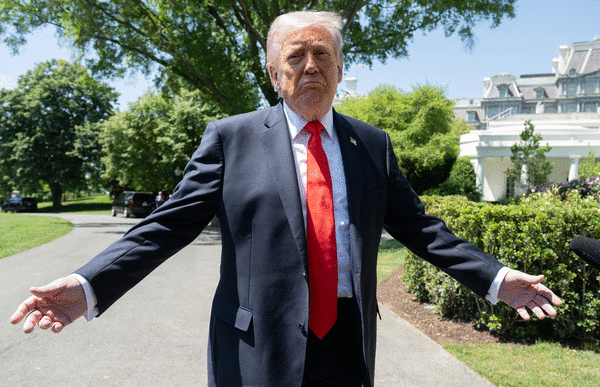
WASHINGTON — The Justice Department on Monday announced a new $1.8 billion “anti-weaponization fund” to compensate anyone for perceived targeting by past administrations as part of settling President Donald Trump’s $10 billion suit against the IRS.
Monday’s DOJ announcement came shortly after Trump attempted to drop his lawsuit against the IRS, though the court filing related to that attempt did not mention the settlement. Multiple experts and dozens of congressional Democrats argued that he should not be allowed to proceed with the IRS lawsuit when he controls both sides of the litigation.
According to a Justice Department announcement, the “anti-weaponization fund” will provide payments to people seen as being “targeted” by prior administrations.
“The machinery of government should never be weaponized against any American, and it is this Department’s intention to make right the wrongs that were previously done while ensuring this never happens again,” acting Attorney General Todd Blanche said in a statement.
The announcement said the fund was created as a condition of Trump dropping his IRS lawsuit as well as dropping claims for damages resulting from the raid on Mar-a-Lago seeking classified documents he kept in his possession while a private citizen and the “Russia-collusion hoax.”
The fund will be run by five members chosen by the attorney general, and Trump can remove any of them, the announcement said.
The court filing came two days before a deadline in the case for Trump and the Department of Justice to explain whether the judge has the authority to hear the dispute at all because Trump is effectively both the plaintiff and the defendant in the litigation.
Monday’s filing argues that the judge has no power to review the decision to drop the suit.
Trump filed the suit in January, arguing that the IRS violated federal law when former contractor Charles Littlejohn leaked thousands of his tax return records during Trump’s first term in office. Littlejohn pleaded guilty to one charge connected to the leak and was sentenced to five years in prison in 2024.
Trump’s initial complaint, joined by two of his sons and several Trump family companies, sought $10 billion in damages for the leaked documents.
Also Monday, more than 90 members of the House of Representatives asked to file their own brief in the lawsuit, arguing that the president is colluding with the DOJ for personal profit.
“Should this lawsuit achieve Plaintiffs’ desired ends, it would result in the improper and unconstitutional transfer of taxpayer dollars into the pockets of the President, his family, and his allies,” Monday’s filing from lawmakers said.
The brief also argued that the judge should take steps to make sure any settlement between Trump and the DOJ would not violate the Constitution. The filing also argued that the judge should not accept the fund that the Trump administration may create through the settlement.
Last month, Judge Kathleen M. Williams of the U.S. District Court for the Southern District of Florida, who is overseeing the case, asked outside experts to weigh in on whether there was an actual case she could hear — as Trump nominally controls the IRS and DOJ attorneys working on the case in his capacity as head of the executive branch.
In their filing last week, those outside experts called Trump’s suit “unprecedented” and said the judge should do more investigation into how much Trump controlled the attorneys defending the IRS.
“With respect to these Defendants specifically, the President’s capacity for control is extraordinary,” the brief said.
The experts cited Trump’s own statements that he controls both the IRS and the DOJ lawyers handling the case. The brief said that if the judge found that Trump controlled both sides of the case, she could not hear it, as it was not a genuine legal dispute.
©2026 CQ-Roll Call, Inc., All Rights Reserved. Visit cqrollcall.com. Distributed by Tribune Content Agency, LLC.






Comments