Mother who searched for jailed son dies after Venezuela reveals his death
Published in News & Features
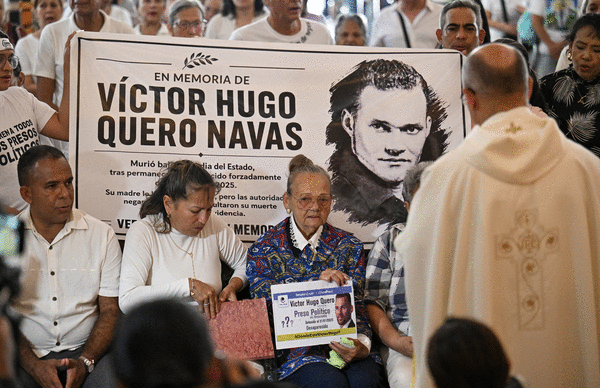
Carmen Teresa Navas, the 82-year-old Venezuelan mother who spent months desperately searching prisons, military facilities and government offices for answers about her detained son, died Sunday just days after authorities admitted that he had died nearly a year ago while in state custody — a revelation that has intensified outrage over alleged forced disappearances and abuses against political prisoners in Venezuela.
Journalist Maryorin Méndez, who had accompanied Navas during her months-long search for information about her son, confirmed the death Sunday evening.
“At 7 p.m. this Sunday, May 17, Carmen Teresa Navas — mother of political prisoner Víctor Hugo Quero Navas — has just passed away,” Méndez wrote in a message shared on social media.
Her death came only days after Venezuelan authorities admitted that Quero Navas had died on July 24, 2025, while detained at the Rodeo I prison complex near Caracas — information officials had withheld for more than nine months even as his mother publicly pleaded for proof that he was still alive.
The case has become one of the most emblematic examples cited by rights organizations accusing Venezuela’s security apparatus of using arbitrary detention, incommunicado imprisonment and forced disappearances against dissidents and suspected opponents.
In a statement released Thursday, Venezuela’s Ministry for Penitentiary Services said Quero Navas died after being hospitalized while in custody.
According to the ministry, the 51-year-old merchant was detained on Jan. 3, 2025, and later transferred to the Dr. Carlos Arvelo Military Hospital on July 15 after suffering from what authorities described as “upper gastrointestinal bleeding and acute febrile syndrome.”
The ministry said he died 10 days later from “acute respiratory failure secondary to pulmonary thromboembolism.”
Officials claimed no relatives formally requested visitation rights and alleged Quero Navas failed to provide information about family contacts while incarcerated. Authorities said that because no relatives appeared to claim the body, he was buried by the state on July 30, 2025, following “legal protocols.”
The explanation immediately drew outrage from relatives, lawyers and human rights advocates, who noted that Carmen Teresa Navas had spent months traveling to prisons, courts and government institutions trying to determine her son’s whereabouts.
Human rights group Foro Penal denounced the government’s account as misleading.
“Víctor Quero died while he was disappeared!” Foro Penal president Alfredo Romero wrote on X. “The Penitentiary Ministry says he provided no family information, but his mother went many times to Rodeo I and authorities denied he was there. Outrageous!”
Family members said Quero Navas was arrested by officers from Venezuela’s military counterintelligence agency on Jan. 1, 2025, allegedly without a judicial warrant. Since then, relatives said they received contradictory information from authorities and detention centers, with officials repeatedly denying he was being held there.
Rights organizations classified the case as a possible forced disappearance and repeatedly demanded proof of life.
Just days before the government admitted Quero Navas had died months earlier, attorneys with the Coalition for Human Rights and Democracy were still publicly demanding information about his location.
“Despite this judicial decision, we will continue demanding answers regarding the whereabouts of Víctor Quero, who remains in forced disappearance,” attorney Moisés Gutiérrez said on May 5 after a Venezuelan court rejected amnesty measures requested on Quero Navas’ behalf.
The case had already drawn international concern before the government’s disclosure.
On April 18, the Inter-American Commission on Human Rights granted precautionary measures in favor of Quero Navas and his mother, concluding they faced a “serious and urgent situation” that placed their rights to life, personal integrity and health at risk.
The commission said Venezuelan authorities had repeatedly failed to provide information about Quero Navas’ legal status, health condition or official place of detention despite sustained efforts by his mother to obtain answers.
“The longer the beneficiary’s health condition, legal situation and official location remain unknown, the greater the possibility of irreparable harm to his rights,” the commission said.
The organization also expressed concern over allegations that Carmen Teresa Navas had faced intimidation and pressure from state officials while advocating publicly for her son.
On Sunday evening, Venezuelan opposition leader and Nobel Peace Prize laureate María Corina Machado published an emotional tribute honoring Carmen Teresa Navas and condemning the circumstances surrounding both deaths.
Machado said the grieving mother had come to represent “thousands of Venezuelan mothers” searching for relatives who are imprisoned, persecuted, missing or dead.
“Carmen Teresa’s death cannot be separated from the suffering, cruelty and impunity that marked the final months of her life,” Machado wrote. “Venezuela has a moral duty to remember her name, as well as that of Víctor Hugo.”
She also warned against what she described as the normalization of abuses committed against detainees and their families.
“A country that forgets its victims runs the risk of becoming accustomed to horror,” Machado said.
©2026 Miami Herald. Visit at miamiherald.com. Distributed by Tribune Content Agency, LLC.






Comments