For Trump in China, a tonal shift yields few results
Published in News & Features
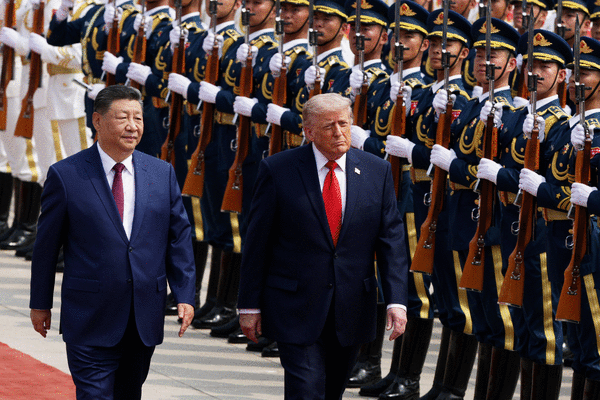
BEIJING — A conciliatory President Donald Trump on Friday hailed success in his state visit to China, claiming a tonal reset with Xi Jinping despite departing Beijing with few concrete achievements.
The visual spectacle around Trump’s visit was itself considered a breakthrough by the two sides, who expressed an eagerness entering the talks to move on from a years-long stretch of deteriorating relations.
But the U.S. delegation boarded Air Force One on Friday afternoon with little else to show from a summit the president had trumpeted for weeks as a historic event.
Treasury Secretary Scott Bessent said the two sides had agreed to open direct dialogue on safety concerns over artificial intelligence, without detailing what the channel would look like. The president’s trade representative said China had agreed to robust investments in the U.S. economy that went unacknowledged by Beijing.
And at a final meeting before his departure, Trump claimed his Chinese host shared similar views as him on Iran, the dangers of its nuclear program and the problems with its control over the Strait of Hormuz. Xi sat by his side in silence.
On the plane flight home, Trump told reporters that the summit was “a pretty historic couple days.”
He denied asking Xi to pressure the Iranians to reopen the strait, “because I don’t need favors,” the president said. “I think he will, I think, automatically. He’d like to see it opened up. He gets about 40% of his energy ... from the strait.”
Chinese state media touted the trip as a “reset” in a relationship fraught with rivalry and suspicion. But the gestures of trust and goodwill ended at the airport. With the risks of espionage known, every item distributed to the American delegation by Chinese officials — including credentials, pins and keepsakes — were collected in a bag along with White House burner phones and thrown off Air Force One before departure.
New power dynamic
Trump’s deference to Xi was a striking display of a commanding president adapting to a new power dynamic, an acknowledgment of China’s rise and its emerging role in the world.
He deployed a charm offensive throughout his stay here, confident in the impact of his personal touch on world leaders, often seen patting Xi on the back and repeatedly calling him his friend.
Yet in private, tensions gripped negotiations that touched nearly every major issue on Trump’s agenda, including trade relations and the Iran war.
“He’s all business,” Trump said from Beijing in an interview with Fox.
China purportedly agreed to buy 200 Boeing jets and spend billions on American agricultural products, U.S. officials said — modest deals that fall short of restoring Chinese investment levels to their pre–2025 highs, before Trump launched a trade war that aggressively targeted Beijing
Nevertheless, Trump referred to the trade agreements as “fantastic,” and said Xi had also pledged to purchase U.S. energy going forward.
Beijing — which has yet to fulfill the trade pledges it made the last time Trump met Xi in October — did not confirm any new agreements.
It also remains unclear what came of China’s request for access to buy the most advanced chips produced by Nvidia, currently the subject of export controls as the two countries race for AI superiority.
“We feel very similar on Iran, we want that to end,” Trump said Friday. “We don’t want them to have a nuclear weapon. We want the straits opened, and we want them to get it ended, because it’s a crazy thing — they’re a little bit crazy.”
At the beginning of the summit, Xi warned the Trump administration that the long-standing U.S. position of strategic ambiguity on Taiwan had set the two nations on a collision course, Chinese state media reported. But departing Beijing, Marco Rubio, the president’s national security advisor and secretary of State, said that Washington’s position on Taiwan remained “unchanged.”
That wasn’t clear when Trump spoke to reporters aboard Air Force One on the flight home, noting he and Xi discussed Taiwan “a lot.”
“On Taiwan, he does not want to see a fight for independence. That would be a very strong confrontation, and I heard him out,” Trump said. “I made no commitment on that.”
Xi asked him whether he would defend Taiwan if China chose to attack, a question he chose not to answer, Trump said.
Yet asked by a reporter whether he would proceed with arms sales to Taiwan, as required under the Taiwan Relations Act and already approved by Congress, Trump equivocated.
“I’ll make a determination over the next fairly short period,” he said. “I have to speak to the person that right now is, you know, is running Taiwan.”
Their second day of meetings was held at Zhongnanhai, an imperial garden and lake district that has served as the secretive seat of power for the Chinese Communist Party since the revolution of 1949.
The two men strolled quiet pathways dotted with Chinese roses and ornamental archways before taking tea and lunch in Xi’s private quarters. Trump was offered rose seeds to bring home for the White House Rose Garden, the Chinese said.
“This has been an incredible visit,” Trump told reporters at the compound. “A lot of good has come of it.”
Reporters traveling with Trump could hear the president, through an interpreter, asking Xi if he had brought other presidents and prime ministers to the compound. He has. Xi recently brought Putin to the CCP headquarters, and in 2014, still relatively new to the Chinese presidency, hosted President Obama overnight at Zhongnanhai, where the two met in private over dinner.
It was another smoggy day for Trump in the Chinese capital, although cooler than Thursday, when Xi greeted Trump at the footsteps of Tiananmen Square with a lavish state welcome. There, Xi hosted Trump and his delegation at the Great Hall of the People for a day of meetings and a state banquet of Peking duck and pan-fried pork buns.
After a lunch of kung pao chicken and other Chinese classics, Trump departed for the airport, uncharacteristically mum with the press.
The two men will have future opportunities to meet. Both leaders will have chances to meet at the APEC and G20 summits, to be held in China and the United States, respectively, later this year. And Trump once again extended an invitation to host Xi in Washington for a state visit at the White House in September.
It is unclear whether Xi has accepted the offer.
“He’s a man I respect greatly,” Trump said.
©2026 Los Angeles Times. Visit at latimes.com. Distributed by Tribune Content Agency, LLC.





Comments