NYC's latest excuse for unearthing long-denied 9/11 toxin files: We were replacing the carpets
Published in News & Features
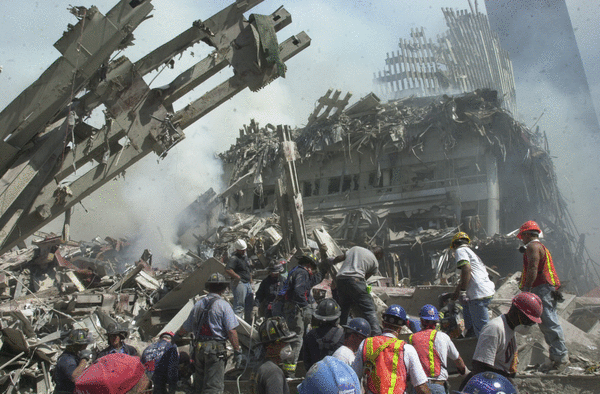
NEW YORK — The 68 boxes of pivotal documents about the toxins swirling over ground zero that the city claimed for years didn’t exist were actually discovered during a remodeling project and “carpet installation” at the city’s Department of Environmental Protection offices, city attorneys humbly admitted as a judge ordered agency heads who denied the documents’ existence to be questioned under oath.
City attorneys said 22 of the boxes were found as DEP employees cleaned out a storage area on the eighth floor in preparation for the new carpets. The rest of the boxes were found in long-term storage, according to a source with knowledge of the case.
While he hasn’t filed his written decision yet, New York Civil Court Judge James Clynes, during a hearing on Monday ordered the DEP to produce the agency officials who denied repeated Freedom of Information Law requests for the documents and explain how the city missed these boxes during the diligent searches they claim to have completed.
Clynes’ decision came at the same time Mayor Mamdani, who hasn’t spoken on advocates’ demands to have the ground zero documents released, attended a breakfast at the 9/11 Memorial & Museum hosted by Fire Commissioner Lillian Bonsignore.
An email to the Mayor’s office about Clynes order to have DEP officials deposed in this case was not immediately returned.
Attorneys for 9/11 advocates, who have been trying to get the documents through FOIL for the last three years, found the city’s carpeting excuse almost laughable.
“I am not aware of any Freedom of Information Law exemption for interior decorating,” said attorney Andrew Carboy, who is representing the families of 9/11 illness victims and 911 Health Watch. “This is what we are dealing with. This is what our brave first responders and survivors are facing. This is a city that does not care about them and will not yield its secret September 11 archive willingly.”
Carboy intends to bring up the carpet installation, as well as the city’s other ongoing stall tactics, when DEP officials who had denied the FOIL requests are deposed in court in early July.
One of the DEP officials to be deposed will be the agency’s public records officer, who rejected attorneys appeals for the documents when DEP said they couldn’t find any to share, Clynes ordered.
“We are glad that the court is allowing us to take sworn testimony and get definitive answers,” Carboy said. “These officials should explain, under oath, why they issued sworn denials, rejected our appeal, and aggressively moved to dismiss our case as a ‘baseless fishing expedition.’ Why did DEP suddenly reverse course and admit to having the records all along?”
Benjamin Chevet, the executive director of 9/11 Health Watch, said Clynes decision is an “extraordinary remedy” in the ongoing struggle for documents.
“We feel it is clear from the record, and from what the City said in court on Monday, that discovery is needed,” Chevet said, adding that Mamdani could fix all this by ordering the documents released.
“While Mayor Mamdani was apparently visiting the 9/11 Museum that day, his lawyer was in court essentially defending the Adams’ administration denial that DEP had any records at all of what the Giuliani Administration did in response to 9/11,” he said. “I have been saying since Mayor Mamdani was elected last year that he could be the Mayor, who finally answers the question: what did the City know about the hazards caused by the toxic chemicals at ground zero, and when did it know it? But he can’t be that Mayor if his lawyer is defending the prior administration actions.”
When reached, the city Law Department declined to comment on the upcoming depositions.
The carpet installation explanation — nearly 25 years after the attack — is the latest chapter on an ongoing saga about the level of toxic exposure in lower Manhattan after the terror attacks and how safe the air was when city officials gave the green light to resume business in the area.
For years, city officials claimed they couldn’t find any documents about what and when City Hall knew about the dangers of the 9/11 toxins swirling around ground zero.
That was until last year, when the DEP discovered the 68 boxes of information that could be pivotal in learning more about what first responders and survivors were exposed to.
In 2023, Carboy requested records from the DEP regarding the city’s response to the collapse of the World Trade Center, along with historical documents and disaster preparation materials, according to the group’s lawyers
Specifically, he and the 9/11 Health Watch wanted to know why then-Mayor Rudolph Giuliani requested liability protection from toxic exposure even as he city repeatedly reassured the public that air quality remained “safe and acceptable.”
Among those seeking answers is Lower East Side state Assembly candidate Mariama James, whose parents died of cancer and complications due to 9/11 toxins.
“My mother worked at Deutsche Bank (at ground zero). She should have been removed, and she was sent back to work like pretty much immediately,” James recalled. “They reopened Wall Street and told all those people to go back to work. She died of cancer. I was almost nine months pregnant. My dad was babysitting, so he was in the dust cloud, consequently, and died from the 911 toxins as well. But within the time, we were all told that it was safe to be out in that air, that we didn’t need any masks that we could clean up our apartments with a wet rag. All kinds of ridiculousness.”
The DEP discovered their documents in November, while Mayor Eric Adams was still in office.
The Adams administration as well as its predecessors, have fought the release of any 9/11 studies and documents, claiming they couldn’t find them. The city has also repeatedly said it was worried about a barrage of lawsuits from survivors and first responders suffering from 9/11 illnesses if the documents were released.
Since the discovery, the city said they plan to be more transparent with 9/11 documents. Newly sworn in Corporation Counsel Steve Banks at a recent budget hearing said he had “set up a team that is reviewing what documents can be posted on a portal to provide access to the public and the cost for maintaining such access and what documents cannot be posted.”
“We’re working on this very hard to be able to, as I said, post documents to be available to the public,” Banks said.
His decision on what will be released or a timeline on the decision hasn’t been announced.
At the same time, the City Council has tasked the city Department of Investigation with finding out what the city knew about the toxins. The DOI probe is expected to be completed in two years if the city approves a $3 million request to hire outside investigators for the mammoth task, the agency said.
More than 9,000 people have now died from 9/11-related illnesses, nearly three times the number killed on September 11, 2001 itself, officials said.
More than 140,000 first responders and survivors are enrolled in the U.S. Center for Disease Control’s WTC Health Program, which provides health care benefits for medical conditions related to exposure to the toxins that hung over ground zero. Out of that number, about 81,000 have a certified condition linked to the toxins that hung above ground zero.
The unearthed documents won’t likely cause a flurry of lawsuits since first responders and survivors who are receiving help from the WTC Health Program and the 9/11 Victim Compensation fund have already signed waivers agreeing not to sue over their illnesses. More than 100,000 have signed these waivers, officials said.
_____
©2026 New York Daily News. Visit at nydailynews.com. Distributed by Tribune Content Agency, LLC.





Comments