With mpox cases increasing, San Diego's at-risk residents urged to get second vaccine dose
Published in News & Features
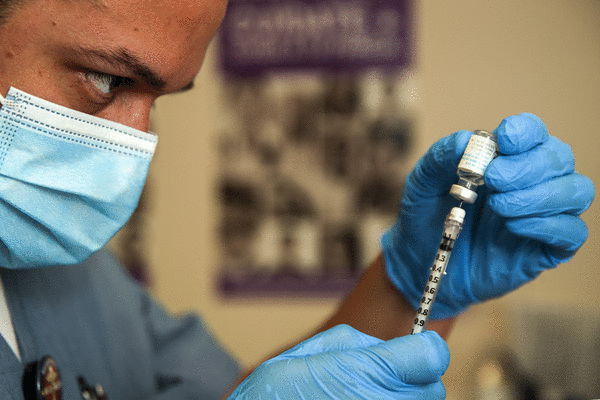
SAN DIEGO — According to San Diego County vaccination records, about 6,800 of the 19,000 residents who received their initial mpox vaccination dose did not receive a follow-up booster shot, a fact that is increasingly important as the “clade I” version of the virus increasingly causes outbreaks worldwide.
San Diego officials this week echoed a recent call from the California Department of Public Health, urging those with only one dose to get a second as recommended. The CDPH said on April 17 that the state has detected seven clade I cases since November 2024.
And clade II is still hanging around. California is experiencing more than double the average weekly number of cases detected in 2025, according to the CDPH.
Though no clade I cases have yet been detected in San Diego County, clade II, which causes painful lesions on sensitive parts of the body, has caused a dozen local cases so far this year.
It was clade II mpox, formerly called monkeypox, that caused the global outbreak of 2022, generating more than 100,000 cases worldwide over the past four years and 637 cases locally.
JYNNEOS, a vaccine made to prevent smallpox infection, is effective against mpox and received approval from the U.S. Food and Drug Administration in 2019. Two doses are recommended at least four weeks apart, though Dr. David “Davey” Smith, a translational research virologist and director at the University of California, San Diego, said that receiving the second dose later, even significantly later than recommended, should still be effective.
“They don’t need to restart the series; they can just go get their second shot,” Smith said. “You just don’t want to get it too close to the first one.”
It is not surprising, he added, that some never got around to getting that second dose.
“When the first mpox outbreak happened, we didn’t have enough shots to go around, so it was actually kind of difficult to get, so a lot of people didn’t get their second shots, but now there is plenty of supply,” Smith said.
Though the transmissability and virulence of clade I as compared to clade II is still being studied, Smith said that the new arrival does appear to have the potential for more severe disease.
“For some reason, clade I is more pathogenic,” Smith said. “If it gets to the brain, it causes meningitis more often.”
Though vaccination may not prevent mpox infection, it should blunt the severity of symptoms.
“The good news is that if you do pick it up, and you’re fully vaccinated, it’s much more likely to be tolerable,” Smith said. “There might be a rash, but it will go away faster.”
Mpox spreads through close contact with infected people, including intimate contact. Vaccination is recommended, according to the CDPH, for men who have sex with men, transgender, nonbinary or gender-diverse individuals, those with HIV, anyone exposed to mpox in the previous 14 days and those planning to travel to a country where clade I mpox is spreading.
_____
©2026 The San Diego Union-Tribune. Visit sandiegouniontribune.com. Distributed by Tribune Content Agency, LLC.






Comments