Senators balk at Architect of the Capitol boost
Published in News & Features
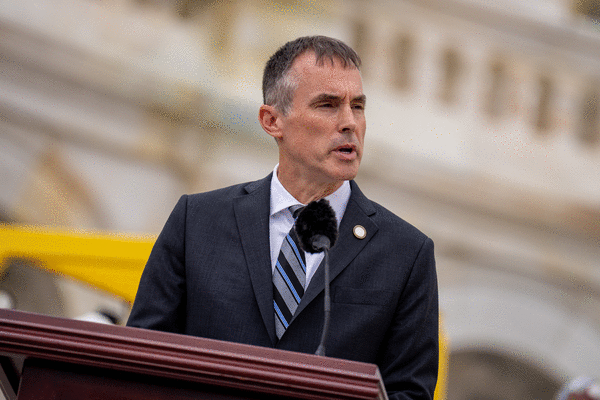
WASHINGTON — The aging congressional campus urgently needs work, Architect of the Capitol Thomas Austin said Tuesday, warning of “system degradation and failure.”
As the deferred maintenance piles up, so do the costs and the risk to lawmakers and staff, he said.
But Senate appropriators had a warning of their own: They need a better sales pitch for the future and are “highly unlikely” to fully meet his $1.6 billion request for fiscal 2027.
That level of funding would “require much more member outreach and education for members to justify it,” Senate Appropriations Legislative Branch Chair Deb Fischer, R-Neb., said at Tuesday’s budget hearing.
“I believe many senators would be surprised to learn the level of significant and sustained investment that may be required over the next 15 to 20 years,” she added.
Austin, who became architect in 2024 after the ouster of Brett Blanton, acknowledged that his agency was “significantly behind” on updating a master plan for the Capitol campus but promised to publish one by the end of the summer.
Beyond more than $600 million for “line item construction projects” like air handler units, roofs and electrical switchgear, the AOC is also requesting money to kickstart major renewal projects. Austin has warned of “catastrophic” consequences for the Rayburn Building on the House side if it isn’t renovated soon.
But the Senate side also needs attention, Austin said. He fielded questions from subcommittee ranking member Martin Heinrich, D-N.M., about what’s known as the Hart Area Renewal Project, which aims to boost security and was slated to displace some senators from their offices this year.
“As you’re aware, I’m not a particularly big fan … at least as it’s currently envisioned,” Heinrich said, urging Austin to communicate directly with Senate offices. “I’ve been concerned that it doesn’t make adequate fiscal or practical sense.”
Austin said they were “identifying adequate swing space to ensure that no senator or Senate staff is left without an office.”
“We originally envisioned it as a two-phase program, which was going to be more disruptive, but would have been shorter. We’ve looked at doing an eight-phase program to minimize impact to members, and that’s currently sitting with Senate leadership for a decision,” Austin said.
It comes as the end is in sight for the renovation of the Cannon House Office Building, a project that took much more time and money than initially projected over a decade ago.
“The lesson we wanted to learn from Cannon is to take into account things like swing space and mitigation factors, that we reduce the impact to members as well as reduce the impact of the construction,” Austin said.
When it comes to convincing members to invest in the Capitol campus, sometimes the aging infrastructure speaks for itself.
“These buildings often make our case for us,” Austin said.
_____
©2026 CQ-Roll Call, Inc. Visit at rollcall.com. Distributed by Tribune Content Agency, LLC.






Comments