US says offensive phase of Iran war over as ship hit in Strait
Published in News & Features
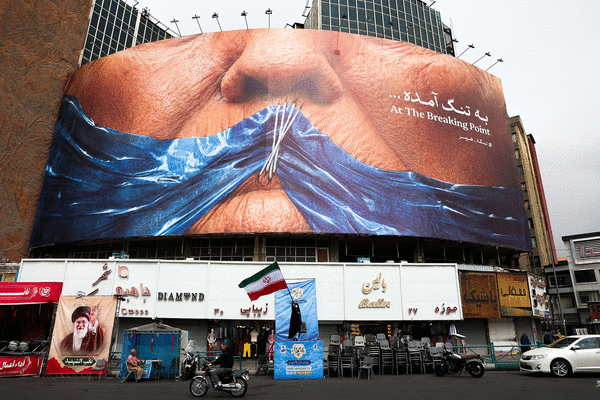
WASHINGTON — The U.S. said offensive operations against Iran are over as it shifts to protecting shipping in the Strait of Hormuz, but the targeting of another cargo vessel after a day of strikes signaled that the conflict is dragging on.
“Operation Epic Fury is concluded,” Secretary of State Marco Rubio told reporters at the White House Tuesday, 66 days after the U.S. and Israel began bombing Iran. “We achieved the objectives of that operation.”
While the U.S. now seems intent on trying to deescalate the conflict, which has killed thousands in Iran and roiled global energy markets, the pathway to a deal that reopens the strait remains distant. The U.S. has imposed a blockade on Iran, which responded by closing a waterway that carries a fifth of the world’s oil exports.
As Rubio spoke, a British monitoring organization reported that a cargo ship in the strait was struck by an unknown projectile. The U.S. said the shutdown around Hormuz has left more than 1,550 commercial vessels, carrying some 22,000 sailors, trapped in the Persian Gulf.
Iran’s president dismissed American demands to resume talks as “impossible.”
“The problem is that while the U.S. pursues a policy of maximum pressure against our country, it also expects the Islamic Republic of Iran to come to the negotiating table and ultimately submit to its unilateral demands — an equation that is impossible,” President Masoud Pezeshkian said in a call with Iraq’s prime minister-designate Ali al-Zaidi, according to the semi-official Fars News Agency.
Oil declined on Tuesday, with Brent trading around 3.6% lower at under $111 a barrel. It jumped almost 6% on Monday.
Rubio’s characterization of Operation Epic Fury, repeated by other top officials over the last 24 hours, signals the pressure President Donald Trump is under to end an increasingly unpopular conflict. At the briefing, Rubio cast Iran as the aggressor and the U.S. as leading a global effort to bring a rogue nation to heel.
Portraying the war as concluded also allows the administration to skirt questions about the legality of the conflict. The War Powers Act requires him to wind down a conflict in 60 days unless authorized by Congress. Trump passed that deadline about a week ago.
“The goal here is pretty simple: establish a zone of transit that is protected by a bubble — the United States, both naval and air assets — and then allow ships who want to move, to move through there and get to market, to begin to increase confidence in the ability to do so,” Rubio said.
Violence erupted on Monday after Trump announced “Project Freedom,” which he described as an effort to guide neutral ships stranded in the Persian Gulf through Hormuz without risking full-scale naval escorts. At least two merchant vessels transited the waterway with U.S. assistance in fending off attacks, while two American warships entered the Gulf.
The UAE said Tuesday it was responding to missile and drone threats, having intercepted almost all of roughly 20 projectiles fired from Iran the previous day.
U.S. officials played down the Iranian attacks, saying they didn’t constitute a breach of the truce announced just under a month ago.
There’s little sign that Iran and the U.S. are nearing a breakthrough. Tehran insists Washington must lift a naval blockade on its ports for that to happen. The U.S. says the blockade is choking Iran’s oil exports and squeezing its economy, forcing it into concessions.
“We see ‘Project Freedom’ as an attempt to break the logjam in the strait, which has cast a long shadow over the global economy,” said Becca Wasser, an analyst with Bloomberg Economics. “Still, it carries significant escalation risks, as the outbreak of fighting Monday illustrates.”
Here’s more related to the war:
— At the UN, the U.S. and its allies backed a draft United Nations Security Council resolution that would open the door to sanctions or even military action if Iran doesn’t ease its chokehold over the strait. The proposal would require support from China and Russia to pass.
— Iran cast the U.S. move in Hormuz as “Project Deadlock” and a violation of the ceasefire. It also said talks mediated by Pakistan are making progress.
— Iran again warned all ships against trying to get through Hormuz without its permission. On Tuesday it announced a new protocol for vessels seeking to transit the waterway, requiring ships to receive an official email signaling approval, state-run Press TV reported.
_____
With assistance from Omar Tamo and Jennifer A. Dlouhy.
_____
©2026 Bloomberg L.P. Visit bloomberg.com. Distributed by Tribune Content Agency, LLC.




Comments