Analysis: US military actions test Trump's claim the Iran war is over
Published in News & Features
WASHINGTON — Even if a recent flareup of military skirmishes in the Middle East merely continues but does not escalate, the clashes cast doubt on President Donald Trump’s formal assertion to Congress on May 1 that hostilities between American and Iran have “terminated.”
The renewed fighting has put intense strain on a tenuous ceasefire in the wider war. In Washington, the surge in combat solidifies a sense that the war’s economic shock waves and electoral risks will not soon subside.
On May 3, Trump announced the launch of what he called a project, “Project Freedom,” not an operation, such as “Operation Epic Fury,” the name for the broader war with Iran. In a May 1 letter to Congress, Trump cited the ongoing ceasefire with Iran as evidence that the conflict had been “terminated,” and the 60-day deadline for either official congressional approval or withdrawal of U.S. troops under the War Powers Resolution no longer applied.
Project Freedom involves U.S. military warships and combat aircraft helping escort commercial ships — at least two U.S.-flagged merchant ships so far — through a narrow passageway cleared of sea mines in the Persian Gulf’s Strait of Hormuz.
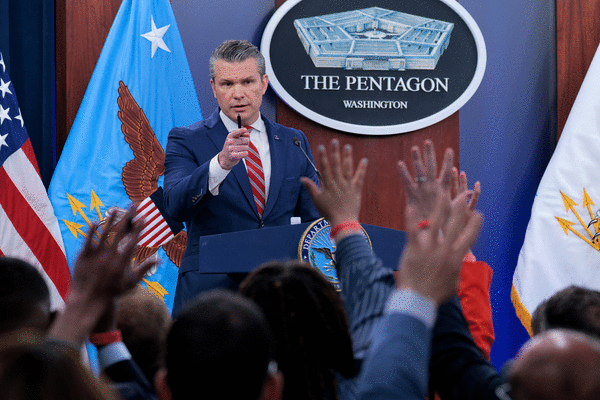
During a Tuesday briefing with reporters, Defense Secretary Pete Hegseth sought to differentiate the two missions.
“To be clear, this operation is separate and distinct from Operation Epic Fury,” Hegseth said. “Project Freedom is defensive in nature, focused in scope and temporary in duration, with one mission, protecting innocent commercial shipping from Iranian aggression.”
Hegseth and Air Force Gen. Dan Caine, the chairman of the Joint Chiefs of Staff, said the initiative falls short of “major combat operations” and does not violate the nearly four-week-old ceasefire, even as Caine said defining when combat becomes major is “a political decision.”
However, the words of Hegseth and Caine, in combination with news reports, reveal how massive the U.S. military operation is, how violent the clashes at sea have been between U.S. and Iranian forces and how Iran is once again retaliating by launching missile attacks on other nations in the region.
Large-scale mission
Trump, in remarks at the White House on Monday, called the spate of recent skirmishes a “mini war” and a “little detour.” The president has also said on occasion that the U.S. has already won the war.
But neither the scale of the U.S. military operations in and around the Persian Gulf nor the extent of Iran’s response is small by any measure.
Caine said America has some 15,000 troops focused on Project Freedom as well as two of the four deployed U.S. aircraft carriers plus their accompanying vessels. The contingent of 15,000 troops is more than America has deployed in any single nation except Germany, Japan and South Korea.
Hegseth said the project entails “hundreds” of drones, attack helicopters and fighter jets — or more than the roughly 150 aircraft used in the raid to capture former Venezuelan leader Nicolás Maduro, a mission categorized as “Operation Absolute Resolve.”
Besides Project Freedom, the U.S. Navy is enforcing a blockade on shipping into and out of Iranian ports — an action that would typically be considered an act of war under international law and by prior U.S. administrations.
For example, President John F. Kennedy’s Justice Department in 1961 allowed that the president’s Cuba blockade “is a belligerent act which, as a matter of international law, is ordinarily justified only if a state of war, legal or de facto, exists,” while justifying the blockade as “an incident to a state of war.”
Hegseth said the U.S. Navy has “turned around” six ships trying to “run the blockade out of Iranian ports.”
The extent of the U.S. military’s potential task is also enormous. Some 1,550 merchant ships carrying 22,500 mariners are trapped in the Persian Gulf because of the choking off of trade through the strait, Caine said.
Hegseth said that the Navy’s escort of ships through the strait show Iranians “don’t control” it.
But for the vast majority of the 1,550 ships trapped in the Persian Gulf, the strait is not yet open. Iran’s response, even if relatively limited so far, has been fierce.
Just this week, Iran “launched cruise missiles, drones, small boats at U.S. forces defending commercial shipping in the strait,” Caine said.
On Monday, U.S. military helicopters fended off attacks by six Iranian attack boats and sank them, Adm. Brad Cooper, the commander of U.S. forces in the Middle East, told reporters that day.
Also on Monday, Iran resumed attacks on its neighbors. Iran fired 15 ballistic missiles and four drones at the United Arab Emirates, that country said, and airspace there has been restricted.
Iran resumed those attacks on Tuesday, the UAE Defense Ministry reported.
Caine said Iran also hit Oman, without elaborating on details. Oman had previously reported a residential building near the strait had been struck.
Pressure in Washington
The back-and-forth attacks could subside.
“Thus far, today is quieter,” Caine said on Tuesday.
But there is no guarantee the skirmishes will not continue and even expand.
All this generates heat in Washington, but it is not clear what if anything Congress might do to constrain the president’s actions in the Middle East, endorse them or something in between.
When Congress returns next week, lawmakers will discuss a possible vote soon on a war authorization measure.
If that authorization vote occurs but falls short, it will indirectly send a message that Congress does not back the campaign, though it is not likely to have great effect on Trump’s decisions on the Middle East.
The war is unpopular in America and has been a drag on Republicans’ electoral chances in the midterms, which are now six months off.
In a Washington Post-ABC News-Ipsos poll conducted in late April, 61 percent of respondents said using force against Iran was a mistake.
Fewer than 2 in 10 Americans believe the war has been a success, the poll showed. Four in 10 say it has been unsuccessful, while another 4 in 10 say it is too soon to tell.
House Democrats, led by Rep. Pat Ryan of New York, are introducing legislation that would cut off funding for the war if the conflict does not receive congressional authorization.
But the odds of that effort succeeding currently appear no better than the recent series of failed war powers resolutions in both chambers calling for a pullout of U.S. troops absent an authorization.
If Congress were to clear an authorization to use military force against Iran, it would probably contain some limits on the president’s conduct of the war — perhaps including its duration. At a minimum, it would include “metrics for success, notice of any changes in objectives and exit criteria,” according to Sen. Lisa Murkowski, R-Alaska, who is writing one such measure.
Yet Trump might call any such restrictions unconstitutional and defy them.
Then there is the real possibility that Congress is unable to muster the majorities needed to clear any measure on Iran at all, which would effectively leave the president unhindered.
_____
©2026 CQ-Roll Call, Inc., All Rights Reserved. Visit cqrollcall.com. Distributed by Tribune Content Agency, LLC.






Comments