Moore touts Md. for foreign investment, announces new global partnerships
Published in News & Features
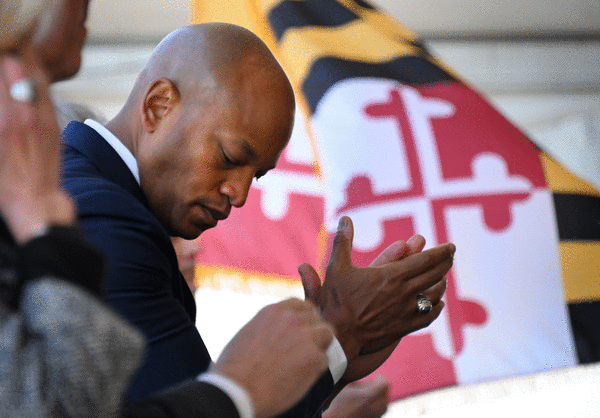
Gov. Wes Moore on Monday pitched Maryland as a “natural home” for foreign investment during a panel at an international business conference, as his administration announced a series of new partnerships aimed at boosting global relations in the state.
For Maryland residents, the push for foreign investment is directly tied to jobs, wages and the state’s long-term economic stability, according to the Moore administration. The governor said attracting international companies can bring new employment opportunities, expand key industries and help reduce Maryland’s reliance on federal jobs and spending. The shift could be critical as budget uncertainty continues and the state remains vulnerable to continued shortfalls. However, some Maryland Republican lawmakers have criticized the administration’s approach, raising concerns about the scope of incentives and warning that out-of-state hiring could limit opportunities for Marylanders.
Shortly after the discussion at the SelectUSA Investment Summit, Moore’s office unveiled agreements including the creation of a Maryland-Korea Trade Desk, a technology collaboration with the Kingdom of Jordan, and the addition of a South African life sciences startup to a state-backed business development program.
“The companies represented here today are not playing for second, and neither is Maryland,” Moore said in a statement. “By aligning these resources with a clear economic strategy, we are ensuring that Maryland remains the best place in the world to change the world.”
The summit, hosted by the U.S. Department of Commerce at National Harbor, annually brings together thousands of international investors and economic development officials. It has helped generate more than $250 billion in investment projects nationwide, according to the summit’s website.
Speaking alongside the governors of North Carolina, Oklahoma and Nebraska, Moore emphasized the competitive nature of attracting global businesses, noting that states often act as both partners and rivals.
“We’re all going to compete for your individual businesses and make the arguments as to why [we] are the right place for you,” Moore said. “The level of consistency, the level of competitiveness, the level of cooperation … is why looking at investing in the United States is a smart bet.”
Moore used the forum to highlight Maryland’s advantages, including its concentration of federal agencies, research institutions, and a diverse workforce. About one in six Maryland residents is foreign-born, he said, adding that companies expanding into the U.S. often view the state as an entry point.
“When it comes to foreign direct investment … Maryland becomes a natural home,” he said, citing strengths in industries such as life sciences, aerospace, and defense.
The governor also pointed to recent economic wins, including the state’s successful recruitment of Samsung Biologics, which opened its first U.S. manufacturing facility in Rockville in March following a trade mission to South Korea.
Since taking office, Moore said Maryland has added more than 55,000 new businesses and attracted more than 85 foreign companies through its Global Gateway program, which helps foreign companies launch parts of their businesses in the state. It is unclear how many of these companies currently remain in the state, though research shows that 58% completing the program in Montgomery County stay.
The administration has paired its outreach with policy changes aimed at making the state more attractive to investors. Moore highlighted the DECADE Act, a package of business incentives and regulatory changes he said is focused on “speed, predictability, and focus.” It passed through the Maryland legislature during the 2026 session, despite opposition from Senate Minority Whip Justin Ready and House Republicans, and now awaits the governor’s signature.
“We’re moving at the speed of business, which I think people need and people want to see,” Moore said, adding that the legislation includes streamlining permitting processes — in some cases, he added, reducing timelines from months to days — and targeting what he has called “lighthouse” industries, including biotechnology, artificial intelligence and quantum computing.
Moore has repeatedly framed those sectors as central to Maryland’s long-term economic strategy, particularly as the state seeks to reduce its reliance on federal jobs and spending. Several major deals underpin that approach. Pharmaceutical giant AstraZeneca announced a $2 billion expansion in Maryland in November 2025 and the state has backed additional, more targeted investments tied to those industries.
At the Port of Baltimore, officials are also betting on long-term growth through a planned $1 billion private container terminal at Sparrows Point, a partnership between Tradepoint Atlantic and the Switzerland-based Terminal Investment Limited. It is aimed at expanding capacity and strengthening the state’s position in a competitive East Coast supply chain.
Moore also cited the state’s response to the Francis Scott Key Bridge collapse as an example of its ability to act quickly, noting that crews cleared the main shipping channel faster than initially projected. Though the immediate response was applauded by lawmakers across the state, the slowed rebuilding process has garnered recent backlash from Republicans.
For companies weighing where to invest, Moore framed Maryland as both globally connected and business-friendly. “We believe Maryland is the best place in the world to change the world,” he said.
________
©2026 The Baltimore Sun. Visit at baltimoresun.com. Distributed by Tribune Content Agency, LLC.






Comments