Alberta vote nears as separatists claim 301,000 signatures
Published in News & Features
CALGARY, Canada — Alberta, the major oil-producing province of Canada, is one step closer to a referendum on independence after leaders of a separatist group said they’ve gathered more than enough signatures to force a vote.
The group, Stay Free Alberta, had until May 2 to collect roughly 178,000 signatures on their petition for a provincewide vote. On Monday, organizers said they’ve collected more than 301,000 signatures to submit to Elections Alberta, the independent elections agency.
If the referendum goes ahead, it would ask: “Do you agree that the Province of Alberta should cease to be part of Canada to become an independent state?” But there are still a number of obstacles.
The signatures need to be verified, and Indigenous groups have launched a legal challenge of the separatists’ efforts. Last month, an Alberta judge issued a ruling that prevents officials from validating the secession petition until that application can be heard.
Alberta has a population of about 5 million and Jeffrey Rath, one of the separatist organizers, had said the goal was to get 1 million signatures. Still, he was encouraged by the amount of signatures collected given the obstacles the group faced.
“We’re elated. It was a fantastic campaign. We’re absolutely thrilled that we just completely crushed the statutory required number of signatures,” Rath said in an interview. “I’m feeling great.”
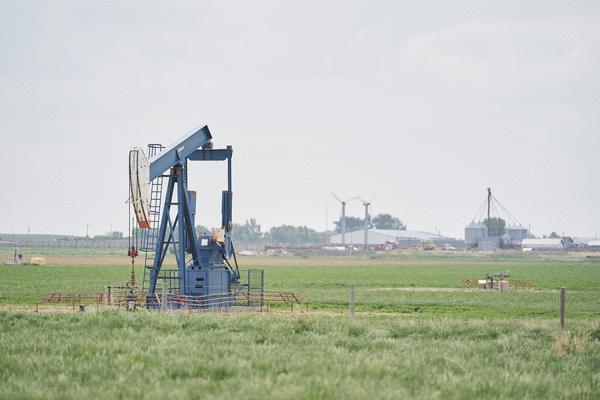
Longstanding disputes between Alberta and the federal government have coalesced into an independence movement seeking to reap the rewards of the region’s resources. The western province has one of the world’s largest reserves of crude, as well as abundant natural gas, and primarily uses pipelines through neighboring provinces to get to export markets, mainly the U.S.
“The driving pieces here have been the desire for almost a conservative homeland, a place with low taxes, limited government, social conservatism, barriers to immigration,” said Lisa Young, a political science professor at the University of Calgary. “There’s a set of ideas that are attached to Alberta separatism that are quite different from the sets of ideas that have been attached to Quebec nationalism over the years.”
Recent surveys suggest that separatism lacks broad appeal, however. A poll last month of 1,200 residents by Alberta-based Janet Brown Opinion Research found support for the separatist cause at 27%, with 67% saying they would vote against it.
Support for separation skews higher among men and people who live in rural Alberta.
The number of signatures the Stay Free Alberta organizers claim they’ve collected is equal to about 17% of the number of votes in the last provincial election. Under an earlier set of rules, at least 20% was required to force a referendum on a constitutional change. However, last year, Alberta Premier Danielle Smith’s government lowered the bar to 10%.
If there’s a vote, it would be held on Oct. 19. Smith has decided to hold a vote on nine other questions on that date, largely to do with immigration measures and provincial powers within Canada.
The premier has been threading a political needle on the issue of separation, knowing that a significant portion of her party membership is in favor of leaving the country and creating conditions for this possible referendum, while also saying she believes in staying within Canada.
“I think of her as as Schrodinger’s premier on this,” Young said. “She’s both federalist and separatist all at the same time. And that’s an awfully difficult stance to maintain.
A pro-Canada petition organized by a former Alberta lawmaker last year garnered more than 400,000 signatures.
Heather Exner-Pirot, director of natural resources, energy, and environment at the Macdonald-Laurier Institute, said she wasn’t surprised they reached the required signature count, but added the separatist sentiment is not high enough yet for businesses to be concerned.
“I don’t think markets are downgrading Canadian oil and gas stocks because they’re worried about this,” she said.
The independence movement was roiled last week by allegations that another separatist organization disseminated a list of voter information containing personal data of more than 2.5 million people. Elections Alberta sought a court order to take down the list and both it and the Royal Canadian Mounted Police are investigating the matter.
Jared Wesley, a political science professor at the University of Alberta, said the data leak calls into question the legitimacy of the signatures the separatists say they’ve collected. He said the path forward should include a public inquiry into how the voter information was obtained and if it was misused. “I’m not sure Elections Alberta has the tools to provide the full verification necessary to determine whether those signatures are legitimate,” he said.
Smith’s government is negotiating with Prime Minister Mark Carney’s team on the details of carbon pricing and other energy-related measures that were part of an agreement between the two leaders last year.
Carney told the Canadian Press it’s “more likely than not” Canada will build a new oil-export pipeline to the west coast — a longstanding wish of Alberta, which relies heavily on the U.S. market to buy its oil and gas. The Alberta government is expected to submit an early-stage proposal for that project by June or July.
Canada is the world’s fourth-largest oil producer and exports about 4 million barrels a day to the U.S. About 85% of Canada’s oil is produced in Alberta.
_____
With assistance from Thomas Seal and Derek Wallbank.
_____
©2026 Bloomberg L.P. Visit bloomberg.com. Distributed by Tribune Content Agency, LLC.






Comments