'We have to work together': Canada's UN envoy visits Haiti, pledges continued support
Published in News & Features
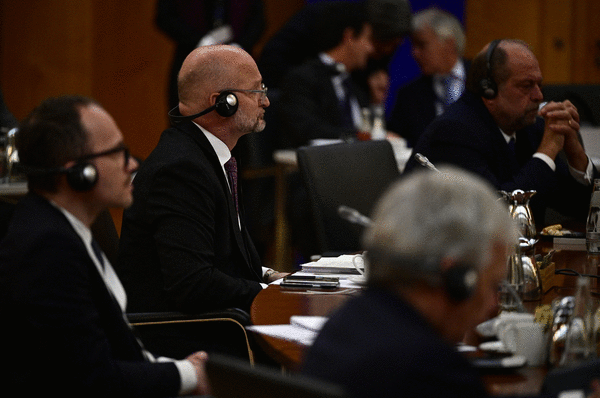
Like most high-level visitors to Haiti, David Lametti recently arrived in Port-au-Prince with grim statistics in hand: mass killings, widespread gang-driven displacements and the steady erosion of public institutions.
But four days into his first visit to the gang-torn country earlier this month, the immediacy of those challenges came into sharper focus for the former lawmaker and justice minister, who last fall became Canada’s top diplomat to the United Nations.
“The scale of what needs to be done was what was really what affected me the most,” Lametti said. “It still affects me.”
Lametti’s visit to Haiti, alongside U.N. Under-Secretary General for Safety and Security Gilles Michaud, came at a pivotal moment. Prime Minister Alix Didier Fils-Aimé, who recently traveled to Washington and New York to press Haiti’s case for continued international assistance, is trying to steer his fragile political transition toward the country’s first general elections in a decade as armed groups continue to expand their reach, the police struggle to hold territory and a hungry, violence-weary population increasingly grows impatient.
In briefings with Canadian, Haitian and U.N. officials, Lametti heard a familiar refrain on the current reality: incremental gains by security forces alongside continued territorial expansion by gangs; cautious optimism about the new international security response, but questions about whether the new Gang Suppression Force will get the support it needs from both a U.N. Trust Fund, to which Canada has already contributed millions, and a newly established U.N. Support Office.
“The thing we discussed was coordination, the need for coordination amongst all of those groups,” he said about the new gang-fighting force, which recently received pledges of $30 million from Qatar, $10 million from the Dominican Republic and 150,000 euros from Greece for its 5,500 members.
In total, 15 Member States have pledged support $213.5 million to the Trust Fund, with $174.1 million in cash received. The bulk of the money, however, had been pledged to support the Kenya-led Multinational Support mission, with the majority of the $58.5 million disbursed used for personnel entitlements and medical and casualty evacuations.
Last of the Kenyans left Haiti
Earlier this week, the final 150 contingents of Kenyan officers who comprised the Kenya-led Multinational Security Support mission departed Port-au-Prince, ending 22 months of service. The remaining personnel in country consists of Guatemalan, Salvadorian and an advance team of Chadian soldiers, who recently arrived.
Though the force did not restore security, its limited and tangible success, marked by sexual exploitation and rape allegations, and the deaths of three of its police officers, did stop a complete collapse.
Though Canada isn’t fielding any troops into the new gang-fighting force, Lametti said Ottawa remains a central supporter of the effort. The first military contingents of the larger, more heavily armed force with personnel drawn from several African and South Asian countries, along with Guatemala and El Salvador, are expected to arrive in Haiti in the next few days.
“We are providing a great deal of human resources to aid the special representative,” Lametti said of Jack Christofides, the former longtime U.N. peace building expert now overseeing the new gang force. “He’s getting a lot of actual human support in his office from Canadians and so financial resources, human resources and I hope moral leadership and moral support.”
Lametti said that as he met with the people leading the security response, he was reassured by the experiences of the personnel the U.N. has deployed, even though the new gang force, which was authorized by the Security Council, is not formally a U.N. peacekeeping mission.
“All are veterans, and they all have experience, and they all work together well,” he said. “So I’m taking from that a bit of cautious optimism.”
Still, he acknowledges the difficulty of what lies ahead in Haiti, where 1 in 4 people in the capital lives in a gang-controlled neighborhood, nearly 6 million do not have enough to eat and children account for as much as half of all gang members.
“Something will have to be done to help reintegrate, reeducate kids, child soldiers. Something will have to be done to establish sanitation and basic services, something will have to be done, probably in the slightly longer term, to help, help reinvigorate the Haitian economy, so that people will have something to do,” he said. “Every effort needs to be made to minimize, to minimize innocent deaths.”
Leading financial backer
Since 2022, Ottawa has poured more than $460 million Canadian dollars in assistance into Haiti, supporting programs run by organizations like the World Food Program, as well as agricultural initiatives, the Haiti National Police and, more recently, the new gang-fighting force.
“We’re investing in the many millions, and we’re going to continue to do that,” said Lametti, who also serves as chair of the U.N. Economic and Social Council and the Ad Hoc Advisory Group on Haiti at the U.N. “Haiti is important to Canada.”
Prior to joining Prime Minister Mark Carney’s government, Lametti spent a decade in politics and served as Canada’s minister of justice and attorney general. He said he intends to build on the “the good work” of his predecessor, Ambassador Robert Rae, while also drawing on his background as a jurist and legal scholar to help Haitians strengthen their justice system. He noted the continued support for sanctions, which Canada has aggressively pursued for Haitian politicians and businesspeople the country believes are supporting gangs.
“Impunity can’t continue,” Lametti said. “It undermines civil society, democracy — any kind of permanent solution to this.... We’re going to continue to work positively on anti-corruption projects.”
The challenges facing Haiti are enormous, Lametti said, but they are not insurmountable.
“We have to work together to meet those challenges. It’s what Haitians want. And I think the rest of us have a moral obligation to do our best to help Haitians” he said.
“Obviously the changes have to come from the Haitian people themselves, and the leadership has to come from Haitians,” Lametti added. ”But we’re there to support and be leaders in conjunction with them.”
_____
©2026 Miami Herald. Visit miamiherald.com. Distributed by Tribune Content Agency, LLC.





Comments