Crime down in Baltimore, but South District residents say streets feel unsafe
Published in News & Features
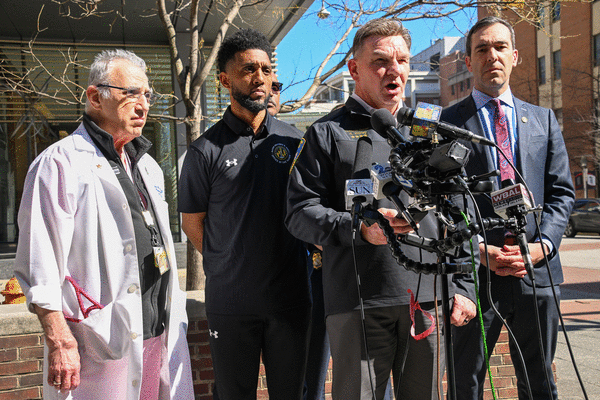
BALTIMORE — A coalition of South Baltimore residents is pressing city leaders and police for tougher enforcement and around-the-clock public safety measures, arguing that daily disorder — from illegal dirt bikes to open-air drug use — is eroding quality of life despite official data showing a sustained drop in violent crime.
The Southern District Coalition, representing neighborhoods including Curtis Bay, Federal Hill, Pigtown, Sharp-Leadenhall, South Baltimore and Locust Point, is calling for a “zero tolerance” approach to offenses they say are already illegal but too often ignored.
“We are taxpayers investing in this city, and we love this city, but we are not safe in our communities,” the group said in a letter sent to the mayor’s office and police officials. “The failure to enforce these laws has had predictable results: excessive noise, hazardous traffic, and unsafe streets for our children and pets.”
Detailing a disconnect
The coalition is seeking 24-hour enforcement and a visible police presence, saying the area has become a draw for “illegal behavior” including reckless dirt bike riding, public drinking, drug markets and impaired driving. Members also point to gun violence, vandalism and break-ins as persistent concerns.
Their demands come as city officials, including the Baltimore Police Department, highlight a sharp decline in violent crime. Homicides fell from 201 in 2024 to 133 in 2025 — a 33.8% drop — and are down roughly 60% since 2021. That’s come as the city implemented programs like Roca in 2018, Youth Advocate Programs in 2019 and the Group Violence Reduction Strategy in 2022.
Robberies have also fallen more than 60% since their 2017 peak, and aggravated assaults have declined in recent years, according to police and federal data.
That disconnect — between statistical progress and residents’ lived experiences — is underscored by a recent poll from the University of Maryland, Baltimore County Institute of Politics. It found 44% of Baltimore residents believe crime has stayed the same, while 21% say it has worsened. Just 27% reported improvement in their own neighborhoods.
Stephen Topping, with the Southern District Coalition, said that his lived experience with crime has gotten worse recently despite FBI, Baltimore Police Department and national statistics saying otherwise.
“My lived experience over the last couple of years is that crime is on the rise,” Topping said. “City leaders present the perception that crime is down, but that is not reality. Vacant storefronts, empty hotels and residential for sale signs are abundant and tell the true story. Without a measurable improvement in public safety, the residential and business tax base of this city will continue to leave.”
Police officials acknowledge that perception gap. Lindsey Eldridge, spokesperson for Baltimore Police Department, said that residents’ personal experiences and perception may color how they see the reality of the city’s drop in crime.
“We recognize that there is still work to be done and that personal experiences and trauma can shape how residents perceive crime,” Eldridge said. “While we continue working to further reduce crime and strengthen public trust, we are encouraged by the progress reflected in this year’s survey compared to last year, as well as continued reductions across all major crime categories.”
Police leadership has also urged patience as reforms and anti-violence strategies take hold. Commissioner Richard Worley previously said residents should give the city’s progress time to resonate.
“You may not believe the city’s safe, and we may change your mind, or we may not change your mind,” Baltimore Police Department Commissioner Richard Worley told The Baltimore Sun earlier this year. “But if you don’t give us a chance, I think you’re going to miss out on a huge shift.”
Looking toward the future
Still, the coalition argues that broader crime trends don’t address the day-to-day conditions shaping neighborhood life — particularly nuisance crimes and quality-of-life offenses they say drive residents and businesses away.
Citywide, 78% of residents surveyed still consider crime a major problem, even as 52% say they feel safe walking in their neighborhoods at night and 61% express optimism about Baltimore’s future.
Eldridge said it is the police department’s goal to sure up their relationship with residents, agreeing that there is always more work the city could be doing.
“Building trust and fostering positive engagement, particularly among young people, remains a top priority,” Eldridge said. “This includes initiatives such as our Junior Cadet program, increasing the hiring of city residents, incorporating community input into policy and training development, and expanding community policing plans.”
_______
©2026 The Baltimore Sun. Visit at baltimoresun.com. Distributed by Tribune Content Agency, LLC.






Comments