Supreme Court ruling reshapes redistricting rules, puts Maryland maps at risk
Published in News & Features
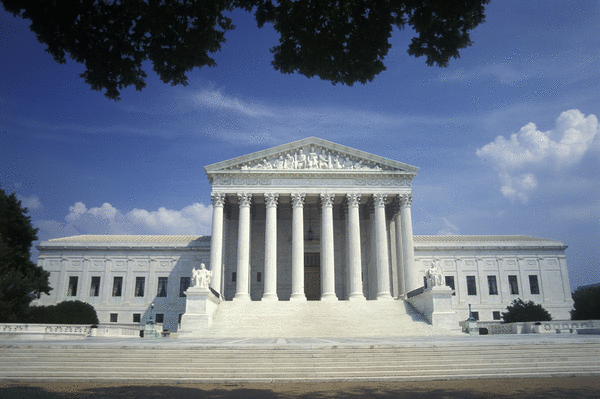
A sweeping ruling Wednesday by the U.S. Supreme Court is poised to reshape redistricting battles in Maryland and across the country, narrowing how courts apply a key provision of the Voting Rights Act and making it harder to challenge political maps as racially discriminatory.
The decision, stemming from a Louisiana congressional map dispute, raises the legal bar for proving discrimination and limits when governments can consider race in drawing voting districts — changes experts say will ripple through redistricting at every level, from Congress to county councils and school boards.
In Maryland, the impact could be immediate. Newly drawn districts, including Baltimore County’s expanded council map, may now face legal challenges, while the state’s newly signed voting rights law could confront the same constitutional hurdles outlined by the court.
Legal analysts say the ruling effectively narrows federal oversight of voting maps, shifting power toward states and local governments while giving them broader leeway to defend maps as politically — rather than racially — driven.
What the court decided
In the Louisiana case, the court’s 6-3 conservative majority struck down a 2024 congressional map that created a second majority-Black district after a lower court found the previous map likely violated Section 2 of the Voting Rights Act.
Writing for the majority, Justice Samuel Alito said the state did not have a compelling reason to rely on race because the Voting Rights Act did not require the additional majority-minority district.
“Because the Voting Rights Act did not require Louisiana to create an additional majority-minority district, no compelling interest justified the State’s use of race,” Alito wrote.
He added that Section 2 is focused on present-day conditions — not historical discrimination — and found insufficient evidence that Louisiana’s earlier map was the result of intentional racial bias.
In a sharply worded dissent, Justice Elena Kagan said the ruling undermines one of the nation’s most consequential civil rights laws.
“The Voting Rights Act … is — or, now more accurately, was — one of the most consequential” statutes in U.S. history, she wrote, warning the court’s new standard will allow states to justify maps with race-neutral explanations, including partisanship.
“Assuming the State has left behind no smoking-gun evidence … Section 2 will play no role,” Kagan wrote.
Some civil rights advocates echoed that concern, warning the decision could erode protections that have shaped voting access for decades.
“They used race to remedy the race discrimination, and then you have a group of voters who challenged that remedy,” Gilda Daniels, a voting rights expert and law professor at the University of Baltimore, said, referencing how the case started. “And today, the United States Supreme Court said that they were right.”
“It certainly [undermines] the Voting Rights Act, and particularly Section 2 of the Voting Rights Act, which is responsible for a lot of litigation in ensuring that the results would provide an equal opportunity to participate in the election process,” Daniels said. “Instead, this court has dismantled decades of voting rights laws for certainly a much more discriminatory and prejudicial plan that moves us away from a true democracy and free and fair certain districts.”
A higher burden to prove discrimination
The ruling marks a significant shift in how voting rights cases will be litigated, raising the burden for plaintiffs by placing greater emphasis on proving intentional discrimination, rather than relying primarily on a map’s discriminatory effects.
Baltimore Mayor Brandon Scott said it was part of what he described as a broader erosion of civil rights protections nationwide.
“We are witnessing a targeted, systematic effort to roll back rights and freedoms that our ancestors fought and died to secure,” Scott said, speaking as President of the African American Mayors Association. He added the ruling “weakens the foundation of our democracy and threatens the rights and freedoms of every American.”
University of Maryland law professor Mark Graber said that change will make challenges far more difficult to win.
“It makes it much harder to prove discrimination with voting districts, with the burden that’s been set,” Graber said. “They would have to prove intentional discrimination. And the opposing side could say, ‘oh no, we didn’t discriminate. It just so happens that the majority of Republican voters were white and the majority of Democratic voters were black.’ And based on this ruling, a court would be fine with that answer.”
Maryland maps in the spotlight
The implication could be felt in Maryland, where jurisdictions have recently redrawn political boundaries.
In 2024, Baltimore County voters approved expanding the County Council from seven to nine members starting with this year’s elections, in part to better reflect the county’s racial and geographic diversity. The current council is made up of six white men and one Black man.
Graber said those diversity-based arguments — once central to redistricting debates — could now be challenged as unconstitutional.
“Someone could walk into court tomorrow and challenge Baltimore County’s districts,” he said.
Baltimore County’s Office of Law is reviewing the court’s ruling, according to Dakarai Turner, a county spokesman.
The ruling also casts uncertainty over Maryland’s newly enacted voting rights law, signed just a day before the decision. Supporters say the law is designed to strengthen protections against racial vote dilution, but critics argue it may now face the same constitutional limits imposed by the Supreme Court.
Gov. Wes Moore, a Democrat, sharply criticized national Republicans in his response, arguing the ruling could encourage efforts to reduce minority representation.
“Washington Republicans have repeatedly rejected those efforts and bent the knee to Donald Trump as he unleashes chaos on our economy and in our communities,” Moore said. “Make no mistake: The plan is already in motion. Across the country, Republicans are openly floating mid-decade maps designed to dilute Black voters’ representation. That is not theoretical. It is political redlining, and it is happening in real time.”
The governor said in a statement that “every state should stay part of the conversation” to “protect the right to equal representation under the law” and that his support for national redistricting reforms “remains unmoved.”
Moore and Democratic lawmakers considered redrawing Maryland’s congressional map in an effort that could have eliminated the state’s lone Republican-held congressional seat, arguing it would counter GOP redistricting efforts nationally and preserve Democratic influence in Congress. Republicans criticized the proposal as partisan gerrymandering.
Maryland Democrats failed to pass new congressional maps, however, Moore emphasized that Maryland “[met] the moment” when he signed the Maryland Voting Rights Act into law, which prohibits vote dilution at the county and municipal level.
The Maryland Freedom Caucus said in a statement that the Supreme Court ruling revealed the state’s Voting Rights Act to be “little more than a symbolic bill” and will “invite endless ligitation.”
“Any future lawsuits brought under Maryland’s new statute will now face the same heightened constitutional barriers,” the statement said.
Wave of litigation expected
Legal experts predict the ruling will trigger a surge of challenges to political maps nationwide, particularly in jurisdictions where race has played a role in drawing districts to comply with federal law.
But the clock is ticking for states that are attempting to make changes ahead of Election Day in November. Daniels said changes could mean “utter chaos” for state and local boards of elections, many of which have set polling places and started training workers long before the election.
For Maryland, that could mean court battles over newly drawn maps and increased scrutiny of how state and local governments balance race, politics and representation.
Graber said the shift will force local governments into a legal bind: comply with civil rights law while avoiding any appearance that race was a driving factor.
“The court is tightening the space in which governments can legally consider race — even when they’re trying to follow the law,” Graber said.
_____
©2026 The Baltimore Sun. Visit at baltimoresun.com. Distributed by Tribune Content Agency, LLC.



Comments