Trump's big promise for veteran housing is AWOL in VA budget proposal, mystifying vets
Published in News & Features
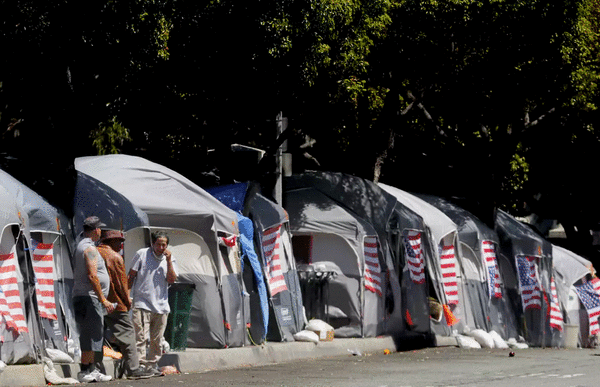
LOS ANGELES — Veteran advocates who welcomed President Donald Trump's May executive order calling for a new National Center for Warrior Independence in West Los Angeles now say they are mystified and disappointed by the budget produced by the U.S. Department of Veterans Affairs to implement it.
Trump's executive order said the VA's West Los Angeles campus would provide housing for 6,000 veterans by the end of his term. But the budget proposal submitted to Congress this months does not request funding for a single new bed.
Instead, the VA is asking for a $500-million appropriation to rehab six aging buildings, erect an 800-space parking structure and improve infrastructure on its sprawling campus spanning Wilshire Boulevard west of the 405 Freeway. It identified three other projects, including the rehabilitation of the historic but dilapidated Wadsworth Chapel, that would be funded by redirecting $212 million from previous authorizations.
The proposal comes as Trump is asking for a colossal $445-billion increase in the defense budget and spending billions every week on a deeply unpopular war with Iran.
The proposal would require relocation of about 330 current residents in treatment programs while the four buildings housing those programs were being renovated — with no indication where they would be temporarily housed or for how long.
"I don't think that plan puts the well-being of veterans first," said Anthony Allman, executive director of Vets Advocacy, a nonprofit created to monitor court-ordered development of the campus. "We can create a plan that builds new facilities while not disrupting current treatment programs."
He and others with stake in the future of the 388-acre campus saw a few upsides in the plan.
"The chapel project is there, which is something we've all been waiting for for a long time," Allman said.
But the proposal was a letdown for veterans who were buoyed by earlier indications that Trump's order would break a logjam in the construction of hundreds of units of temporary housing ordered by a judge last year, which have stalled since the VA appealed the decision.
"I am thankful for the executive order; I'm hoping they follow through on it," said Rob Reynolds, an Iraqi war veteran who advocates for veterans seeking VA services. "At the same time, we are not seeing the request for funding to build the temporary housing, or to build the permanent housing."
The VA did not respond to questions from The Times.
The overall effect of the proposal will be to displace veterans, not add housing, said a congressional staffer who is familiar with the issue but not authorized to speak publicly.
"They don't have the funding and they don't have the expertise," the staffer said. "There is no plan. This budget is a reflection that veterans have been fed a lie."
The proposal faces a potentially tough review in Congress, where it could have to compete with other projects ranked as the VA's top priorities, including a $1.6-billion medical center in Indianapolis.
Rep. Brad Sherman (D-Sherman Oaks), whose district includes the West Los Angeles property, said that he had expected there would not be money in the budget for all 6,000 units, but that it didn't occur to him there would be none.
Sherman said Congress could shift money from the $98-million parking structure to housing, but thought that unlikely with a Republican majority "slavishly dedicated to whatever Trump says."
In justifying the request for Los Angeles, the VA said the renovated facility would enable "the modernization of a growing campus which may expand up to 6,000 Veterans across assorted permanent and temporary housing units, medical center care, and unique program care."
Over the last year, the VA has sent conflicting signals on its plan for housing.
In a court last year, the team working on the executive order said the VA had funding authorized in 2025 to install 750 to 800 tiny homes on the campus by the end of this year. Facing criticism that the 8-by-8-foot sheds would not be acceptable housing, the VA issued a notice in January seeking reaction from developers on a much more expensive project with temporary units of 120 to 390 square feet.
"Each unit will provide a bed, a bathroom with shower, a kitchenette with sink, microwave, refrigerator, and HVAC," the notice said. The plan included small courtyards and utilities.
Installation would be in phases, with the first to be completed between June and August. The notice was not a solicitation for bids and did not say how the project would be funded.
In a filing with an appeals court, the VA said that, regardless of the court's injunction, its policy was to construct 750 to 800 units of temporary supportive housing on the campus by September. But it has yet to issue a request for bids on any units.
Those who took that as a hopeful sign now say their hopes are deflated.
"What you don't see is what you don't see," said Mark Rosenbaum, attorney with the nonprofit law firm Public Counsel who is representing veterans in the class-action federal lawsuit seeking more housing. Rosenbaum said he was disappointed, "but sadly not surprised."
"My concern would be that they would come in and say we're going to put 2,000 in right away and they're going build one big tent," said Steve Soboroff, a real estate developer and civic leader who testified in the trial that decent modular housing could be built on the campus for about $120,000 per unit.
Others said they didn't know what to make of the budget because the team planning the National Center for Warrior Independence has released only sketchy information on its plan and required those involved to sign nondisclosure agreements.
"Admittedly we're left reading tea leaves because of the nondisclosures," said Allman of Vets Advocacy. "I don't think anybody can be truly certain what VA is planning. Not even the VA."
Based on the projects outlined in the budget, it also appears that the VA has backed off from a plan detailed late last year to renovate two buildings as a gathering place for veterans.
The budget seeks no funds for that project and instead would turn one of the buildings into administrative space. It does not mention the other, a 1929 Art Deco landmark. A VA contractor has applied to the state for tax credits to turn it into housing.
A contractor who attended the tour, speaking anonymously because of a nondisclosure agreement, said it appeared to him that the VA didn't have a plan and was "only trying to figure out the lay of the land."
©2026 Los Angeles Times. Visit at latimes.com. Distributed by Tribune Content Agency, LLC.






Comments