Boston City Council slams Mayor Wu for transportation project delays, loss of federal funding
Published in News & Features
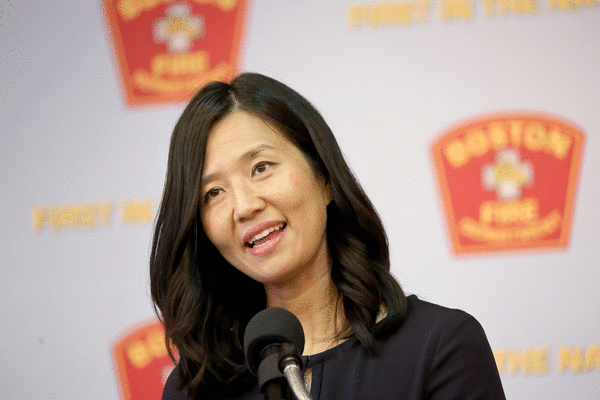
Boston city councilors and transit advocates hammered the Wu administration for delaying transportation projects, saying that its inaction has cost the city millions in federal grant funding and put cyclists and pedestrians at risk.
Councilor Sharon Durkan chaired a Council committee hearing Wednesday that focused on three orders that were reactive to a reported change in policy by Mayor Michelle Wu that resulted in, per one order, the city’s participation in “numerous transportation projects” being “indefinitely paused.”
“Boston has committed, through Vision Zero, to eliminate fatal and severe traffic crashes by 2030, and there are a number of important street and safety projects underway to help get us there,” Durkan said. “But in recent months, there has been concern that too many of these projects have been slowed down or stalled without clear evidence of what’s happening or why.
“Many of these projects are desperately needed to protect all road users and ensure everyone can get around our city safely, especially our most vulnerable. I continue to advocate for a city that works for everyone and makes it easier for people using all modes of transportation — walking, biking or taking public transit.
“More and more young people are choosing not to drive. We need to embrace the future and plan accordingly, recognizing that many Boston residents, including myself, do not own a car. The delay of many of these projects has also put state and federal transportation funding at risk,” Durkan added.
Council President Liz Breadon said in one of the day’s orders that continued delays to city transportation projects “could jeopardize an estimated $200 million in public investment for the city of Boston at a time when the city can least afford to lose investment.”
Breadon cited, for example, the Trump administration’s decision to claw back a $327 million federal grant for the Allston I-90 multi-modal project this year “because the project was years behind schedule and the money wasn’t obligated.”
“We’re looking citywide at hundreds of millions of dollars that are in jeopardy if we as a city do not move forward decisively and obligate these funds and show forward direction,” Breadon said. “It’s critically important that we partner with our state and federal partners, and that we partner with the MBTA, to make sure that we utilize the funds and use them as they were intended.”
Boston Interim Chief of Streets Nick Gove denied that the city had paused any transportation projects. He said the city was taking steps to “shift away from a one-size-fits-all mindset that prioritizes speed over specifics” and focus on “a range of tools and options to find the win-win for different roadway users.”
“We’ll implement a coordinated, rather than siloed approach, instead of prioritizing new safety infrastructure over state of good repair,” Gove said. “We will lead with streets that are due for state-of-good-repair work and evaluate them for safety improvements. We’ll deploy better enforcement, focusing on key hot spots to keep roads, bike and bus lanes and sidewalks unobstructed.
“This next phase is not about slowing down on progress. It’s about getting the design right and avoiding unintended consequences for residents, communities and local businesses,” Gove added. “We’ll strive for street designs that feel better, work better and last longer because they were designed with the experience of the residents, businesses and commuters who are using them every day.”
The Wu administration’s shift in transportation strategy has come with a leadership shakeup. Gove took over the Streets Department after Wu’s former Chief of Streets Jascha Franklin-Hodge resigned at the end of last year, ahead of her second term.
The city’s widespread implementation of bus and bike lanes under Franklin-Hodge’s leadership drew backlash from residents, became a campaign issue in the mayoral race, and led to a 30-day review last spring that concluded the engagement from the Streets Cabinet was “heavy-handed.”
Wu administration representatives said at the day’s hearing that the new approach to street redesign and implementing projects is informed by community feedback.
Councilor Ben Weber pointed out, however, that the mayor’s office blasted out a press release Wednesday morning ahead of the hearing with a list of seven street improvement projects that will be the focus of the spring construction season, seemingly with little to no community feedback.
“I thought the whole 30-day review process was that we need more community process around these things, and it seems like we’re again starting with the lack of a community process to announce street changes,” Weber said.
Gove said “there’s been thorough engagement with the neighborhoods on those projects” — which per the city release, are for safety and reconstruction work for A Street, Congress Street and Sleeper Street in Fort Point; Cummins Highway in Mattapan; Ellis Elementary School Safe Routes in Roxbury; Harrison Avenue in the South End; Jones Avenue, Ballou Avenue and surrounding streets; lower Roxbury; and Lost Village in Charlestown.
“We feel these are priorities, and we think that there are other opportunities to be able to do some of these other safety improvements that we’re hearing demand for,” Gove said.
There was a heavy focus from council members and transit advocates on putting more speed humps and other cyclist and pedestrian safety infrastructure throughout city neighborhoods, and criticism for specific project delays.
“One of the things that I heard today was, nothing is on pause,” said Reggie Ramos, executive director of Transportation for Massachusetts. “I have never heard anything more inaccurate or disingenuous than that.”
Tiffany Cogell, executive director of the Boston Cyclists Union, added, “Every day of inaction is a day that federal and state dollars slip through our fingers or get transferred to another project.”
“It’s a day a cyclist is endangered, a day a disabled resident is stranded,” Cogell said. “The pause on Boston’s transportation projects is a regional crisis.”
________
©2026 MediaNews Group, Inc. Visit at bostonherald.com. Distributed by Tribune Content Agency, LLC.




Comments