Telework remains energizing force for California state workers as July deadline looms
Published in News & Features
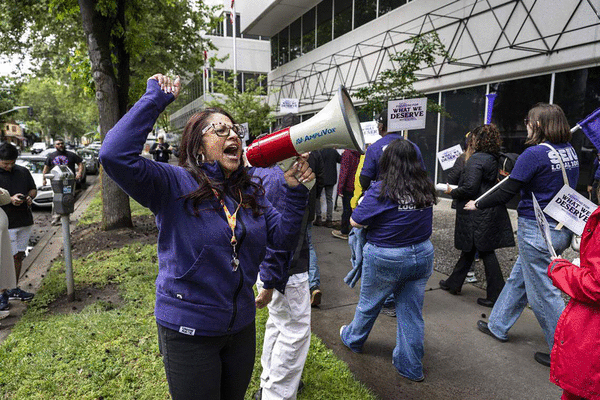
SACRAMENTO, Calif. — Two years and two weeks have passed since Gov. Gavin Newsom issued his first return-to-office order, which directed state employees to begin working from government offices two days a week. Newsom upped the in-office requirement to four days last year, but subsequently postponed that mandate after facing steep pushback from state employees and labor groups. In the intervening time, unions have filed lawsuits, lawmakers have introduced legislation and state workers have continued rallying, all to push back against the governor’s mandate.
On Wednesday, the state workers again vocalized their opposition to the governor’s telework policy during a march from the Capitol grounds to the headquarters of the California Department of Human Resources, leaders of which met with SEIU Local 1000’s bargaining team this week to begin negotiations for a new contract.
About 150 state employees turned out for Wednesday’s demonstration, substantially fewer workers compared to the first rally unions hosted in March 2025, shortly after Newsom first issued his second, more onerous telework executive order. For those who have been advocating for more telework protections since 2024, their fervor hasn’t diminished.
“Attitudes haven’t changed, if anything telework has made us stronger,” said Monica Nepomuceno, an education programs consultant with the Department of Education.
Nepomuceno noted that state employees have been teleworking for the past six years and that it has proven to be successful for agencies and has improved workers’ well-being. “We still know that telework works,” she said.
The changing telework fight
Last year, unions regularly held large rallies opposing the return-to-office order; an anonymous group of state workers erected billboards along Interstate 80 criticizing the governor. This year, unions have taken a different approach, sponsoring legislation that would allow agencies to establish department-specific telework policies.
That bill earned support from an Assembly committee, but faces a major hurdle: the governor’s desk. In the two years since Newsom first issued his executive order on telework, he has not deviated from his position that government employees will benefit from more time collaborating in offices.
Alisa Abraham, an Employment Development Department employee who has been a regular presence at anti-RTO rallies over the past two years, said that she has seen more apathy around the issue of telework compared to last year because some state workers have become reconciled with looming return-to-office deadline.
For many state employees like herself, though, she said, telework remains an important topic because the ability to work from home has made it easier to do her job and improved her work-life balance. Abraham said she doesn’t think some of her colleagues realize how disruptive a four-day in-office schedule will be if the executive order goes into effect in July.
Additionally, Abraham remains opposed to the policy change because she believes the administration is using the issue of telework as a bargaining chip during negotiations with the unions. Last year, SEIU Local 1000 and the other state worker unions agreed to personal leave programs to help the state address its budget shortfall. In exchange, the Newsom administration agreed to suspend the return-to-office order for one year.
‘3% isn’t enough to keep up with inflation’
A common refrain among workers who rallied Wednesday was the financial strain they are facing due to inflation and increasing gas prices, which in California, have reached nearly $6 per gallon — 40% higher than the national average, the Public Policy Institute of California reported.
Carl Miller, the interim president of AFSCME Local 2620, which represents health care and social service employees of the state, said that telework protections remain a top priority for some of his members because it helps them save on gas money and enables them to spend more time with their families.
“The cost of living is far surpassing 3% — 3% isn’t enough to keep up with inflation,” said Anita Phelps, a Department of Consumer Affairs employee.
Phelps said she hopes SEIU Local 1000 can at least secure a 3% raise in contract negotiations this year, though a bigger pay bump would be preferential.
Although she doesn’t reap the benefits of telework, Sarah Mack joined her fellow SEIU Local 1000 members on Wednesday to advocate for this benefit.
“Even though I work in the office every day, I still think it’s valuable for my coworkers to telework,” Mack said. “There are a lot of things we need to be in the office for …but there’s a lot we can do from home securely, safely, and it makes a lot of peoples’ lives better to do that.”
Mack is currently an office technician for the California State Water Resources Control Board, but she hopes to eventually secure a position in that agency that will enable her to telework.
“It’s not just about me right now. It’s about me in five years. It’s me when I have a family,” she said.
_____
©2026 The Sacramento Bee. Visit sacbee.com. Distributed by Tribune Content Agency, LLC.






Comments