Temple has lost average of $200 million annually as enrollment slides, and retention rates are a major issue, internal report says
Published in News & Features
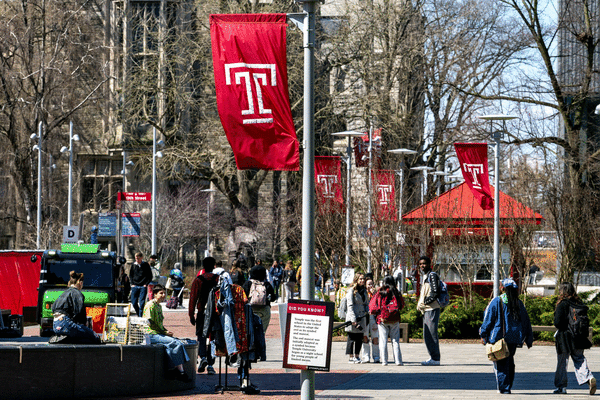



Temple University is retaining fewer students from freshman to sophomore year than it did a decade ago, and the rate at which students progress from fall to spring semester has declined, too.
The retention issue — a problem for many schools nationwide — comes as the North Philadelphia-based university faces increased budget pressures. Temple has lost 27% of its U.S. enrollment over the last eight years, amounting to an average of more than $200 million in lost revenue annually, according to an internal university report obtained by The Inquirer.
The report, compiled by Temple leaders and shared last month with deans and the president’s cabinet, presents numbers not previously made public and offers new insight into the school’s sizable challenge.
A decade ago, 90% of Temple freshmen returned for their sophomore year. By 2024, that figure declined to 82%, and early projections show it likely will slide below 80% this fall, according to the report.
Projections for enrollment growth over the next few years have been downsized, which would mean a loss of $150 million in revenue over five years, according to the report, titled “University Financial Status.”
Temple’s leaders in an interview Friday acknowledged the depth of the challenge, even while the university has received three record philanthropic gifts in the last year, has maintained solid financial ratings, and is way ahead in applications and deposits for fall 2026 freshman and transfer students. They are taking steps to make improvements, including providing additional support for first-year students and considering an array of administrative cutbacks, the leaders said.
“We’re dealing with it,” president John Fry said. “Dealing with it is painful. But it will be more painful if we don’t.”
He estimated it will take three years to improve finances and reach the goal of a 2% to 6% operating surplus that can be reinvested in academic and student success.
Many colleges are facing enrollment and financial challenges. Drexel University lost about 20% of its enrollment in a little over a decade. The Pennsylvania State System of Higher Education, which oversees the 10 state universities, had a 30% enrollment decline since 2010-11, though it recorded an increase this year.
La Salle University’s retention rate from freshman to sophomore year dipped to 66% last fall, down from 73% the year before. Interventions, including a new academic support center in the library, seem to be working, Greg Nayor, La Salle’s senior vice president of university strategy, said Friday, adding that the school is running several percentage points ahead of last year.
Mounting budget pressures
Fry for months has been warning the Temple campus in periodic updates about mounting budget pressures. Earlier this month, he said the school “must act decisively and with a sense of urgency” to address a projected deficit of about $85 million for next fiscal year.
Some steps are already underway. In July 2025, Temple laid off 50 employees, less than 1% of its workforce. A faculty retirement incentive program this year drew 77 takers — 3% of full-time faculty — who will leave by June 30. That ultimately will save about $15 million.
More layoffs of staff are planned in the next few months; Fry said the exact number is still under consideration.
Other belt-tightening measures under consideration include hiring freezes and travel restrictions, consolidation of some schools and colleges, cuts to the athletic budget — though not of individual sports — and discontinuation of under-enrolled majors. And Temple is considering selling or changing the use of its Ambler campus, where enrollment has plummeted.
“All possibilities are on the table given the magnitude of the financial challenge,” Fry said.
Interim provost David Boardman said in his more than a dozen years at Temple, the school has never had stronger leadership, a clearer strategic plan, and better external relations. (Boardman serves on the board of the Lenfest Institute for Journalism, the nonprofit that owns The Philadelphia Inquirer.)
“It’s a good thing we have all these other things to help guide us through this crisis,” he said.
Fewer students are remaining enrolled
In addition to the drop in retention of students into sophomore year, a smaller percentage of freshmen is advancing from the fall to spring semesters. The report said 14% of Temple’s freshmen in the fall did not enroll this spring, compared with 9% from fall to spring last school year.
Among all class years, the share of students who left between semesters also increased, from 6.7% last school year to 8.2% this year.
The loss of students is happening even as Temple enrolled its largest freshman classes in history the last two years.
Fry said retention, including among third- and fourth-year students, remains a top concern.
“If you can attract them but you can’t retain them, that not only impacts young lives but that also impacts the financial future of the institution,” he said.
Boardman said even with the decline, Temple’s retention remains above the national average for large public universities. Financial reasons are the primary driver of student attrition, he said, though academic performance is suffering in some cases, too. That is true particularly in math and among STEM majors, which is a national challenge.
Temple is using technology tools to identify students missing classes and exhibiting other warning signs, he said, and this month hired a new vice provost for undergraduate education from Purdue University in part because of that school’s track record on improving student success. A new orientation and first-year support system will launch in the fall, he said.
And longer term, an audit underway by the National Institute for Student Success is expected to yield new recommendations, from recruitment to career planning.
“I’m sure there are a lot of things that we’re doing which are not state of the art, which we will change as a result,” Fry said.
Temple also plans to continue increasing its financial aid budget, likely to more than $200 million this year. Fry said a major fundraising campaign likely to begin its public phase within the next year will focus in part on funding financial aid.
Overall U.S. enrollment has fallen from 40,240 in fall 2017 to 29,503 in fall 2025. That amounts to about 11,000 fewer students, the report said. Temple’s Japan campus, meanwhile, has grown exponentially to 3,400 this year, and its Rome campus will begin to offer four-year degrees.
Temple adjusted its enrollment projections for 2027 through 2030, given the difficult market. The school forecasts enrollment growth of 5.3%, or 1,552 students, over that time — down from a prior projection of 11%, or 3,347.
But Boardman noted that deposits for the fall are up 26.5% and more students who have been admitted are enrolling.
Temple anticipates finishing the current fiscal year with a $27 million deficit in its $1.3 billion budget (excluding the health system), the report said. The university plans to use $26.8 million of its reserves to plug that deficit.
Some programs have few students enrolled
A Temple-commissioned study by the National Association of College and University Business Officers found that the vast majority of undergraduate students who get degrees are concentrated in about 20% of Temple’s 197 programs.
Forty-one programs enroll more than 75% of students who get degrees, the NACUBO study found. Meanwhile, 120 programs serve about 10%. Thirty-four programs had no students graduating.
There were similar disparities among master’s and doctorate programs, the group found. There are 181 undergraduate, master’s, and doctoral programs with five or fewer students who completed degrees, the report said.
Boardman said some programs were on the books but not operational. Deans and their faculty are reviewing programs, he said, to determine the reason for low enrollment — if there is no longer a demand or if they have not been properly marketed. Programs more likely would be consolidated than be eliminated, he said.
As for consolidating some of the 17 schools and colleges, Fry said the university would do that only if it did not harm teaching or research and yielded significant savings.
“We’re not pulling any triggers quickly on this question,” he said.
University officials also are hopeful that a new budget model to be rolled out over the next three years will better control costs. Fry announced last year that Temple would end its “responsibility center management” budget model, a decentralized system that has been used for over a decade and gives individual units more control over revenue and expenses.
The new approach “centralizes budget authority” and should reduce internal competition and allow resources to be more easily shifted to priorities, the report said.
Fry said Temple’s operations need to become less “decentralized.” Some of its schools and colleges have separate marketing and communications employees and information technology teams, in addition to the central office units. That is under evaluation, he said.
“Maybe self-contained communication units throughout the institution are things that we can’t afford to do anymore,” he said.
_____
©2026 The Philadelphia Inquirer. Visit inquirer.com. Distributed by Tribune Content Agency, LLC.






Comments