Trump risks showdown with Xi before summit over Hormuz blockade
Published in News & Features
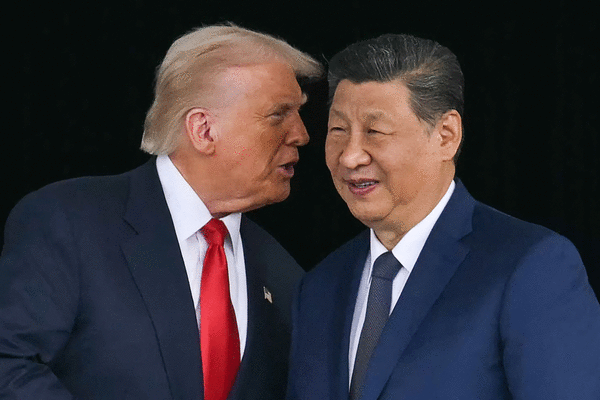
Donald Trump’s bid to block Iran from using the Strait of Hormuz chokes a key Chinese energy supply and risks a showdown with Xi Jinping a month before the two leaders are set to meet in Beijing.
Xi broke his near seven-week silence over the Iran war on Tuesday, warning the world order is “crumbling into disarray,” while pledging to play a “constructive role” in the Middle East. Ramping up its own rhetoric, the Foreign Ministry in Beijing blasted the U.S. president’s naval blockade imposed this week as “dangerous and irresponsible.”
The stronger language out of Beijing underscores how Trump’s war in the Middle East is testing a fragile detente between the world’s biggest economies. U.S. threats to intercept, divert or capture ships violating its blockade risks a confrontation between Chinese aligned vessels and American Navy ships, potentially putting Beijing in a difficult spot even if it wants to avoid directly challenging the blockade.
The fate of one such vessel, a U.S.-sanctioned tanker linked to China but unaffiliated with the government, showed the potential risks of miscalculation. That ship — the Rich Starry — sailed through the Strait of Hormuz on Tuesday before appearing to U-turn as it entered the Gulf of Oman, tracking data show.
“If the U.S. seeks to use this badly bungled war to harm China’s interests, I believe China has many cards to play that would ensure the U.S. gains far less than it loses,” Hu Xijin, former editor-in-chief of China’s nationalist tabloid Global Times, wrote on Monday in a blog post.
So far, there’s no sign that Trump’s visit to Beijing planned for mid-May will be delayed. On Tuesday, he met with David Perdue, the U.S. ambassador to China, to prepare for the trip, which would be the first to the nation by a U.S. president since he last visited in 2017.
But the mood is darkening. Treasury Secretary Scott Bessent has blasted China as an unreliable partner to the world by “hoarding” oil, while U.S. Trade Representative Jamieson Greer last week warned that Beijing’s ties with Iran were complicating the relationship.
The Financial Times reported Wednesday that Iran secretly acquired a Chinese spy satellite that gave it a powerful new capability to target U.S. military bases. Shortly after, Trump told Fox Business that he’d exchanged letters with Xi over weapons reports, claiming the Chinese leader had responded by saying “essentially, he’s not doing that.”
China is “very happy” with Trump’s efforts to open the Strait of Hormuz, the U.S. leader wrote on social media, predicting Xi would give him a “big, fat, hug” in Beijing.
Trump had earlier threatened 50% tariffs on countries arming Tehran, after separate reports China was planning to give its longtime diplomatic friend Iran anti-missile weapons — claims Beijing called a “smear” campaign. While China generally avoids supplying weapons to overseas wars, it has provided Russia with dual-use components.
Any decision to impose tariffs or otherwise hurt China’s interests threatens to upend a one-year truce — a move that would almost certainly prompt China to again retaliate by cutting off rare earths. Beijing controls around 90% of permanent magnets made with the minerals crucial to American manufacturing. Last year, China imposed sweeping exports on those metals to counter Trump’s tariffs and could quickly tighten restrictions.
As the conflict drags, it’s also possible Trump hopes hitting China’s oil imports will encourage Beijing to pressure Tehran to come to the table, said Bloomberg Economic’s Jennifer Welch, after peace talks over the weekend in Pakistan ended in failure. The U.S. and Iran are looking to arrange a second round of negotiations before an April 7 ceasefire expires.
“The risk, if that is Trump’s plan, is that China cushions higher oil costs at home, and strikes back with its own sanctions,” added Welch. China could also hit back by restricting soy bean purchases, broad imports of which fell to a one-year low in the month after the war began.
But for some in Beijing, Trump’s latest moves to pressure China suggest he’s boxed in by the war in Iran.
“The U.S. is passing the bucks onto China as it is incapable of reopening the Strait of Hormuz,” said Wang Yiwei, a former Chinese diplomat and director of Renmin University’s Institute of International Affairs. “When Washington can’t win the war with Iran, it blames Beijing.”
Diplomatic flurry
China’s leader is welcoming a host of dignitaries in Beijing this week, as he portrays China as a force for stability to countries around the world responding to an energy crisis.
Xi pledged to play a “constructive role” in the Middle East during a Tuesday meeting with Abu Dhabi’s Crown Prince — widely seen as the next leader of the United Arab Emirates. He also sat down with Russia’s top diplomat Sergey Lavrov and Vietnamese chief To Lam on Wednesday.
While China has emerged as among the most resilient Asian economies, thanks to its vast oil reserves and a robust renewable energy sector, the U.S. blockade of Hormuz has broader implications about freedom of navigation.
“China has long feared that its access to energy might be blocked at the Strait of Malacca, especially by the U.S. in the context of a war,” said Jennifer Kavanagh, senior fellow and director of military analysis at Defense Priorities.
Indonesia’s Prabowo Subianto last week touted his country’s leverage over that shipping artery, highlighting in a speech that approximately 70% of East Asia’s energy and trade passes through Indonesian waters. “Do we even realize how important Indonesia is?” he asked.
The free passage of vessels through choke points like Hormuz and the Strait of Malacca is protected under principles laid out in the U.N. Convention on the Law of the Sea. While the U.S. never ratified the treaty, it played a key role in the document’s drafting and its almost 300-ship navy has served as chief enforcer of the rules.
One Chinese scholar warned of dangerous precedents being set in global shipping, saying even Iran’s use of the yuan for Hormuz toll payments shouldn’t be seen as a win for China, given the risk of secondary sanctions. The U.S. Treasury Department warned on Tuesday that it’s ready to take actions against foreign financial institutions that support Iran.
“From the perspective of international law and the grand narrative of great power competition, China’s optimal strategy in the Hormuz crisis is by no means to maximize local renminbi settlement gains,” Ye Yan, a scholar on international law at Southwest University of Political Science and Law, wrote in a journal article.
With weeks to go until Trump’s trip to Beijing, much uncertainty remains over what will be on the agenda — and how the world will look.
Trump already delayed his meeting to game the Iran war, said Renmin University’s Wang.
“All these gambits are aimed at serving his negotiations,” added Wang. “Trump had hoped to visit China as a winner of the war, but now the war has become his Waterloo.”
---------
—With assistance from Lucille Liu, Colum Murphy, Nectar Gan, Claire Jiao, Charlie Zhu, Alan Wong and Skylar Woodhouse.
©2026 Bloomberg L.P. Visit bloomberg.com. Distributed by Tribune Content Agency, LLC.






Comments