Trump says Iran could 'die tonight' as Hormuz deadline looms
Published in News & Features
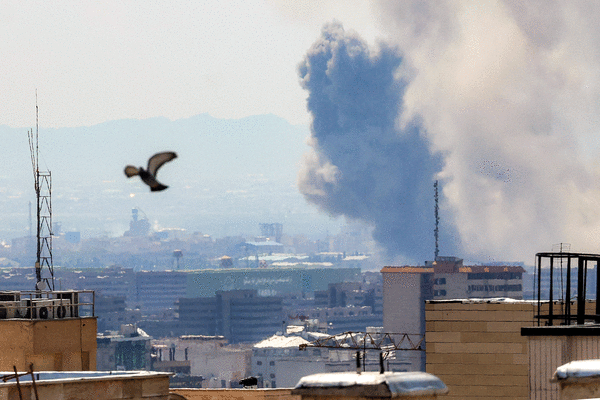
WASHINGTON — President Donald Trump threatened Iran with civilizational destruction as the United States attacked military targets on the country’s key oil export hub, ramping up pressure on Tehran to reopen the Strait of Hormuz by his Tuesday deadline or face massive strikes on critical infrastructure.
Iran halted participation in ceasefire talks in response to Trump’s social media post, according to a person familiar with the matter who asked not to be identified discussing private deliberations. Those discussions have been conducted through third-party channels. Mediators were scrambling to resuscitate negotiations ahead of the deadline, the person said.
A senior White House official downplayed Iran’s maneuver and said that legitimate negotiations continue to take place.
The lead-up to Trump’s Tuesday 8 p.m. EDT deadline has been marked by military escalation and increasingly bellicose threats from the U.S. president. Earlier in the day, American forces struck sites on Kharg Island similar to those that were hit in a round of attacks last month, but didn’t target energy infrastructure, according to U.S. officials.
“A whole civilization will die tonight, never to be brought back again. I don’t want that to happen, but it probably will,” Trump posted on social media. “Maybe something revolutionarily wonderful can happen, WHO KNOWS? We will find out tonight.”
Even as the U.S. and Israel kept up attacks on infrastructure earlier Tuesday, Trump’s threat raised the specter of a massive new bombing campaign far exceeding anything they’ve carried out over the course of a campaign that began Feb. 28.
Oil prices swung between losses and gains in yet another choppy session as investors tried to gauge whether energy infrastructure would come under attack ahead of Trump’s deadline.
Brent was trading near $109 a barrel while U.S. crude for May traded above $115 a barrel.
The U.S. leader’s latest ultimatum marks a critical juncture in the war that has killed more than 5,200 people, most of them in Iran and Lebanon, and seen energy facilities struck across the region. The president began issuing deadlines on March 21 to force Iran to reopen Hormuz, which carries roughly a fifth of seaborne oil shipments, and has repeatedly extended the timeline. He said Monday it’s “highly unlikely” he’ll do so again.
Russia and China vetoed a United Nations Security Council resolution that would have encouraged efforts to revive shipping traffic in the strait, amid concerns that it would have tacitly condoned military action.
Trump said during a news conference Monday that freedom of navigation through Hormuz must be part of any deal. He has previously threatened to destroy Iranian power plants, bridges and other infrastructure as part of his ultimatum. The U.N. has warned that indiscriminate targeting of civilian infrastructure could constitute a war crime. Trump said he’s “not at all” concerned about that potential outcome.
Speaking earlier in Budapest, Vice President JD Vance said he’s confident Iran will issue a response in time. But he also hinted at a military operation that would surpass anything the U.S. and Israel have waged so far against Iran.
“They’ve got to know we’ve got tools in our toolkit that we so far haven’t decided to use,” Vance said in Hungary. “The president of the United States can decide to use them and he will decide to use them if the Iranians don’t change their course of conduct.”
Strikes on Kharg Island are seen as particularly sensitive given its central role in the domestic and global energy market. Fox News said the U.S. targeted bunkers, a radar station and ammunition storage on Kharg, alongside an unintentional hit on the island’s landing docks.
Elsewhere, two people were killed in a U.S.-Israel attack on a railway bridge near the Iranian city of Kashan on Tuesday, state-run Nour News reported.
Israel is preparing for the possibility that fighting could continue for several more weeks, and on Tuesday told Iranians not to use their country’s railway network until 9 p.m. local time — the type of warning it sometimes issues before attacks on civilian areas.
Trump has repeatedly sent conflicting signals on what he’ll do with Iran’s oil sector, which he has openly coveted. At times, he’s mused about seizing control of the country’s crude — an outcome that he sees as expanding U.S. energy dominance and in turn earning the U.S. leverage in talks with China, people familiar with the matter say.
Iran has warned it would respond to that type of escalation by ramping up its own attacks on energy infrastructure in the Gulf — a move that could heighten the global fuel squeeze and amplify damage to the world economy.
The Islamic Republic launched seven ballistic missiles and several more drones at Saudi Arabia overnight into Tuesday, and debris from interceptions fell in the vicinity of some energy sites, the kingdom said. A key bridge connecting Bahrain and Saudi Arabia was briefly closed as precaution.
Israel approved further Iran missions for the coming three weeks if necessary, an Israel Defense Forces spokesperson said. The country is also fighting a parallel war in Lebanon against Tehran-backed Hezbollah, and struck targets in Beirut on Monday.
Trump has struggled to find an off-ramp to a conflict that’s become increasingly unpopular with Americans, with average gasoline prices above $4 a gallon. He said Vance is involved in ceasefire negotiations along with special envoy Steve Witkoff, though Tehran on Monday rejected a ceasefire proposal.
Iran has called for a permanent end to the war, reconstruction efforts and the lifting of sanctions, in addition to protocols for ensuring safe passage through Hormuz, according to Iran’s state-run Islamic Republic News Agency.
_____
(With assistance from Devika Krishna Kumar, Magdalena Del Valle and Salma El Wardany.)
©2026 Bloomberg L.P. Visit bloomberg.com. Distributed by Tribune Content Agency, LLC.






Comments