Environmental groups sue over drilling carve-out for Gulf wildlife protections
Published in News & Features
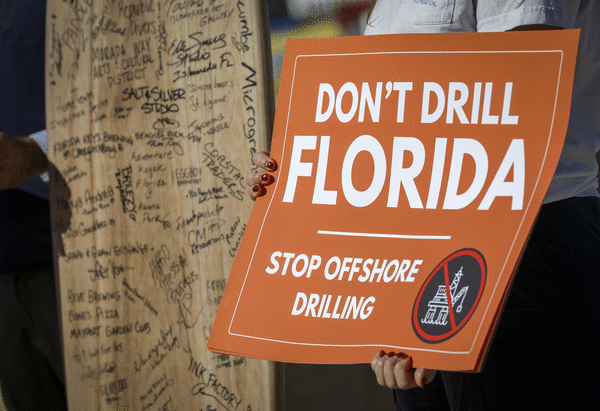
Environmental groups have filed multiple lawsuits against the Trump administration over its decision earlier this week to broadly exempt the oil and gas industry from requirements that protect all endangered species in the Gulf of Mexico.
In one federal lawsuit filed Thursday in Washington, D.C., a coalition of four Gulf advocacy organizations argue that the rarely used Endangered Species Committee, which met Tuesday for the first time in more than 30 years, bypassed long-standing rules with the vague justification of national security.
Calling it an “unprecedented blanket-exemption,” the coalition said the decision made by the so-called “God squad” would bring vulnerable Gulf wildlife closer to extinction, including turtles, corals, birds and the Rice’s whale, one of the world’s rarest species with an estimated 50 remaining in the wild. The coalition was made up of Healthy Gulf, Friends of the Earth, Turtle Island Restoration Network and the Sierra Club.
In a separate federal complaint filed Wednesday, the international nonprofit Natural Resources Defense Council made a similar argument, calling the broad national security rationale “arbitrary and capricious.” The Center for Biological Diversity, another environmental group, also amended a preexisting lawsuit to contest the Tuesday vote.
On Tuesday, Defense Secretary Pete Hegseth said litigation from environmental advocacy groups is blocking the nation’s energy supply and that exempting all Gulf oil and gas activities from wildlife protections is essential to national security.
“These legal battles waste critical government resources and make it impossible for energy companies to plan and invest in new projects,” Hegseth said. “When development in the Gulf is chilled, we are prevented from producing the energy we need as a country and as a department.”
Several federal agencies did not immediately respond to emails from the Tampa Bay Times seeking comment on the lawsuits.
During a Zoom news conference Thursday afternoon, the environmentalists emphasized that their lawsuit doesn’t seek to stop oil and gas drilling in the Gulf — which has surged even while companies have been bound by rules to protect endangered species.
But they warned that letting this stand would allow the country’s defense leaders to decide, without providing evidence, whether national security merited species going extinct.
This exemption “will not bring down the cost of gasoline by one red cent,” said Drew Caputo of Earthjustice. But the cost of such an action could be enormous, particularly to the Rice’s whale “that is literally at risk of being no more and could be rendered extinct by this decision,” he said. “Extinction is forever.”
Steve Mashuda, the lead attorney on the coalition’s case, referenced the last time the Endangered Species Committee was convened in 1992, when it had to make a decision on spotted owls.
At that time, public hearings in Oregon “lasted weeks,” Mashuda said, during which witnesses presented evidence in a stadium-like venue.
This week’s meeting lasted around 15 minutes.
“We literally should not be having this discussion today,” Mashuda said. “There has been no instance of the committee meeting and talking about an exemption and deciding the fate of species in less time than it takes to watch a rerun of a ‘Friends’ episode. .... That is almost unfathomable for a decision of this weight.”
The surprise move Tuesday to spare oil drilling in the Gulf of Mexico from requirements that shield endangered species drew a mixed response from Florida’s leading politicians. While Democrats strongly objected, Republicans were more split.
U.S. Sen. Rick Scott said he wasn’t concerned with Donald Trump’s plans and that they don’t affect a federal ban on offshore drilling that’s in place until 2032.
“I support the Trump administration’s efforts to unleash American energy,“ Scott said in a statement. The ”decision does not affect President Trump’s longstanding moratorium and is a step in the right direction for American energy dominance, which will help drive down energy costs for all families.”
Of the Republican gubernatorial candidates, only Lt. Gov. Jay Collins has objected so far. A spokesperson for Gov. Ron DeSantis has not responded to multiple requests for comment.
“This is one of those things where our people in Florida have been very, very clear,” Collins said during a Wednesday news conference in Tampa.
Local mayors, including St. Petersburg Mayor Ken Welch, a Democrat, and Clearwater Mayor Bruce Rector, a Republican, spoke against the Trump administration’s decision.
The committee vote comes as the federal government looks to expand offshore oil drilling closer to Florida’s shores. In December, all 28 members of Florida’s congressional delegation joined a bipartisan letter opposing that plan.
U.S. Rep. Kathy Castor, a Democrat from Tampa, also joined the news conference Thursday to say that she and her colleagues would fight this move in Congress.
“The Trump administration is again doing Big Oil’s bidding under the label of national security,” she said. “It is outrageous and it is a lie.”
©2026 Tampa Bay Times. Visit at tampabay.com. Distributed by Tribune Content Agency, LLC.






Comments