Nearly $900 million OK'd to bolster Maryland's foster care system; unlicensed housing settings eliminated
Published in News & Features
BALTIMORE — Maryland’s beleaguered foster care system received approval Wednesday to spend almost $900 million to add more placements and strengthen standards of care for youth with the greatest health and behavioral needs.
Contracts approved by the Board of Public Works will build a foster system “that is more compassionate, effective and accountable to the kids we serve,” Gov. Wes Moore, who chairs the state’s spending panel, said in a Wednesday statement.
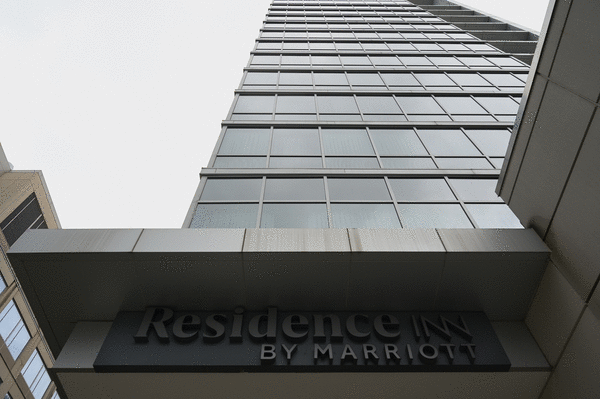
The added placements and services come in the wake of a tragedy that has come to encapsulate the system’s failings: the death by suicide of Kanaiyah Ward, a 16-year-old girl in foster care, in September in a Baltimore hotel where she had been living as social services staff looked for a home or other facility for her.
The spending board approved a series of contracts that will allow the Department of Human Services (DHS) to invest up to $743.9 million for the foster care system to build up a capacity of 637 placements over three years. The contracts also stipulate that placements cannot reject or dismiss children referred to them, which has been a problem, particularly for youth with complex needs, and has led to some of them staying in unlicensed settings such as hotels, homeless shelters or office buildings, or “overstaying” in hospitals past when they were cleared for discharge.
Stephen Liggett-Creel, a senior adviser to the DHS secretary, told The Baltimore Sun that the approved expenditure will help the agency continue its work of the past several years to expand the number of placements and improve its care of children in its custody.
“There’s lots of work to continue to do, but we have made tremendous progress,” Liggett-Creel said. “These are all steps toward a system that is better for families and better for children.”
The expenditure will allow for 37 additional beds in group homes, which DHS said comes on the heels of the agency adding 92 more “treatment” foster care beds, which are in homes where the parents have a higher level of training. The agency has also increased the number of youth in so-called “kinship” care, which is relatives or close friends.
The public works board also approved a total of $10 million for children with significant medical, psychiatric or behavioral needs to be housed in out-of-state facilities.
And finally, the board approved a contract of up to $115.6 million through November 2028 for contracting with “one-on-one” providers to support youth with particularly challenging needs, such as those who have experienced trauma. The use and oversight of contracted one-on-ones has been standardized as well, to remedy what had been a “wildly” inconsistent system across the 24 local agencies that, with DHS, operate foster care in the state, Liggett-Creel said.
Some contracts have a renewal option that could increase their value if exercised, according to the documents from the public works board.
A DHS investigation into Kanaiyah’s death faulted the one-on-one provider contracted to stay in the hotel with the girl, who had a history of self-harm. Because someone had called in sick, a single worker was tasked with watching the girl for 53 straight hours despite a requirement that they not sleep while on duty. The contracted company for Kanaiyah, Fenwick Behavioral Services, is not one of the eight firms DHS has approved for use to provide care.
By standardizing training requirements and centralizing oversight of one-on-one providers throughout the state, the contractors are on notice that “they have to follow the guidelines,” Liggett-Creel said.
Amid the outcry over the girl’s death, DHS discontinued the practice of housing children in unlicensed settings.
Gloria Brown Burnett, DHS interim secretary, said in a statement released by the governor that “every child in our care deserves the same standard of care I would expect for my own children, whether that means a placement designed to meet their unique needs or a specially trained individualized caretaker.”
She took over for the former DHS chief, Rafael López, who resigned last month.
Mitchell Mirviss, a Venable law partner who has been suing the foster care system for decades over its treatment of youth, said he would like to see more details about the additional placements and the new standards for one-on-ones, which he said are “long overdue.” Mirviss added he has been told of one-on-ones who were found sleeping or playing on their phones when they were supposed to be watching the children in their care.
Much of the problem is in even knowing the scope of the problem, and whether the number of placements is adequate for DHS’ needs, he said. At a recent budget hearing, Mirviss said, officials spoke of an uptick in needs, so it’s hard to assess if the agency has planned for adequate placements.
“They still have not conducted the level of planning needed to accommodate the children in their care,” Mirviss said, “a three- or five-year plan of what they need.”
________
©2026 The Baltimore Sun. Visit at baltimoresun.com. Distributed by Tribune Content Agency, LLC.





Comments