Defining 'ultraprocessed' could spur research, school lunch rules
Published in News & Features
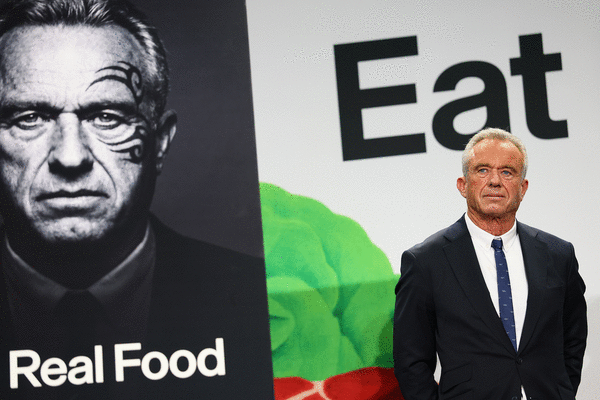
WASHINGTON — The Trump administration is nearing a key milestone in its “Make America Healthy Again” agenda — proposing a definition of ultraprocessed foods.
Stricter scrutiny of nutrition and food additives has been a focal point of the MAHA movement, gaining support from food policy experts as well as lawmakers across the political spectrum. Ultraprocessed foods have been blamed for widespread obesity rates and malnutrition, as well as being contributing factors to chronic diseases, heart disease and cancers.
But what does it mean to be ultraprocessed?
Health and Human Services Secretary Robert F. Kennedy Jr. said the administration is preparing to answer that by next month. Advocates say the result will open avenues to research to determine which products are the most harmful, while providing a basis to clamp down on unhealthy school lunches.
The Trump administration appears to taking a two-pronged approach. The Food and Drug Administration is aiming for a more informative role to equip the public with the best information about nutritional intake.
“I’m not saying that we’re going to regulate ultraprocessed food,” Kennedy said in a “60 Minutes” interview. “Our job is to make sure everybody understands what they’re getting, to have an informed public.”
The Department of Agriculture, however, could use the end result to create policies that have an impact on areas like federal food assistance.
The two departments last summer opened a request for information to solicit feedback on a definition of ultraprocessed foods. By the time it closed in the fall, it had garnered more than 5,000 responses.
Speaking on Joe Rogan’s podcast earlier this month, Kennedy underscored the administration’s efforts.
“We’re not going to change this overnight, but we’re going to change this pretty quickly,” he said. HHS spokesperson Andrew Nixon confirmed that the definition “remains a priority for the secretary and administration.”
Cracking down on processed foods has been a bipartisan bright spot for the MAHA movement, which has fomented divisiveness on other issues such as vaccines.
At a Senate Health, Education, Labor and Pensions Committee hearing for Trump’s surgeon general pick, Casey Means, ranking member Bernie Sanders, I-Vt., said he wants to work with the administration on banning junk food ads.
“I think you will be frustrated by how much I will be talking about ultraprocessed foods,” Means said in response.
“Good,” Sanders said. “I won’t be frustrated, I’d be delighted.”
Health effects
Policy experts and food researchers said that coming to a conclusive definition of ultraprocessed foods will help them study health effects.
Peter Lurie, executive director of the Center for Science in the Public Interest, said in an interview that not having a concrete definition has been a limitation, and that even the definition of the term “processed” isn’t entirely clear to scientists.
“I’m an enthusiastic supporter of this effort to define them,” he said. “And then once you define it, then you can start attaching various policy initiatives to that.”
But Lurie noted that the administration’s approach oversimplified the issue. He said officials should be focused on cracking down on foods that are known to cause the most harm, rather than being averse to all chemicals in foods.
“You can’t look at even a trend like obesity and just sort of say, ‘Well, it’s just this one thing,’” he said.
Dalia Perelman, a research dietitian at Stanford University, said in an interview that the current research standard is known as the Nova scale, a system created by a Brazilian researcher that ranks foods based on how much they have been processed.
The scale has been useful over the years to measure processing, but it falls short in considering the effect on health. Perelman said the research on determining which food additives are most harmful is still evolving, but a clear definition of “ultraprocessed” would be a good place to start.
“I hope it’s not a missed opportunity to really overhaul the food system and have a little more guidance for the food companies,” she said.
The School Nutrition Association, in comments to the FDA, noted that the Nova scale doesn’t account for nutrient density. “For instance, a nutrient-dense item like hummus that contains a stabilizer to maintain texture is treated the same as a cupcake, despite their vastly different nutritional profiles,” it said.
School meal effects
Agriculture Secretary Brooke Rollins and Kennedy have tackled ultraprocessed foods in lockstep. The USDA is currently in the process of creating new regulations on school meals, industry experts say, based on the updated Dietary Guidelines for Americans released earlier this year.
The guidelines did not include the term “ultraprocessed,” but instead advise against the consumption of highly processed foods. They set the nutritional standards for federal programs like school lunch and breakfast, as well as the Supplemental Nutrition Assistance Program.
“These dietary guidelines are foundational to so many USDA programs, and their introduction marks the first step in connecting America’s schools and dinner plates to the best of American agriculture,” Rollins said at an event in January.
School meals won’t change overnight, or even at a speedy pace. It could take years for the industry to adjust the recipes for premade foods.
“Schools do not have the staff, the equipment, the infrastructure, the culinary training or the funding available to them to scratch-prepare everything that they serve their students,” said Diane Pratt-Heavner, the director of media relations for the School Nutrition Association.
The organization in January surveyed 1,240 school meal program directors nationwide, finding that 99% of respondents need more funding; 94% need more staff, equipment and infrastructure; while 95% need more culinary training.
Nearly all respondents reported the cost of food as a challenge, making for no easy transition away from ultraprocessed foods.
Pratt-Heavner said there is a “need to continue to be able to offer pre-prepared items because of operational and funding limitations” as schools rely on prepared foods to service 30 million students per day.
Carole Erb, the executive director for education and governmental sales at J.T.M. Food Group, which makes meals for K-12 students, said it will take time for companies to research and develop recipes to comply with any new regulations.
“At J.T.M., it takes about 18 months to three years,” said Erb, who is also the School Nutrition Association’s industry advisory council chair. “I heard others say that it takes them five years to reformulate.” Erb added that she heard cost estimates ranging from $250,000 per end item to upward of $1 million.
Producers also have to create products that children will want to eat. “That’s the tightrope that we all seem to be working on, having a product that meets the nutritional guidelines in the very strict K-12 meal pattern, and yet, having something that is palatable,” Erb said.
Both Erb and Pratt-Heavner cautioned against states implementing a patchwork of regulations. The end result could mean companies either comply with the strictest requirements, pull products from certain states or halt the sale of those products altogether.
“I call this ’50 kings, 50 kingdoms’ effect,” Erb said. “I can’t produce 20 different kinds of taco meat to meet a whole bunch of different regulations.”
©2026 CQ-Roll Call, Inc., All Rights Reserved. Visit cqrollcall.com. Distributed by Tribune Content Agency, LLC.






Comments