Pulse nightclub is demolished, nearly 10 years after the mass shooting
Published in News & Features
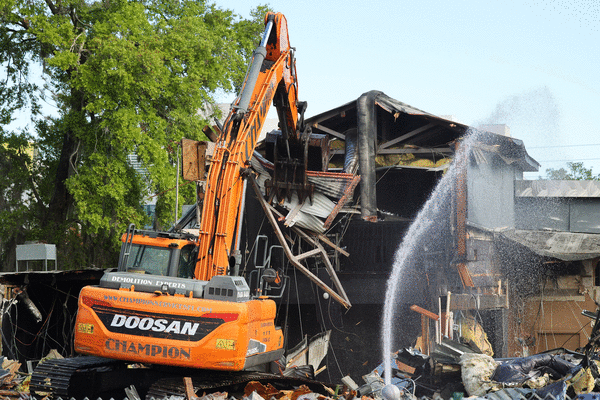
ORLANDO, Fla. — At about 9:02 Wednesday morning, the arm of an excavator dug into the roof of the shuttered Pulse nightclub, and within two hours much of the building was a pile of concrete, wood and metal.
Dozens of city officials, media, mental health professionals and curious observers watched the demolition of the nightclub, where nearly a decade ago 49 people were killed and 53 were wounded in one of the nation’s worst mass shootings.
Crews are expected to work over the coming weeks to clear the wreckage and make way for the construction of a permanent memorial to the victims, a project slated to be completed in September 2027.
“We think this is a big milestone,” Orlando Mayor Buddy Dyer said this week. “We hope when we complete it — we know it won’t bring complete closure — but we hope it will give some peace of mind and give us a place where we can come and think about and remember the victims.”
The massacre at the gay nightclub on Orange Avenue, just south of downtown Orlando, happened in the early hours of June 12, 2016. The effort to build a permanent memorial on the site has been fraught, complicated and delayed, but with the demolition that work should begin later this year.
Orange Avenue was business as usual with morning rush-hour traffic, even as the demolition work got underway. A few people walked by the old club to catch a glimpse of the activity, partially visible above fencing the city crews erected around it. A temporary memorial has been in place at the site for years, but it was removed recently.
Some customers of the neighboring Dunkin’ Donuts pulled out their phones and recorded the wreckage. A woman and three children who stopped by the store, came out with drinks and watched for a time.
The event didn’t seem to draw large numbers of survivors or family members of the victims, though they were allowed to tour the empty, and cleaned, club last year if they wished. The city offered the private tours ahead of planned demolition.
The Rev. José Rodríguez, who has provided mental health counseling to the families and victims of the Pulse tragedy over the years, stood by, taking in the beeping of the machinery and the crunching sound of the excavators tearing down the walls.
The city invited Rodríguez to the demolition in case some onlookers needed counseling. This last bit of clamor will bring a sense of closure to the “painful noise” that hovered over the site, he said.
“A future is being born right now out of this tragedy,” he said.
In the early 2000s, Rodríguez used to frequent the nightclub with his girlfriend. Their second date was at the club where he recalled they ordered $2 martinis. It was also the place where he decided that he wanted to marry her.
The demolition marks the closing of a chapter and a new beginning, Rodríguez said.
“What I’m seeing is people lump together as one tribe at peace with what’s going on,” he said.
The path to building a memorial has been difficult, however. A nonprofit set up in the aftermath of the shooting by the original owner of Pulse, had extravagant plans for a memorial and museum, which were deeply unpopular among survivors and victims’ families. The organization never came close to raising enough money to build the flashy big-money design.
As the so-called OnePulse Foundation fell apart, the city of Orlando bought the property from the Poma family and took control of the process. It formed an advisory committee comprised of survivors, family members of victims and others to help guide the design of the eventual memorial. Throughout the protracted process, there was debate about whether to include the nightclub building as part of the memorial — among the reasons demolition has taken so long to commence — but ultimately the committee decided not to do so.
Earlier this month, architects revealed updated construction drawings, showing a plaza with a reflection pool in the center marked by a rainbow ripple. An “angel ellipse,” or a curved shade structure, will have a tribute to each victim and space for grieving visitors. A water wall also will have each victim’s name along with the quote “For all those who just wanted to dance” etched in English and Spanish.
The night of the shooting was Latin night at the club, and many of the victims were Hispanic and had Puerto Rican roots.
Construction of the memorial is expected to begin in September and be completed the following year.
------------
©2026 Orlando Sentinel. Visit at orlandosentinel.com. Distributed by Tribune Content Agency, LLC.





Comments