Forensic expert: Haiti president was shot a dozen times, died from bullet to the heart
Published in News & Features
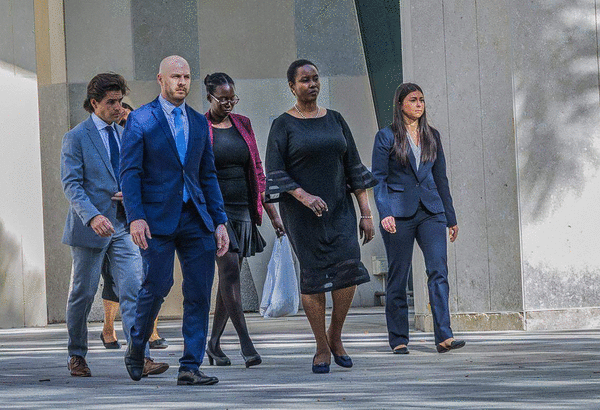
Haitian President Jovenel Moïse died from a gunshot to the heart after his body had already been riddled with bullets during the brazen July 7, 2021, attack on his home, Haiti’s top forensic expert testified Thursday in Miami federal court.
Jean Armel Demorcy, one of two of Haiti forensic pathologists, said he performed the autopsy on Moïse after receiving the body three days after gunmen stormed the president’s home. He told jurors that he counted “a dozen entry wounds,” including one large wound that appeared to have been caused by two bullets piercing the body at nearly the same time.
There were also wounds in the forearm, wrist and head. Demorcy said he believes a shot to the heart proved fatal.
“When we did the dissection we followed the trajectory all the way to the exit,” Demorcy said as federal prosecutors showed him multiple photographs of Moïse’s bullet-riddled body. “We discovered this trajectory went through the lungs, went through the heart and busted the heart.”
That bullet, he said, exited through the president’s back. Another bullet, lodged in the head, appeared to have been fired after the president had already died.
Moïse was shot at close range, Demorcy said, after describing one of the photos: “The head is completely deformed, especially the forehead and the sinking in of the left eye and a wound, which is the exit of the bullet.”
Federal prosecutors are seeking to prove that four South Florida men conspired to kill Moïse by hiring former Colombian soldiers to execute the deadly attack more than four years ago at his home in the hills above Port-au-Prince.
Demorcy’s testimony followed earlier testimony in the trial from Moïse’s widow, Martine, their daughter, Jomarlie, and a Jackson Memorial Hospital orthopedic surgeon who treated Haiti’s former first lady after she was airlifted from Port-au-Prince to Broward County following the attack. While Martine Moïse named several people as being responsible for her husband’s assassination, their daughter testified that she didn’t “particularly know” when asked by the defense if her father had a lot of enemies.
During the attack, she and her college-age brother were left in a downstairs bathroom with one of their dogs, she and her mother testified.
On Thursday, Dr. Steven Kalandiak testified that Martine Moïse, who was assigned three different aliases upon arrival at Jackson, was hit by “multiple bullets” and suffered injury to her right arm that required four surgeries.
In addition to bullet fragments, some of which were found in her thigh, Kalandiak said surgeons also found “pieces of wood, which were extremely uncommon after a gunshot.”
Pressed about the origins of the wood, he said he did not know. “I think this is the only times I’ve seen wood in a gunshot injury,” he said.
Standing trial in Miami are Arcángel Pretel Ortiz, 53, a former FBI informant, Colombian national and U.S. permanent resident; Antonio Intriago, 62, the Venezuelan-American owner of a Doral security company that hired Pretel; James Solages, 40, a Haitian-American handyman who also worked for Intriago, and Walter Veintemilla, 57, an Ecuadorian American prosecutors say helped finance the plan targeting Moïse.
All four have been in custody in the Miami federal detention center since their arrests. A fifth defendant, Christian Emmanuel Sanon, a Haiti-born doctor who prosecutors say wanted to be named president, will be tried at a later date due to health issues.
Prosecutors say the defendants helped recruit a group of Colombian commandos who killed Moïse while he was in his bedroom. Defense attorneys argue that their clients were misled about the mission and were acting on an arrest warrant for the president issued by a Haitian investigative judge. They have put the blame on others in Haiti, including a former government official, Joseph Felix Badio, who is currently jailed in Haiti in connection with the assassination along with dozens of others.
Central to the defense strategy is the autopsy report, which they described in opening statements as being “a complete disaster,” and part of the broken chain of custody of evidence in the high-profile case.
“It is a complete mess and can only be attributed to either incompetence, intimidation or corruption, or perhaps some combination of all three,” one of the defense attorneys said during opening statements on Tuesday.
During his testimony Demorcy, who will take the stand again on Friday, testified that the X-ray machine he normally used during autopsies was broken and the government had to request the services of a private lab to do the X-rays of the president’s body.
Demorcy testified that although there were “lots of” bullet fragments observed in Moïse’s body from the imaging, he only extracted two bullets and two fragments.
Pressed during cross-examination by defense attorney Orlando do Campo on why he did not extract others, including a bullet lodged in the president’s chest, the pathologist said: “It would require a lot of dissection. There was no need for that.”
Pressed further, he said it was not requested by Haiti’s chief prosecutor, Bedford Claude, at the time he ordered the autopsy.
“Our mission was to determine the cause of death and to give a description of the wound,” Demorcy said. “We do not decide on our mission in an autopsy.”
_____
©2026 Miami Herald. Visit miamiherald.com. Distributed by Tribune Content Agency, LLC.

Comments