What are federal workers' free speech rights? Yosemite ranger sues after firing
Published in News & Features
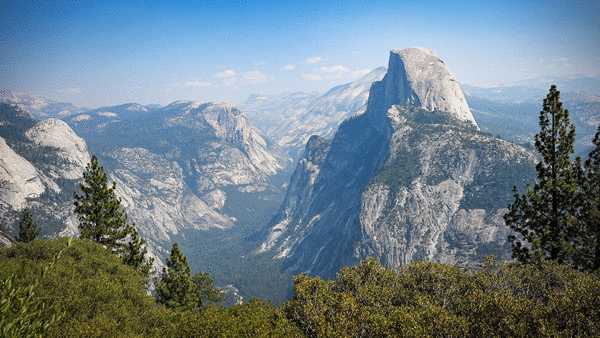
FRESNO, Calif. — A former Yosemite National Park ranger was fired after unfurling a transgender pride flag on El Capitan.
Now the ex-ranger suing to get their job back — alleging the U.S. Department of the Interior violated their First Amendment rights.
What protections do federal employees have in California when it comes to freedom of speech?
Here’s what to know:
Yosemite park ranger sues over pride flag firing
Shannon “SJ” Joslin, a nonbinary biologist and park ranger who studies bats, helped a climbing group hang a 66-foot-wide pride flag on the climbing wall face of El Capitan on May 20 before removing it voluntarily, The Associated Press previously reported.
Although the giant pink, blue and white flag was on display for “less than three hours,” Joslin was “summarily fired and then, in a significant escalation, criminally investigated,” according to a lawsuit filed in federal court in Washington, D.C. on Feb. 23.
“This vindictive campaign violated Dr. Joslin’s First Amendment and Privacy Act rights and continues to chill their expressive conduct and speech,” the suit says.
Joslin told the Associated Press that they received a termination letter in August for “failing to demonstrate acceptable conduct” in their capacity as a biologist.
“I was really hurting because there were a lot of policies coming from the current administration that target trans people, and I’m nonbinary,” Joslin told the Associated Press in August, adding that hanging the flag was their way of saying, “We’re all safe in national parks.”
Joslin’s lawsuit names the Department of the Interior, National Park Service, U.S. Department of Justice and U.S. Attorney’s Office for the Eastern District of California as defendants, along with U.S. Secretary of the Interior Doug Burgum and Jessica Bowron, acting director of the National Park Service.
“Dr. Joslin has not been indicted, but neither have they been informed that any investigation has concluded,” the suit says. “This sends a clear message: Hanging a trans flag in the park results in firing and criminal investigation. Future expression in support of trans rights would lead to even more severe punishment.”
Which rights does the First Amendment protect?
The First Amendment is part of the U.S. Constitution’s Bill of Rights, which “spells out Americans’ rights in relation to their government,” the National Archives say.
“Congress shall make no law respecting an establishment of religion, or prohibiting the free exercise thereof; or abridging the freedom of speech, or of the press,” the First Amendment says.
The First Amendment also protects people’s right to gather together “peaceably” and “petition the government for a redress of grievances.”
Can the First Amendment prevent you from being fired?
Can the First Amendment protect you from being fired for saying something your employer doesn’t like?
It depends, Chessie Thacher, senior staff attorney at the ACLU of Northern California, previously told The Sacramento Bee.
“If an employer is a private company or entity or person, and not the government, then the First Amendment isn’t going to constrain how that employer reacts to your speech,” Thacher told The Bee in October.
That means your employer gets the ultimate say whether you get to keep your job or not, The Bee previously reported.
What are government workers’ free speech rights in California?
The First Amendment potentially protects city, county, state and federal employees from being fired if they speak out.
However, it depends on whether the worker was speaking “in a professional capacity” as a government employee, Thacher said.
If so, their employer can terminate their job or take disciplinary action.
If the government employee was speaking in a personal capacity on an issue of public concern, they have more protections than private workers, Thacher told The Bee.
In general, “public employers can’t punish employees for their personal, off-the-clock speech,” a nonprofit organization dedicated to defending constitutional freedoms.
In other words, “The government can’t punish you for your speech just because it doesn’t like what you’re saying, either because of the content or your viewpoint,” Thacher said.
Still, some categories of speech aren’t protected under federal law, including incitement to violence, harassment and true threats, according to the Library of Congress.
Is flying a flag protected as free speech?
Flying a flag is “generally” considered a form of free speech under California and federal law, according to the Freedom Forum, a nonprofit organization dedicated to defending constitutional freedoms.
“Like all First Amendment freedoms, there are limits, and restrictions on flag flying can come from private entities or the government,” the Freedom Forum said. “Courts are most likely to uphold these restrictions if they are ‘content-neutral,’ meaning they’re not aimed at restricting the flag’s message.”
Regulations can limit “when and where flags can be flown, the flag’s size, or the number of flags in a certain area,” the nonprofit added. “The government often applies these kinds of restrictions to political signs and billboards as well, aiming to ensure public safety and/or aesthetics.”
Because “federal, state and local parks exist as public goods for everyone to enjoy,” government officials can limit how flags, signs or other messages are displayed in those parks without violating the First Amendment, according to the Freedom Forum.
National park bans banners, flags and signs in wilderness areas
On May 21, one day after Joslin and the climbers displayed the trans pride flag at El Capitan, Yosemite National Park Acting Superintendent Ray McPadden signed a rule banning people from hanging banners, flags or signs larger than 15 square feet in areas designated as “wilderness” or “potential wilderness.”
Those areas cover 94% of the park, according to Yosemite National Park’s website.
“The timing signaled the beginning of the government’s retributive conduct,” the suit says, adding that the new rule was reportedly dated May 20 but wasn’t signed electronically or made public until the following day.
The ban appeared in the annual Superintendent’s Compendium, which stated that the “restriction is necessary to preserve the values of wilderness character in accordance with the Wilderness Act, provide for an unimpaired visitor experience, protect natural and cultural resources” and “maintain public safety,” the San Francisco Chronicle reported in May.
Hanging flags or banners at Yosemite as a form of protest is nothing new.
Climbers hung a 25-foot-long banner reading “Stop the Genocide” in the colors of the Palestinian flag in June 2024, SFGate reported.
In February 2025, a group of demonstrators displayed an upside-down American flag from the El Capitan summit to protest the firing of National Park Service employees by the Trump administration, NBC News previously reported.
Displaying an upside-down American flag is traditionally a sign of “dire distress,” according to the United States Flag Code.
The Trump administration fired roughly 1,000 newly hired National Park Service workers weeks before the start of the busy summer season, The Sacramento Bee previously reported.
_____
©2026 The Fresno Bee. Visit fresnobee.com. Distributed by Tribune Content Agency, LLC.


Comments