Macron gifted a chance to start making France more Le Pen-proof
Published in News & Features
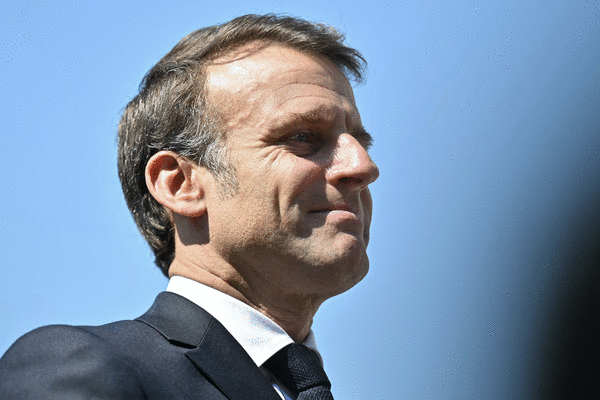
PARIS — President Emmanuel Macron has been handed a golden chance to insulate one of France’s most important institutions from the far right.
With Marine Le Pen’s National Rally strongly positioned for next year’s election, the early resignation of the Bank of France chief offers the current head of state — rather than whoever wins the vote to replace him — the opportunity to name a successor. The job is a crucial one, involving attendance at European Central Bank meetings in Frankfurt, and acting as an economic watchdog back home.
Francois Villeroy de Galhau, the governor now set to depart this June instead of October 2027, insists his exit to run a charitable foundation for troubled youngsters is a personal choice. That would stand out as a fairly exceptional step among Group of Seven peers, who have tended to serve out terms or move on to similar economic roles.
Regardless of the reason for his decision, the net result remains the same: France’s elite is now in position to start pulling up the drawbridge in earnest if it wants to prepare for Le Pen, or potentially, her protégé, Jordan Bardella.
And in case that ruling class has any doubts on what populist politicians can unleash, US President Donald Trump’s attempts to force easing by the Federal Reserve offer a demonstrative warning; Villeroy himself decried that push against central-bank independence in a joint statement with global peers last month.
“If it turns out that there’s more to this than personal reasons, then I see a defensive move by an elite that is trying to keep the republic standing,” said Sofia Ventura, a professor at the University of Bologna and author of books on French politics. “Leaving economic policy in the hands of people who don’t share certain values is troubling to some.”
The danger there is that filling roles with appointees of the established order plays into populist narratives that doing so undercuts democracy. Already in France, actions by the judiciary to block candidates — a fate that could yet befall Le Pen — have prompted that criticism.
During Macron’s time in office, he has frequently infused governments and key French and European institutions with technocratic figures who share his calls for deeper integration and a respect for economic orthodoxy.
But the president’s grip on power has weakened significantly after an ill-fated gamble on legislative elections in 2024 handed gains to the far left and Le Pen’s party.
Even if her appeal against a ban on running for office fails, surveys of voting intentions show the party’s current leader, Bardella, is equally well placed to be the next French leader.
This wouldn’t be the first time that the prospect of a looming populist win sparked speculation of pre-emptive personnel moves.
In June 2022, former Bank of Italy Governor Ignazio Visco denied plans to step down after a newspaper report that then-Prime Minister Mario Draghi would replace him and others in key positions before possible elections. Ultimately that didn’t transpire, and Brothers of Italy leader Giorgia Meloni took power later that year.
Populist accusations of a deep state resisting change also featured in the UK after the Brexit vote in 2016, and have been a recurring US theme of Trump and his accolytes too.
Pressure in the UK could indeed focus on its central bank if Nigel Farage’s Reform UK wins power. In Davos last month, the party leader refused to rule out trying to cut short the Bank of England governor’s term in favor of a preferred candidate.
Back on continental Europe, the central banking community remains particularly wary of Le Pen’s far right after her 2017 election campaign centered on pulling France out of the euro and picking apart EU institutions.
She has since reversed course, but still pledges to challenge the federal powers of Europe. Bardella, meanwhile, said in November that in power, his party would push the ECB to relaunch quantitative easing as a way to tackle France’s bloated debt burden.
A spokesperson for the National Rally declined to comment on Villeroy’s resignation and Macron’s responsibility for naming a successor.
A French governor picked by the Le Pen’s party would create “noise and uncertainty” in Frankfurt, Frederik Ducrozet, head of macro research at Pictet Wealth Management said. He also flagged that investors have been concerned by the possibility of a far-left candidate winning the presidency with similarly disruptive anti-EU policies.
“The ECB is the most politically independent central bank in the world,” Ducrozet said. “If you have one of the extremes winning in 2027, you risk having someone who is opposed to anything the ECB does.”
In that context, Villeroy’s early exit evokes a counterpoint to US Supreme Court Justice Ruth Bader Ginsberg, who didn’t retire during Barack Obama’s presidency, giving Trump the opportunity to fill the slot when she died just before the end of his first term.
The 66-year-old Bank of France governor is adamant that his departure was his choice alone, and insisted as much when questioned on the matter in an interview with Les Echos.
“All those who know me as a free man, and who know my independence, know that if I had been asked, I would have refused,” he said. “This is a personal decision.”
____
(With assistance from Ania Nussbaum and Richard Bravo.)
©2026 Bloomberg L.P. Visit bloomberg.com. Distributed by Tribune Content Agency, LLC.




Comments