Trump's Cuba oil tariff threat creates new diplomatic challenge for Mexico's Sheinbaum
Published in News & Features
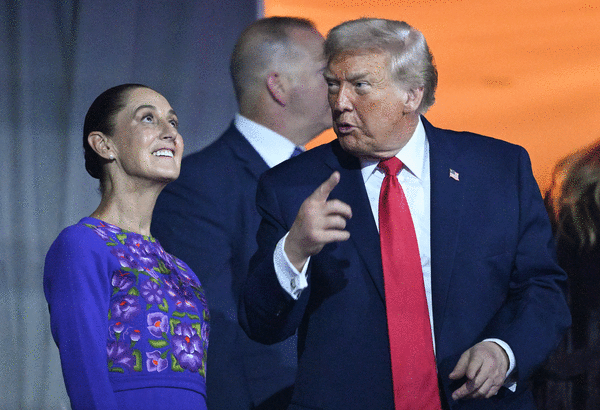
MEXICO CITY — President Trump’s plan to slap tariffs on nations that provide oil to Cuba has created a formidable new challenge for Mexican President Claudia Sheinbaum in her efforts to balance Mexico’s interests with White House demands.
On Friday, Sheinbaum said Mexico would seek a clarification from Washington in a bid to avoid a difficult choice: Halt oil shipments to Cuba, potentially triggering a humanitarian crisis on the island, or face new tariffs on Mexican products exported to the United States.
Ceasing oil deliveries to Cuba, she warned, could result in a catastrophic scenario — a cutoff in electrical power to hospitals and homes, threatening medical care, food supplies and other essential services across the island, home to 11 million people.
However, the leftist president signaled that she would not risk the imposition of additional U.S. levies on imports from Mexico, a nation heavily dependent on cross-border trade. “We cannot put our country at risk in terms of tariffs,” Sheinbaum told reporters at her regular morning news conference.
For a year, Sheinbaum has been fending off Washington’s plans to impose punishing new tariffs on Mexico. Her efforts have mostly succeeded — and she has won warm praise from Trump — but a White House decree targeting oil supplies to Cuba presents a difficult new test.
On Thursday, Trump issued an executive order establishing potential tariffs on goods from countries “that sell or otherwise provide oil to Cuba,” a step that, Trump said, was intended to protect “U.S. national security and foreign policy from the Cuban regime’s malign actions and policies.”
Cuban President Miguel Díaz-Canel denounced Trump’s move on social media as a “fascist, criminal and genocidal” plan to “asphyxiate” the Cuban economy, which is already struggling with blackouts and a lack of gasoline, among other shortages.
Sheinbaum has also been engaged in strenuous efforts to dissuade Trump from following through on his threats to deploy U.S. military assets against cartels in Mexico. She has called any prospective U.S. strike on Mexican territory a violation of Mexican sovereignty.
Mexican crude has taken on a new urgency for Cuba since the U.S. ouster this month of Venezuelan President Nicolás Maduro, whose socialist government was long the major supplier of oil to Cuba. (Havana said 32 Cuban officers, members of Maduro’s security detail, were killed in the operation.)
Maduro’s fall and the Venezuelan government’s subsequent submission to Washington has resulted in a cut-off of Venezuelan oil to Cuba. U.S. imports of Venezuelan oil, meanwhile, have soared.
Mexico supplied Cuba with about 20,000 barrels a day of oil for much of 2025, said Jorge R. Piñon, an energy expert at the University of Texas. But shipments have declined drastically this year, apparently because of U.S. pressure.
“The faucets are being shut off,” said Piñon. “Sheinbaum is walking a tightrope.”
Without imports, he said, Cuba faces a daily oil shortfall of about 60,000 barrels to meet its energy needs. Other potential sources for Cuba include the oil-exporting nations of Russia, Angola, Algeria and Brazil, Piñon said, but it was unclear if any of those countries would be inclined to defy the White House and help bail out Cuba.
Mexico’s support for the Cuban government has long been a point of pride here, a sign of a foreign policy independence from the United States, especially during the Cold War. Mexican leaders, including Sheinbaum, have repeatedly decried Washington’s more than half-century embargo of the island as an illegal blockade that punishes ordinary Cubans, not the country’s communist elite.
It was from the Mexican coast that, in 1956, Fidel Castro sailed to Cuba along with Ernesto “Che” Guevara and other revolutionaries in the yacht Granma, launching an improbable but ultimately successful armed rebellion to overthrow U.S.-backed dictator Fulgencio Batista.
Former Mexican President Andrés Manuel López Obrador — Sheinbaum’s predecessor and political mentor — labeled Castro a “giant” and called Havana a “progressive” model for resistance to U.S. pressure.
But the U.S. push to block Mexican oil exports to Cuba is also exposing divisions in the ruling Morena political bloc, which was founded by López Obrador.
Leftists in Morena have assailed Washington’s attempt to halt Mexican oil exports to Cuba. But more conservative members of the ruling party have urged caution.
Ricardo Sheffield, a prominent Morena senator who was previously a member of the center-right National Action Party, has called for a review of oil pacts with Cuba. In a recent speech, he acknowledged “the relationship and the history that unites” Mexico and Cuba, but warned: “If we continue giving away oil to Cuba, we will have more problems with our neighbors in the U.S.”
_____
Special correspondent Cecilia Sánchez Vidal contributed to this report.
©2026 Los Angeles Times. Visit at latimes.com. Distributed by Tribune Content Agency, LLC.





Comments