LA Unified School District says Palisades High is safe for students to return to after fire. Some parents and experts have concerns
Published in News & Features
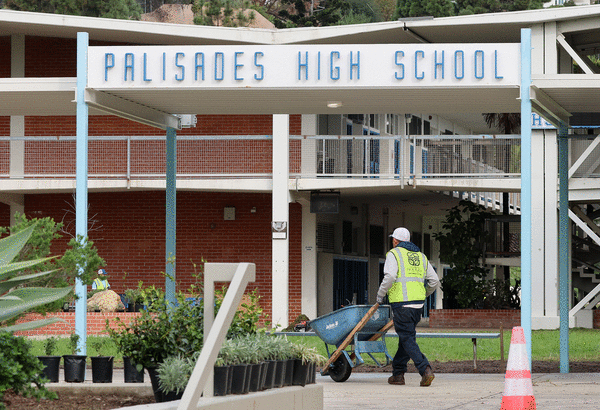

LOS ANGELES — The Los Angeles Unified School District released a litany of test results for the fire-damaged Palisades Charter High School ahead of the planned return of students next week, showing the district’s remediation efforts have removed much of the post-fire contamination.
However, some parents remain concerned with a perceived rush to repopulate the campus. And while experts commended the efforts as one of the most comprehensive post-fire school remediations in modern history, they warned the district failed to test for a key family of air contaminants that can increase cancer risk and cause illness.
“I think they jumped the gun,” said a parent of one Pali High sophomore, who asked not to be named because she feared backlash for her child. “I’m quite angry, and I’m very scared. My kid wants to go back. ... I don’t want to give him too much information because he has a lot of anxiety around all of these changes.”
Nevertheless, she still plans to send her child back to school on Tuesday, because she doesn’t want to create yet another disruption to the student’s life. “These are kids that also lived through COVID,” she said.
The 2025 Palisades fire destroyed multiple buildings on Pali High’s campus and deposited soot and ash in others. Following the fire, the school operated virtually for several months and, in mid-April of 2025, moved into a former Sears department store in Santa Monica.
Meanwhile, on campus, the U.S. Environmental Protection Agency and the U.S. Army Corps of Engineers cleared debris from the destroyed structures, and LAUSD hired certified environmental remediation and testing companies to restore the still-standing buildings to a safe condition.
LAUSD serves as the charter school’s landlord and took on post-fire remediation and testing for the school. The decision to move back to the campus was ultimately up to the charter school’s independent leadership.
The Los Angeles Department of Water and Power tested the drinking water for a slew of contaminants, and environmental consultants tested the soil, HVAC systems, indoor air and surfaces including floors, desks and lockers.
They tested for asbestos, toxic metals such as lead and potentially hazardous organic compounds often unleashed through combustion, called volatile organic compounds, or VOCs.
“The school is ready to occupy,” said Carlos Torres, director of LAUSD’s office of environmental health and safety. “This is really the most thorough testing that’s ever been done that I can recall — definitely after a fire.”
A handful of soil samples had metal concentrations slightly above typical post-fire cleanup standards, which are designed to protect at-risk individuals over many years of direct exposure to the soil — such as through yard work or playing sports. An analysis by the environmental consultants found the metals did not pose a health risk to students or staff.
On indoor surfaces, the consultants found two areas with lead and one with arsenic, spaces they recleaned and retested to make sure those metals were no longer present.
The testing for contamination in the air, however, has become a matter of debate.
Some experts cautioned that LAUSD’s consultants tested the air for only a handful of mostly nonhazardous VOCs that are typically used to detect smoke from a wildfire that primarily burned plants. While those tests found no contamination, the consultants did not test for a more comprehensive panel of VOCs, including many hazardous contaminants commonly found in the smoke of urban fires that consume homes, cars, paints, detergents and plastics.
The most notorious of the group is benzene, a known carcinogen.
At a Wednesday webinar for parents and students, LAUSD’s consultants defended the decision, arguing their goal was only to determine whether smoke lingered in the air after remediation, not to complete more open-ended testing of hazardous chemicals that may or may not have come from the fire.
Andrew Whelton, a Purdue University professor who researches environmental disasters, didn’t find the explanation sufficient.
“Benzene is known to be released from fire. It is known to be present in air. It is known to be released from ceilings and furniture and other things over time, after the fire is out,” Whelton said. “So, I do not understand why testing for benzene and some of the other fire-related chemicals was not done.”
For Whelton, it’s representative of a larger problem in the burn areas: With no decisive guidance on how to remediate indoor spaces after wildland-urban fires, different consultants are making significantly different decisions about what to test for.
LAUSD released the testing results and remediation reports in lengthy PDFs less than two weeks before students plan to return to campus, while the charter school’s leadership decided on a Jan. 27 return date before testing was completed.
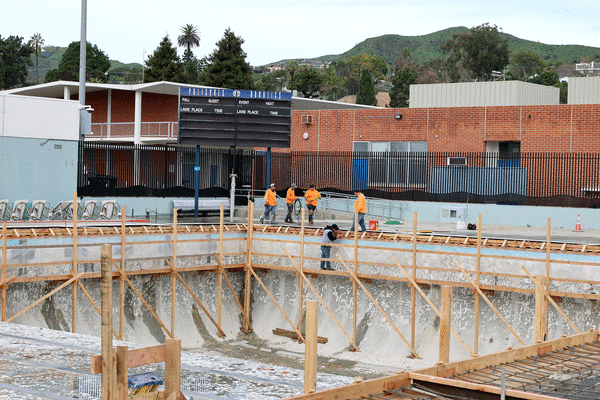
At the webinar, school officials said two buildings near the outdoor pool have not yet been cleared through environmental testing and will remain closed. Four water fixtures are also awaiting final clearance from the Los Angeles Department of Water and Power, and the school’s food services are still awaiting certification from the L.A. County Department of Public Health.
For some parents — even those who are eager to ditch the department store campus — it amounts to a flurried rush to repopulate Pali High’s campus that is straining their decisions about how to keep their kids safe.
Torres stressed that his team acted cautiously in the decision to authorize the school for occupancy, and that promising preliminary testing helped school administrators plan ahead. He also noted that the slow, cautious approach was a point of contention for other parents who hoped their students could return to the campus as quickly as possible.
Experts largely praised LAUSD’s efforts as thorough and comprehensive — with the exception of the VOC air testing.
Remediation personnel power washed the exterior of buildings, wiped down all surfaces and completed thorough vacuuming with filters to remove dangerous substances. Any soft objects such as carpet or clothing that could absorb and hold onto contamination were discarded. The school’s labyrinth of ducts and pipes making up the HVAC system was also thoroughly cleaned.
Crews tested throughout the process to confirm their remediation work was successful and isolated sections of buildings once the work was complete. They then completed another full round of testing to ensure isolated areas were not recontaminated by other work.
Environmental consultants even determined a few smaller buildings could not be effectively decontaminated and consequently had them demolished.
Torres said LAUSD plans to conduct periodic testing to monitor air in the school, and that the district is open to parents’ suggestions.
For Whelton, the good news is that the school could easily complete comprehensive VOC testing within a week, if it wanted to.
“They are very close at giving the school a clean bill of health,” he said. “Going back and conducting this thorough VOC testing … would be the last action that they would need to take to determine whether or not health risks remain for the students, faculty and visitors.”
©2026 Los Angeles Times. Visit at latimes.com. Distributed by Tribune Content Agency, LLC.






Comments