Trump claims US destroyed Venezuelan dock used for drug shipments
Published in News & Features
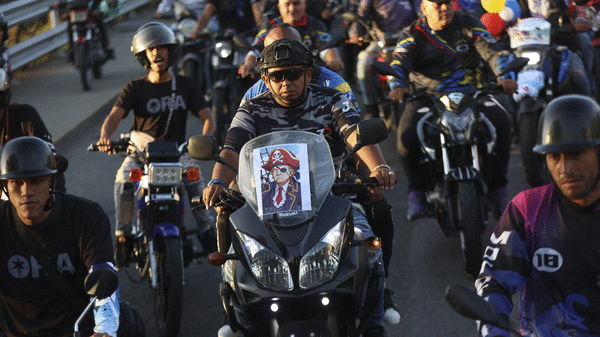
President Donald Trump said Monday that the United States has destroyed a docking area used by suspected drug traffickers in Venezuela, marking what would be the first publicly acknowledged U.S. ground strike inside the country amid escalating tensions with the Nicolás Maduro regime.
Speaking to reporters at his Mar-a-Lago residence in Florida during a meeting with Israeli Prime Minister Benjamin Netanyahu, Trump said U.S. forces targeted a coastal facility used to load drugs onto boats bound for international markets.
“There was a big explosion in the dock area where they load the boats with drugs,” Trump said. “So we hit all the boats, and now we hit the area. It’s the staging area. And that’s gone now.”
The president did not specify whether the operation was carried out by U.S. military forces or intelligence agencies, nor did he identify the precise location of the strike, saying only that it occurred “along the coast.” He also declined to say whether there were casualties.
Trump’s remarks, first made during a radio interview on Friday and reiterated Monday, have not been confirmed by U.S. defense officials. The White House has issued no formal statement, and the Pentagon referred questions to the president’s office.
Venezuelan authorities have likewise remained silent. State-controlled media have not reported any attack, although social media users in western Venezuela circulated images and videos over the weekend of a large fire at what appeared to be a warehouse near the city of Maracaibo. The cause of the blaze has not been independently verified.
The blaze erupted early Tuesday morning at the Primazol facility in the city of San Francisco, in Zulia state, roughly 700 kilometers west of Caracas and near Lake Maracaibo, one of the largest bodies of water in South America. Local authorities said the incident was unrelated to any foreign military action.
According to Mayor Héctor Soto, a political ally of strongman Nicolás Maduro, the fire was caused by an electrical failure. Speaking to local media, Soto said no one was injured and dismissed suggestions that the incident was linked to an external attack. He added that agents from Venezuela’s military counterintelligence agency, along with police and firefighters, responded immediately to the scene.
“Let the Americans — the gringos, in this case Donald Trump and all his people — continue to dream,” Soto said. “We will defend the homeland of Bolívar.”
Primazol dismissed in a statement the unofficial versions that linked the fire to President Trump’s statements, calling it an “incident.”
If confirmed, the strike would represent a significant escalation in Washington’s pressure campaign against the Maduro regime and the first known instance of a U.S. military strike on Venezuelan territory in the current standoff.
The Trump administration has accused Maduro and senior officials of leading what it calls the “Cartel of the Suns,” a network of military and political figures allegedly involved in large-scale cocaine trafficking. U.S. authorities have offered a reward of up to $50 million for information leading to Maduro’s arrest on charges including narco-terrorism and conspiracy.
Trump said Monday that he had spoken “very recently” with Maduro by phone but characterized the conversation as unproductive. “Not much came of it,” he said.
The alleged strike comes amid an intensifying U.S. campaign against drug trafficking networks operating in the Caribbean and along South America’s northern coast. Since September, U.S. forces have increased maritime and aerial patrols in the region, targeting vessels suspected of transporting narcotics.
According to U.S. officials, at least 107 people have been killed in operations tied to what the administration has dubbed Operation Southern Spear, a sweeping effort aimed at disrupting transnational drug networks. Washington has described the campaign as one of the largest U.S. military deployments in the Caribbean in decades.
The Pentagon has recently surged additional assets into the region, including the aircraft carrier USS Gerald R. Ford and several guided-missile destroyers. U.S. officials say the deployments are intended to bolster interdiction efforts in both the Caribbean Sea and the eastern Pacific.
Human rights organizations, however, have raised concerns about civilian casualties and the legal basis for some of the operations. Several groups have accused the United States of carrying out extrajudicial killings, allegations the administration has firmly denied, insisting all actions comply with international law and are conducted in self-defense.
The reported strike also comes as Washington tightens economic pressure on Caracas. The Trump administration has expanded sanctions on Venezuela’s oil sector and recently ordered the seizure of vessels linked to sanctioned entities. U.S. officials argue that oil revenues are being funneled into drug trafficking, corruption, and the financing of armed groups.
The Maduro regime has repeatedly rejected those claims, accusing Washington of waging economic warfare and seeking to justify regime change. Venezuelan officials insist that the country is the victim of an international disinformation campaign aimed at undermining its sovereignty and seizing control of its vast oil reserves.
Trump, however, struck a defiant tone, suggesting that the operation marked a turning point. “They’re loading the ships with drugs,” he said. “So we attacked the ships, and now we’re attacking the area. That area no longer exists.”
_____
©2025 Miami Herald. Visit miamiherald.com. Distributed by Tribune Content Agency, LLC.



Comments