French premier resigns after Macron's Cabinet gamble backfires
Published in News & Features
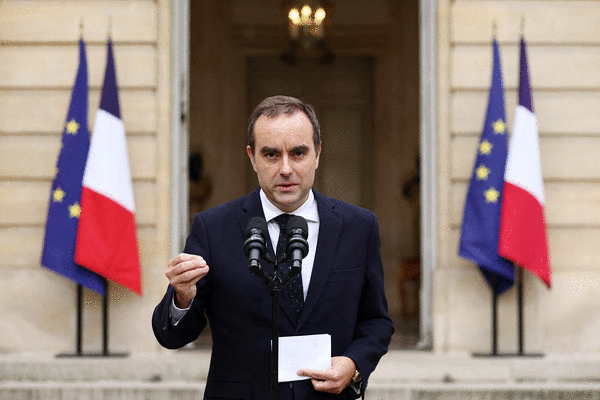
PARIS — Sebastien Lecornu unexpectedly resigned as France’s prime minister on Monday, blaming the intransigence of the groups in the country’s fractured parliament and deepening a national political crisis.
The move sparked a selloff in French assets with stocks tumbling by the most since late August and the yield on the benchmark 10-year note rising nine basis points to 3.6%.
While Lecornu was clearly in deep trouble with no majority emerging to back him in parliament, and speculation that he could face a vote of no confidence as soon as this week, his abrupt departure was a surprise.
The resignation came less than 24 hours after President Emmanuel Macron named a new Cabinet stacked with centrist loyalists, ignoring threats from opposition parties not to appoint a continuity government. That plan immediately backfired.
“The conditions were no longer met for me to be able to exercise my functions as prime minister,” Lecornu told reporters in Paris Monday. “I was ready to compromise but each political party wanted the other political party to adopt its entire program.”
Lecornu faced the same intractable problem that sank the premierships of his two forerunners: having to pass a budget that included unpopular spending cuts and tax increases to rein in the largest deficit in the euro area.
Macron now has three main choices: He can name a new prime minister, who would then need to propose a fresh Cabinet; he could call a parliamentary election; or he could resign himself — something he’s previously said he won’t do. The deadline to file a regular budget is next Monday, which means the government will likely need to resort to emergency measures.
French Socialist Party leader Olivier Faure, whose party holds a potential swing vote in parliament, said Macron’s group is imploding and the new government had no legitimacy. “We are witnessing an unprecedented political crisis,” he said shortly before Lecornu announced his resignation.
French bonds fell as investors braced for more political uncertainty, widening the nation’s borrowing premium over German debt — a key gauge of fiscal risk — to over 89 basis points, the highest level since late 2024.
“The current situation is bringing us closer to fresh elections and in this scenario, I would expect the spread to rise and test 100 basis points,” Vincent Juvyns, chief investment strategist at ING in Brussels, said in an interview before Lecornu’s resignation.
In the immediate aftermath of Lecornu quitting, far-right leader Marine Le Pen reiterated her call for a fresh legislative election as her National Rally party sees an opportunity to build on the gains it registered in the last snap vote in 2022.
“We’ve come to the end of the road. We need to go back to voters, they must decide,” she said.
Lecornu’s immediate predecessor, Francois Bayrou, was forced to resign last month after losing a confidence vote over his plan for a sharp reduction in the deficit next year. He had succeeded Michel Barnier, who was ousted in December — also over proposed budget cuts.
Macron and Lecornu’s picks for top jobs in the new government didn’t indicate the change of direction demanded by opposition parties.
The only significant adjustments in the composition of the short-lived government in fact contributed to the political backlash, with the return of close Macron allies Bruno Le Maire as defense minister and Roland Lescure as finance minister.
Le Maire served as finance minister for the first seven years of Macron’s presidency and is associated with the pro-business policies criticized by opposition parties. Crucially, he also had strained relations with the center-right Republican party which he quit in 2017 to join Macron’s centrist group. Bruno Retailleau, the interior minister who now leads the Republicans, said on Monday a “problem of trust” emerged with Lecornu as he was not aware that Le Maire would be named defense minister.
French historian and political expert Jean Garrigues said Monday’s “incomprehensible psychodrama” makes it increasingly difficult for Macron to avoid calling snap legislative elections, as he did in June 2024.
“Even though Macron doesn’t want it, he might be forced to do it again,” Garrigues said.
----------
—With assistance from Samy Adghirni and Julien Ponthus.
©2025 Bloomberg L.P. Visit bloomberg.com. Distributed by Tribune Content Agency, LLC.





Comments