Report calls for acknowledging Maryland's lynching history -- and offering up to $100,000 to victims' descendants
Published in News & Features
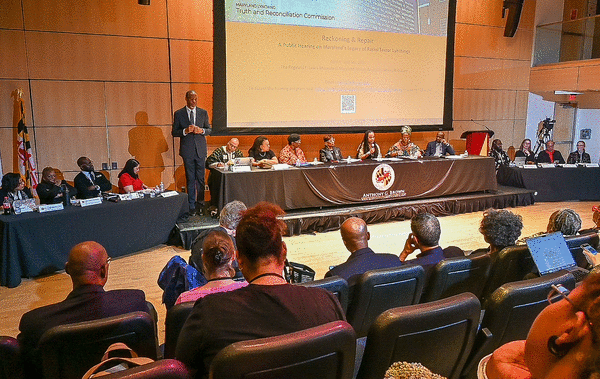
BALTIMORE — A final report produced by a commission established to investigate the history of lynchings in Maryland urges the state and several local jurisdictions to acknowledge their parts in the acts of racial terror committed during the 19th and 20th centuries — and calls for payments of up to $100,000 for every descendant of a known lynching victim, among dozens of other recommendations.
The Maryland Lynching Truth and Reconciliation Commission, established by the House of Delegates in 2019, has spent six years working to “investigate, document, and reckon with the history of racial terror lynching” that resulted in the murders of at least 38 Black men in the state.
“This work represents an opportunity to investigate and address 38 open murder cases — crimes against humanity for which no one was ever held accountable,” said David O. Fakunle, chair of the commission. “There is no statute of limitations on murder, and the systems that enabled racial terror lynching did not disappear in 1933.”
That was the year of the last known lynching in the state, that of an African American laborer named George Armwood, by a white mob in Princess Anne.
According to the 630-page work, the commission’s goal has been to “bear witness to a chapter of Maryland history too long denied ... when Black Marylanders ... were terrorized, brutalized and murdered by White mobs, often with at best the negligence and at worst complicity of local and state institutions.”
The report includes 84 recommendations, among them that Maryland and an array of local governments issue a written apology for the past crimes; create an interagency task force to identify “relevant descendants” of victims and offer them the monetary compensation; establish law-school scholarships to law school for descendants of Black residents from counties where lynchings took place; fund grants to support education on the history of lynching in the state, and support efforts to create a permanent and public Maryland Lynching Memorial.
The recommendations include dozens designed to address the entrenched racial disparities the authors say “racial terror lynching was designed to enforce,” including “today’s racial wealth gap, disproportionate incarceration rates, maternal mortality disparities, and land loss among Black families,” in the authors’ words.
The report offers no total cost estimate for the recommendations, but it argues that whatever expense is incurred will pay ample dividends in the long run. The commission presented it to the Maryland General Assembly for consideration on Dec. 9.
Gov. Wes Moore expressed appreciation to the commission for “delivering a final report with recommendations aimed at confronting this painful chapter of our history and advancing accountability and healing,” Ammar Moussa, a spokesman, said.
"Given the scope of the report, it would be premature to commit to specific proposals, but the administration takes the commission’s work seriously and is committed to engaging in that process with the Commission members and the General Assembly,” Moussa continued. “The Governor and his team will review and evaluate the report in full and work in partnership with the General Assembly to determine the best path forward.”
In May, Moore vetoed a bill that would have launched a two-year study into whether the state should provide reparations to Marylanders impacted by the state’s history of slavery and inequality. The legislature overrode that veto Tuesday, during a special session held to elect a new House speaker.
The 17-member group that looked into lynching — the first state-sponsored commission of its kind in the United States — confirmed and documented 38 of the murders of Black people by white mobs in Maryland, all committed between 1854 and 1933; held 14 hearings in 10 counties to educate members of the public about the subject and seek input from community members, and produced the report, which was finalized Dec. 9.
The work cites historic legislation, such as the federal Civil Liberties Act of 1988, as precedent for its proposed acts of reparation. That act granted redress of $20,000 and a formal presidential apology to Americans of Japanese ancestry who were incarcerated in internment camps during World War II.
But because lynchings had even worse consequences for its victims, as well as for their descendants, the commission calls for Maryland to be more proactive than the federal government was with internment victims 37 years ago.
“Unlike the Japanese-Americans who were wrongfully interned, the Black victims of racial terror lynchings were murdered, and thus the State of Maryland will bear the onus to identify, locate, and compensate direct lineal and collateral descendants.”
Proposals for rectifying the ongoing racial disparities that commission members believe lynching helped bring about include ending qualified immunity for police officers who have violated training or policy; requiring law enforcement officers, government attorneys and judges to undergo “implicit bias” training every year, and providing free job training and career counseling for formerly incarcerated individuals.
“Lynching was never solely about the individuals killed; it was a system of terror designed to subjugate an entire community and to enforce racial hierarchy that harmed — and continues to harm — Black Marylanders,” the authors write. “To limit repair to direct descendants would be to fundamentally misunderstand the nature and scope of racial terrorism.”
_____
©2025 The Baltimore Sun. Visit at baltimoresun.com. Distributed by Tribune Content Agency, LLC.


Comments