Secrecy, uncertainty dominate as Michigan reaches budget deadline
Published in News & Features
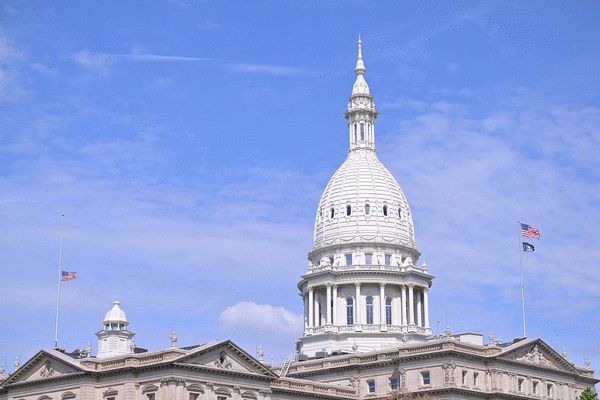
LANSING, Mich. — Michigan lawmakers from both sides of the political aisle were still waiting for details on the state's new budget Monday afternoon, a day before the deadline by which the Legislature must approve a funding plan to avoid a government shutdown.
Negotiations among Republican and Democratic leaders continued into Monday in Lansing. And some officials had begun planning for the possibility the budget bills might not be voted on until after Tuesday — the final day of the state's fiscal year — according to two sources with knowledge of the internal discussions in the Capitol.
The sources requested anonymity because they weren't authorized to speak about the planning process. But their comments pointed to the uncertainty surrounding the last-minute talks, despite an announcement Thursday evening that there was an agreement among GOP and Democratic leaders to pass a budget before Wednesday.
Lawmakers were also grappling with the idea Monday that they could be forced to vote on the new budget with little time to review billions of dollars in new appropriations in advance. State Sen. Jonathan Lindsey, R-Coldwater, acknowledged he didn't have access to the complete details about the final budget bills as of Monday afternoon.
"Things could still change," Lindsey said of the information he did have.
"I feel like at this point we should either be locked in and knowing this is what we're going to vote on or have those continued negotiations in the context of where everything sits," Lindsey added.
State Sen. Mallory McMorrow, D-Royal Oak, said legislators were attempting to cram months of work into a few days. Asked if it was the ideal way to craft a budget, she replied, "Of course not."
"This is ridiculous," McMorrow said.
McMorrow, who's part of the majority Democratic caucus in the Senate, blamed House Speaker Matt Hall, R-Richland Township, the leader of the majority GOP caucus in the House, for the delay. But McMorrow said she was confident she would ultimately have enough details to cast an informed vote.
Normally, the House and Senate each approve budget plans in the spring and then come together to adopt a compromise over the summer. The Legislature has a self-imposed budget deadline of July 1, but there's no penalty for missing it.
The repercussions don't hit until Oct. 1 each year, which comes Wednesday. That's when the new fiscal year begins, and state government operations are supposed to at least partially shut down if there's no funding approved to support them.
Amid negotiations in 2019, Democratic Gov. Gretchen Whitmer's then-Budget Director Chris Kolb told state employees that temporary layoffs would begin at 12:01 a.m. Oct. 1, 2019, without an approved budget.
"Without appropriated funds in place to begin the new fiscal year, the Michigan Constitution prohibits the expenditure of public funds," Kolb wrote in one message to state employees that year.
Whitmer's office hasn't explained this year how it will handle Wednesday if lawmakers haven't approved a budget.
House Republicans won the majority in their chamber back from Democrats in November, and Hall has said his caucus was spending time going line by line through the budget, looking for places to cut unnecessary spending. The House didn't approve its initial budget proposal until late August.
"The governor and I both understand that we shouldn’t shut down the government, and we’re working very hard," Hall said on Sept. 20. "And the government isn’t going to shut down because of House Republicans. I’ll tell you that.
"It’s going to shut down because Senate Democrats are fighting for waste, fraud and abuse.”
Michigan's current budget amounts to about $82.5 billion. House Republicans have sought to cut the budget down to $79 billion for next year.
The work to create a new spending plan has been complicated this year by cuts spurred by the federal government and the push by the Democratic governor and Hall to find billions of dollars for road projects.
On Thursday, a joint statement from Whitmer, Hall and Democratic Senate Majority Leader Winnie Brinks of Grand Rapids said the Legislature had reached an agreement to pass the annual state budget before Wednesday. And the framework of a plan to impose a new 24% wholesale tax on marijuana to create new revenue for roads advanced out of the House.
But lawmakers still have to figure out how to fund schools, local governments and state departments. Normally, the budget amounts to more than 500 pages. The ideas of the House's GOP leaders, who have been seeking spending reductions and policies against remote work by state government employees, clash with the Senate's more traditional spending plans.
The differences make it difficult to guess where the final budget proposal will land, said Rep. Carrie Rheingans, D-Ann Arbor.
"Nobody knows what's in those individual budgets," Rheingans said.
Likewise, a coalition of school organizations, including the Michigan Association of School Boards and the Michigan Association of Superintendents & Administrators, sent a letter to lawmakers Monday asking them to immediately disclose the full details of their plans to find $1.5 billion in additional money for roads. The plans include changing the way gasoline is taxed so all of the revenue from fuel purchases goes to roads.
The deal would move about $750 million collected at the pump through traditional sales tax away from the fund that traditionally supports K-12 public schools.
"At a minimum, Lansing must be transparent, end the uncertainty, and not finalize a budget in the dead of night," the school groups' letter said. "We implore you not to vote on a final School Aid budget or road funding deal until you have reviewed the entire budget and these questions are answered."
The Senate didn't approve any specific budget bills on Monday, but did sign off on a resolution involving the disclosure of grants in the budget and their sponsors — an idea Hall has championed.
A lengthy budget shutdown would be unprecedented in modern Michigan political history.
The last two years lawmakers went past Sept. 30 to approve a budget were 2007 and 2009. In those years, there were brief shutdowns in Michigan. The 2007 shutdown lasted about four hours, and the short-lived 2009 version lasted about two hours.
_____
©2025 The Detroit News. Visit detroitnews.com. Distributed by Tribune Content Agency, LLC.






Comments