Baltimore council, mayor haven't funded student absenteeism bill after promising action
Published in News & Features
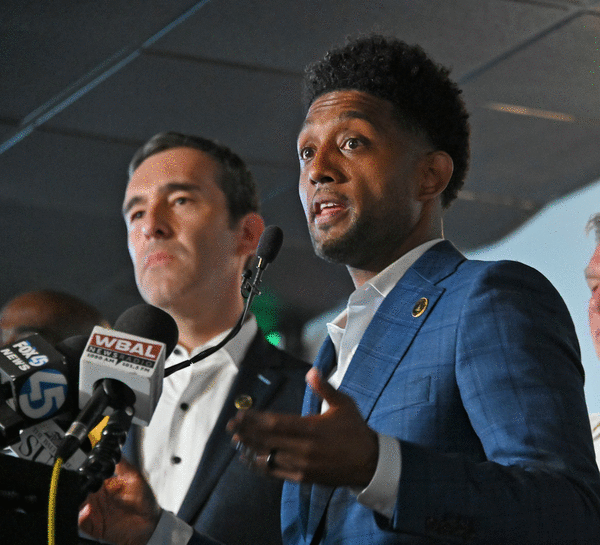
The City Council kicked off its new term in January promising to figure out why thousands of Baltimore children are frequently missing school — but nearly nine months later, a bill they almost unanimously sponsored to study the issue hasn’t been funded.
The bill’s sponsor, Council Member Mark Conway, claims Mayor Brandon Scott chose not to fund the bill as an act of “political retaliation,” after Conway criticized the mayor’s relationship with the Baltimore Children and Youth Fund earlier this year. Specifically, Conway says he is concerned about the fact that BCYF, a nonprofit organization almost exclusively funded by the city, sends much of its funding to the mayor’s office, instead of directly spending the money on youth programs.
“Nine members of the council stood together and talked about how important it was that we took every effort that we could to make sure that kids got to school,” Conway said, referring to the January news conference. “And despite that concerted effort to work together, we’re seeing every effort from the administration to thwart anything that I’ve done.”
Conway said he had met with Scott last November and told him the absenteeism study would cost $100,000 to produce, per his prior discussions with the school system. Conway said he also had explained this funding need to Council President Zeke Cohen the week before his meeting with the mayor. Cohen is listed as a co-sponsor on the bill, which the mayor signed in May.
The mayor’s office said in a statement to The Baltimore Sun on Wednesday that it “did not receive correspondence from Councilman Conway outlining a request for this funding. The Councilman should have simply asked the Mayor in person. The Councilman’s indirect and manufactured complaints are not an effective use of the Mayor’s time.”
In an email record that was forwarded to The Sun, Conway informed the City Council president’s staff of his budget priorities on Feb. 11, which included a request for $100,000 for the absenteeism study.
The Baltimore Sun emailed Cohen’s spokesperson, Tijani Harris, on Tuesday afternoon, asking for clarity about funding for the absenteeism bill and requesting a response by Wednesday at noon, and did not receive a response by that time. The Sun sent additional questions Wednesday afternoon, and Harris called The Sun around 4:45 p.m., saying he couldn’t explain why the bill wasn’t funded or when a conversation about the bill had taken place, and he needed to speak to Cohen about it. Harris asked for the story to be delayed until Thursday.
The Sun previously asked the mayor’s office in August about the lack of funding for the absenteeism study. They said there is nothing in the bill that “requires or expresses a need for the City to independently fund said study.” Conway said the mayor’s response was “not a real answer” because funding for legislation is handled separately.
The mayor’s office said in Wednesday’s statement to The Sun, “this bill did not ask the city to fund the study it requested, and despite there being systems in place to do so, Councilman Conway did not follow the necessary protocols to secure funding. It is a choice not to follow the process, and a choice to turn to the media to vent frustration, as opposed to numerous other channels for city leaders to collaborate in support of our residents. Any frustration about the lack of funding should be directed at the fact that this bill did not include any funding provisions that would ensure it could be actionable and impactful legislation, rather than simply a messaging opportunity for the sponsor.”
Conway said the mayor has created difficulties in accomplishing other initiatives over the past year, including legislation related to combating opioids. The mayor’s office has said in the past that opioid hearings would have jeopardized the city’s legal efforts related to pharmaceutical companies distributing drugs in the city.
Conway said he believes the mayor withheld funding for the absenteeism bill because Conway voted against this year’s budget, citing his concerns about BCYF.
“I’m not here to let politics get in the way of good outcomes for our students … and it is really frustrating to see wrong decisions made because of the wrong incentives,” Conway told The Sun. “The fact that we have yet to come up with a plan to support our school system and our young people to get there is totally unacceptable.”
The most recent data on student absenteeism in Baltimore shows nearly half the city’s students are missing at least 10% of enrolled days, considered to be a “chronic” level of absenteeism. The city’s absenteeism rates spiked during the COVID-19 pandemic as high as 58%, and still haven’t dropped below pre-pandemic levels.
Students miss school for a variety of reasons, including illness, unreliable public transportation, fear of violence or simply not wanting to go to school. The Council’s bill asked the school system to create a report, detailing the causes of absenteeism and offering solutions.
City Schools told The Sun it is currently waiting on funding from the Council and “cannot conduct the study without it.”
Scott launched the “mayor’s attendance challenge” in 2023, recognizing schools with positive student attendance numbers on a quarterly basis. During a virtual town hall last week, the mayor said he considers chronic absenteeism to be the school system’s most pressing issue.
-------------
©2025 The Baltimore Sun. Visit at baltimoresun.com. Distributed by Tribune Content Agency, LLC.






Comments