Dennis Anderson: Complex and beautiful birds, snow geese should be hunted -- but not piled up like vermin
Published in Outdoors
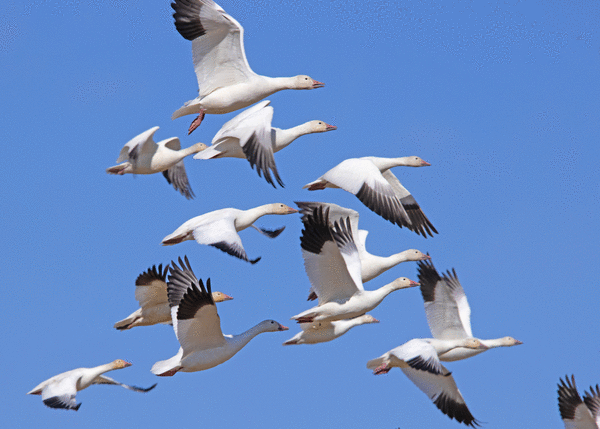
MINNEAPOLIS — One day recently, Alex Russo ambled into a field near his home in northeast South Dakota. With him were his son and two friends, who also guide for Russo at his hunting lodge, Flatland Flyways.
This was a hunt for snow geese, for which there is no limit in South Dakota in spring. Nor is there a limit in any other state for hunters who target these birds in spring en route to their nesting grounds in Arctic and sub-Arctic Canada.
Legally, Russo and the others could have shot a pickup load of snow geese and posted a hero photo of themselves and their bounty on social media.
Instead, they left the field with five birds apiece, each of which would be cleaned and eaten — not tossed into a ditch or deposited in a dump.
“The majority of the problems we have today with waterfowl hunting are tied to snow geese,” Russo said. “This idea that you can have no limits on these birds, whose population, it should be noted, is declining, is just plain wrong.”
In 1999, federal, state and Canadian waterfowl managers issued a “conservation order” governing springtime hunting of light geese, which include snow geese and Ross’s geese.
Though mid-continent light geese migrate in the Mississippi and Central flyways, they aren’t often seen in large numbers in Minnesota. Still, in the late 1990s, the birds were believed by state and federal managers to be so numerous they were depleting vegetation on their far-north nesting grounds, threatening not only their existence but that of other wildlife.
By lifting light-goose hunters’ springtime restrictions on the use of electronic calls and the number of shells their shotguns could hold, and eliminating harvest limits of these birds, U.S. waterfowl managers hoped the population of adult light geese could be right-sized with its spring and summer food sources. (Canadian prairie provinces have springtime daily limits on light geese ranging from 20 to 50 birds, but no possession limits.)
But there was a problem.
Two, actually.
One was that waterfowl managers’ premise was incorrect. Light geese were not overgrazing all of their Arctic homelands. Instead, it was later learned, when they ran out of vegetation in one location, they moved to a more abundant food source nearby.
Second was that the onset of super-sized spring light goose harvests coincided with the increased use by nearly everyone, including hunters, of social media.
The result has been a seemingly endless parade of photos and videos appearing online that depict smiling hunters with piles of dead snow geese.
Some of these hunters might think they’re performing a public service, given that waterfowl managers essentially gave them a green light to kill as many birds as possible. But the online images are considered by many observers to be disrespectful of complex and beautiful birds, and degrading to hunters and hunting.
“I’m an avid snow goose hunter, and my companions and I have the opportunity to shoot many more birds than we do,” said Bill Hohman, who grew up in White Bear Lake but now lives in Texas. Retired, Hohman was a career federal waterfowl research scientist. “Instead, we limit our harvests to the number of birds we can eat. Unfortunately, I don’t believe many springtime goose hunters are similarly restrained.”
Though state and federal waterfowl managers are now realizing their goal of fewer mid-continent light geese, hunting, ironically, isn’t the reason. Waterfowlers’ harvest rates have stayed at between 2% and 3% of adult birds since before the conservation order began in 1999.
Dropping from a peak of about 20 million birds in 2007 to about 6 million recently, the light goose population reduction has been so significant that in 2024 Texas ended its springtime hunt, the only state to do so.
“The idea that we had to kill snow geese to save snow geese, all that conversation was 100 percent false,” said Kevin Kraai, waterfowl program leader of the Texas Parks and Wildlife Department. “But unfortunately, when the hunting restrictions were loosened on light geese, an industry was built around the spring season that will be tough to stop.”
Kraai said Texas hunters generally have supported the state’s return to traditional light goose regulations, in part because the state no longer winters large numbers of the birds.
“Fewer than 5,000 light geese are killed in Texas today,” he said. “We used to harvest about 100,000.”
Many geese that once wintered in Texas now spend the cold months in mid-continent states. Temperate winter weather prevails in those states more often than it once did, perhaps attracting the birds.
“Additionally, as waste grain has become more available in agricultural fields, and as habitat conditions in Kansas, Arkansas, Illinois and Missouri have become increasingly favorable, snow geese have been drawn to those areas,” Kraai said.
Mitch Weegman, a University of Saskatchewan associate professor and the Ducks Unlimited Canada endowed chair in wetland and waterfowl conservation, is among researchers who hypothesize that frequent, extended, cold springtime rains that have fallen in recent years in the Arctic have contributed to the light goose decline.
If the rains come after goslings are hatched but before they can regulate their body heat, entire colonies of young birds can be wiped out, Weegman said.
“We’re seeing the same thing occur with Arctic nesting geese in Greenland, Norway and Russia, as these unprecedented spring rains become more frequent,” he said.
If light geese can adjust their spring migrations to arrive earlier in the Arctic than they traditionally have, they might avoid the rains’ deadly effects while benefitting from the quicker-growing vegetation the rains produce, said Weegman, who advocates continued monitoring of the springtime seasons.
Meanwhile, another threat — bird flu — awaits light geese and other waterfowl when they fly south in fall.
The disease has been so prevalent in Kansas that some afflicted geese have dropped from the sky while migrating. In South Dakota, Russo, the hunting lodge owner, said he’s seen thousands of snow geese dead or dying of avian flu.
All the more reason, he believes, to return springtime light goose hunting to traditional methods and limits.
“Ending the conservation order will benefit hunters and hunting, regardless of its effect on snow geese,” Russo said. “It’s a privilege to hunt these birds, and we’ve lost sight of that. Instead of posting photos of piles of dead geese, hunters should be posting photos of their friends and family, their dogs, a sunset — all the things that used to attract us to hunting and unify us."
Said Kraai, the Texas waterfowl manager:
“There are few things in the world that inspire pure awe at their abundancy. Do we really want snow geese to be at 2 million? What’s wrong with 10 million?”
©2026 The Minnesota Star Tribune. Visit startribune.com. Distributed by Tribune Content Agency, LLC






Comments