NOAA delay threatens 2026 sea bass, flounder rules for Maryland anglers
Published in Outdoors
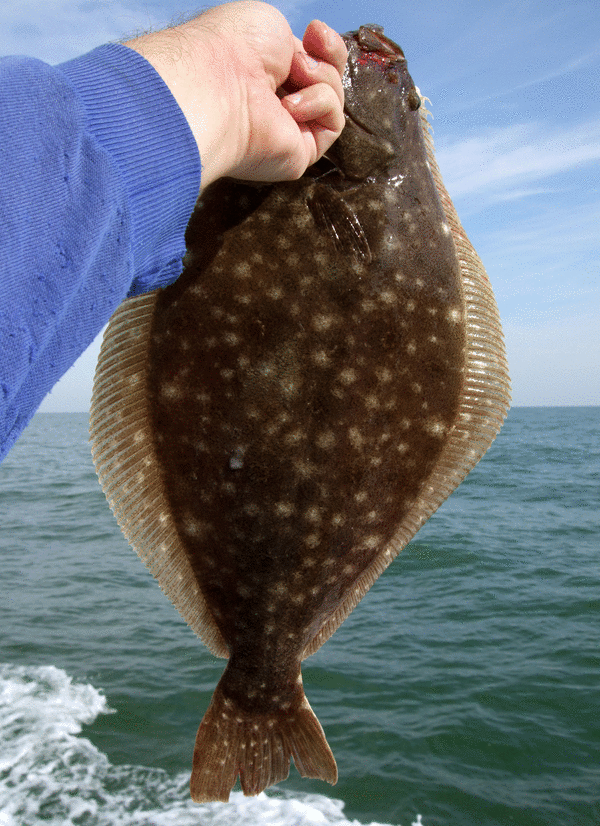
BALTIMORE — Maryland and Mid-Atlantic fisheries officials are warning that delays in updating federal recreational fishing rules could disrupt the 2026 season for black sea bass and summer flounder, threatening anglers, charter operations and coastal businesses already strained by a difficult year.
The concern follows a string of setbacks for Maryland watermen, including a collapse in the oyster market, a severe winter freeze, a major sewage spill in the Potomac River, and ongoing uncertainty surrounding rockfish regulations and blue catfish.
In letters sent last week, the Maryland Department of Natural Resources, the Mid-Atlantic Fishery Management Council, the Atlantic States Marine Fisheries Commission and U.S. Rep. Andy Harris urged the National Oceanic and Atmospheric Administration to complete rulemaking tied to recreational measures for summer flounder, scup, black sea bass and bluefish.
Officials say the delay could force anglers and charter boats to operate under older, more restrictive federal rules just as the season begins. That scenario, they argue, would create confusion between state and federal waters, eliminate expected easing of black sea bass limits, shorten fishing opportunities and undermine years of work toward more stable management.
“NOAA waited until just weeks before the season to reverse course on these proposed measures, leaving small businesses and watermen on Maryland’s Eastern Shore dealing with the fallout at a critical time,” Harris said in a statement.
At issue is the Recreational Measures Setting Process Framework, an update intended to guide how recreational fishing rules are set beginning in 2026. Maryland Natural Resources Secretary Josh Kurtz said the framework was designed to improve consistency and better account for fish stock conditions, angler preferences and uncertainty in catch data.
But in an April 15 letter, Kurtz said NOAA had yet to approve the framework, creating a disconnect between state and federal regulations. Maryland plans to implement more generous black sea bass rules in state waters, but anglers fishing in federal waters — beyond three miles offshore — could be subject to stricter coastwide limits.
Kurtz said that mismatch could result in higher size limits, reduced bag limits and the loss of more than four months of fishing opportunities for some Maryland anglers and charter operators.
“Such inconsistencies are expected to create significant confusion among recreational anglers and cause disproportionate social and economic harm to Mid-Atlantic states like Maryland, where catch is primarily concentrated in federal waters,” Kurtz wrote.
The Mid-Atlantic Fishery Management Council and ASMFC warned the delay could also erase anticipated regulatory relief, increase the risk of noncompliance and leave states scrambling just weeks before the season. Council officials said the situation is avoidable, noting NOAA could still act through interim or emergency rulemaking.
“This outcome is completely unnecessary and entirely preventable,” council officials wrote.
That uncertainty is already rippling through the for-hire fleet, where bookings hinge on predictable rules and access.
Scott Lennox, owner of the Fish in OC website and a member of the Maryland Sport Fisheries Advisory Commission, said the fallback to “non-preferred” federal rules would be a major setback.
“If this doesn’t get approved, it resorts to non-preferred coastwide measures in federal waters,” Lennox said. “The season wouldn’t start until May 15, with a 15-inch size limit and a five-fish bag limit. Charter operators would lose weeks of business and potentially most of their bookings.”
Lennox called the potential change “the worst kick in the teeth” he has seen for recreational fishermen, particularly after expectations of more lenient regulations.
“Instead of a liberalization, they’re looking at the toughest restrictions they’ve ever faced — all because of bureaucratic delays,” he said.
In a statement, a NOAA spokesperson said the agency is aware of the concerns and is reviewing the letters.
“NOAA Fisheries remains committed to sustainable and robust recreational fisheries that support American fishermen and ensure our nation’s environmental and economic resilience,” the spokesperson said. “We will respond through the appropriate channels.”
For those on the water, the stakes are immediate.
“This is shaping up to be a devastating start to the season if nothing changes,” Lennox said. “People plan these trips months in advance, and uncertainty like this hurts everyone.”
“We need clarity and consistency,” Kurtz wrote. “Without it, Maryland’s anglers and coastal economy will bear the consequences.”
©2026 Baltimore Sun. Visit baltimoresun.com. Distributed by Tribune Content Agency, LLC.






Comments