Mikaela Shiffrin's Olympic slalom triumph turns into a moment of remembrance
Published in Olympics

CORTINA D'AMPEZZO, Italy — It was a day of grief and gratitude for Mikaela Shiffrin, the most decorated skier in history.
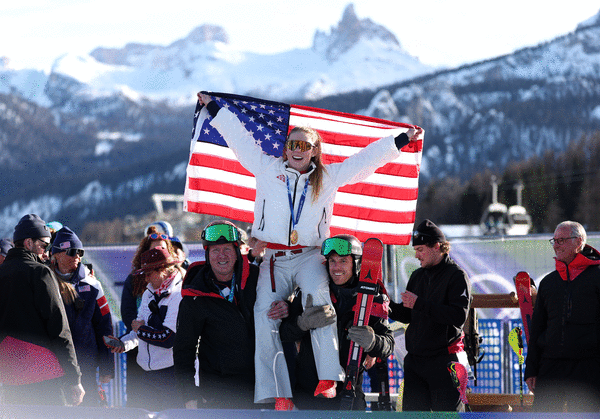
The world saw her win the women's slalom at the Milan-Cortina Games, wrap herself in an American flag, hold it high above her head and twirl in triumph.
And for good reason. Shiffrin won her first Olympic gold medal in slalom — a discipline she otherwise dominates — since she was an 18-year-old in 2014.
But it was more complicated than that for her, as she closed her eyes at the medal ceremony, took several deep breaths, then kissed her fingers and touched the podium before stepping up to the highest tier.
She was awash in thoughts about her father, Jeff, who died in 2020 after falling off the roof of the family's Colorado home. The former Dartmouth ski racer was 65 and a renowned anesthesiologist in the Vail Valley.
"[He] didn't get to see this," she said, choosing her words carefully with a trembling voice. "I mean, this was a moment I have dreamed about. I've also been very scared of this moment."
Between the morning and afternoon races — her skiing was as flawless as the pristine blue skies over the Tofane Alpine Skiing Centre — she tried to take a nap but found herself breaking down in tears.
"Everything in life that you do after you lose someone you love is like a new experience," she said. "It's like being born again. I still have so many moments when I resist this. I don't want to be in life without my dad.
"Maybe today was the first time that I could actually accept this ... like, reality. Instead of thinking I would be going in this moment without him, to take the moment to be silent with him."
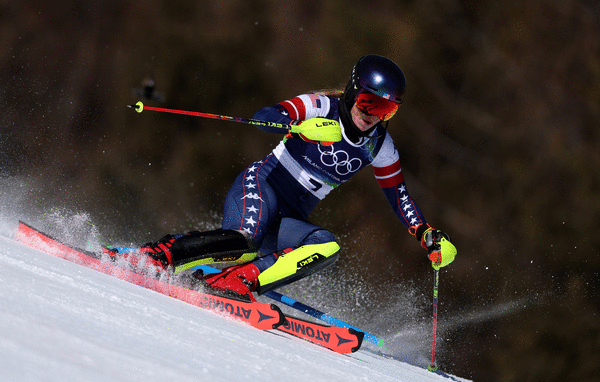
Shiffrin's combined times for the two races was 1:39.10, which was 1.5 seconds faster than that of silver medalist Camille Rast of Switzerland, an eternity in ski racing. Sweden's Anna Swenn Larsson won bronze.
"Everybody wants to ski as fast as Mikaela, and she's the fastest today again," Rast said. "Keep working, keep improving, searching for solutions, and the battle will continue."
The racers who were in second and third place after the morning session — Germany's Lena Duerr and Sweden's Cornelia Oehlund — both failed to finish the reconfigured course in the afternoon. In fact, Duerr missed the first gate.
Shiffrin called Duerr "one of my favorite competitors of all time."
"I saw Lena standing there, and I wanted to just hug her," she said. "Just say, like, 'You did everything. You've done everything.'"
That said, there was a larger lesson there about focusing on the moment and not looking too far ahead.
"I remember watching that and saying, on top of everything else that we do, we also have to remember the first gate," Shiffrin said, as if to remind herself of that. "That's actually something I think about always going out of the start. I think every single race, I think, just remember the first gate."
It was anything but a smooth start to these Olympics for Shiffrin. She had a chance to medal in the women's combined — especially after teammate Breezy Johnson won the downhill segment — but their hopes evaporated when Shiffrin finished 15th in the slalom portion. Then, on Sunday, Shiffrin finished a disappointing 11th in the giant slalom. And keep in mind, she has won 108 World Cup races, more than anyone in history.
Through it all, though, she remained steady and sanguine. Everyone was watching to see how she would respond to going 0 for 6 on podiums at the Olympics four years ago.
The whispers got louder. Had the stage gotten too big for her? Was the Beijing fiasco still haunting her? Considering how dominant she has been on the World Cup tour, winning seven of eight slalom races this season, her flat performances in Cortina had people scratching their heads.
Not that Shiffrin was distracted by the chatter. She took pains to block out the noise.
"I knew after the team combined that there would be some stories out there that would be really frustrating to look at, because it's just not the reality of the sport," she said after becoming the first U.S. skier to win three Olympic gold medals. "It's such a different perspective when you're watching it and not totally understanding all of the demands that go into it."
Some of that has come from the media, she said, and some from "the keyboard warriors." She spoke without a hint of resentment in her voice. The moment was truly bittersweet for her — and there was a lot of sweetness to that. She and her mother, Eileen, were locked in a long embrace when Shiffrin secured the gold — the third of her career and sixth medal overall.
Her mom's reaction?
"I think she said, 'Wow,'" Shiffrin said, trying to recall the dizzying moments in the glow of victory. "You know, my mom and I have kind of a language of our own, and sometimes it's just the hug, actually, very similar to Sochi [in 2014]. You just get that moment to actually embrace."
Technically speaking, there were 63 turns on the Tofane course.
For Shiffrin, the dozen years between slalom golds have been even more serpentine than that. Wednesday, with her eyes closed tight, she quietly celebrated a finish line.
____
©2026 Los Angeles Times. Visit latimes.com. Distributed by Tribune Content Agency, LLC.





Comments