Chip Scoggins: These Vikings rookies are chasing NFL jobs after bigger college paydays
Published in Football
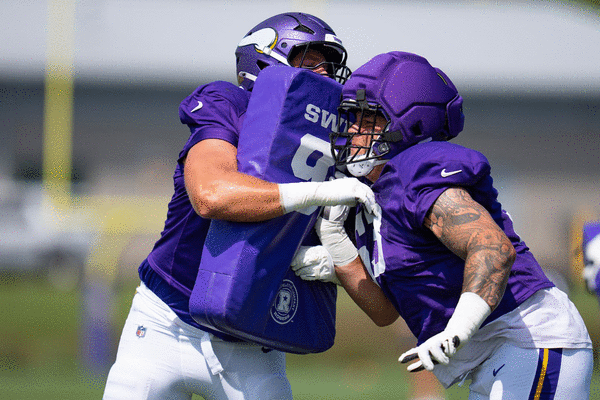
MINNEAPOLIS — Higher education is rooted in the mission to provide advanced learning, but let’s be honest: the ultimate objective in attending college is to get a job and make money as a professional.
That first job earning a salary after spending years eating toast for lunch and dinner as a broke college student feels like winning the lottery.
Unless that student is a high-level college football player. In that case, the move from college to pros could involve a pay cut.
“I made way more in college than what my signing bonus was,” said Dillon Bell, the Minnesota Vikings undrafted rookie receiver from Georgia who received a $25,000 signing bonus as part of his total guarantee of $272,500.
He’s not an outlier.
Fellow undrafted rookies Tyreek Chappell and Tristan Leigh said they also made more money in their final season of college than they received in guarantees after signing with the Vikings. There are undoubtedly dozens of players with similar stories across the NFL.
None of the Vikings rookies are complaining. It’s just the reality of going undrafted. It’s also another sign that college football has become a lucrative business for players.
“Everybody’s starting point is different,” said Leigh, an offensive lineman from Clemson. “I was just grateful for an opportunity here.”
This NFL rookie class arrived with more money in their bank accounts and more financial literacy than any previous one. They are the first group of college players to receive payments from both name, image and likeness deals and the House v. NCAA settlement, which allowed schools to share revenue with athletes. Colleges could distribute up to $20.5 million to athletes last school year, with the cap increasing to $21.3 million this year.
Athletic departments typically don’t share publicly how they divide their revenue-sharing dollars among teams. However, an educated theory is that Power Four conference schools earmark 75% of the cap for football.
That money plus individual NIL deals thrust college football players into a new financial realm.
ESPN recently unveiled a position-by-position cost analysis after surveying team executives and agents in college football. A sampling of what they learned:
At the Power Four level, the average deal for a starting quarterback is more than $2 million.
The price for a receiver typically ranges from $400,000 to $1 million.
Offensive tackle: $600,000 to $1.2 million.
Edge rushers: $500,000 to $1.2 million.
Cornerbacks: $400,000 to $900,000.
“In college, guys are just spending money because a lot of guys never really had it growing up,” said rookie safety Jakobe Thomas, a third-round draft pick. “NIL teaches you the value of a dollar.”
The transition from college to the NFL used to require a crash course on finances. Players suddenly had money to spend.
Yes, college players receiving bags of cash under the table from wealthy boosters is a tale as old as time, but payments are legal now. They’re more widespread and come with higher prices. Top-tier college football programs are funding payrolls of $40-plus million this season.
“We used to say [at Clemson], ‘Try to be a pro before you’re a pro,’” Leigh said.
Translation: Spend wisely.
Bell started an LLC at Georgia after studying finance. His compensation package included an NIL deal with a national fast-food chain.
“A lot of stuff I spend my money on is dealing with football,” he said. “Football is my business. I do a lot of purchases for football. Treatment and all that [training].”
The House settlement created a gold rush, a situation that probably is both exhilarating and scary. The rookies agreed that understanding taxes was the main hurdle they had to overcome.
“The hardest part for me was, I don’t like paying people to manage my money,” Thomas said. “Learning my own finances and how to manage it, I just gave up on it and hired a financial advisor. I tried to do my taxes. It wasn’t good.”
Many college programs now offer life-skills programs that provide financial resources and education. Leigh also sought advice about managing money from former Clemson players who are in the NFL.
“You get exposed to that world and get exposed to the business side of football before you are in the NFL and a professional,” Leigh said. “It’s good to have some of those baby steps you have to go through and learn things like taxes.”
Chappell, a cornerback from Texas A&M, said his mom guided him on financial matters.
“If you have the right people in your corner,” he said, “you should be good.”
Undrafted rookies face an uphill climb to make NFL rosters. They can’t allow themselves to get sidetracked by thoughts of a massive payday. Thomas’ advice to college players flush with cash is to proceed with a similar mindset.
“Don’t lose sight of what the big vision actually is,” he said. “Just because you made a couple hundred grand, that’s not life-changing money. It will change you for six, seven months. Then five years from now, you’ll be like, ‘Well dang.’”
____
©2026 The Minnesota Star Tribune. Visit startribune.com. Distributed by Tribune Content Agency, LLC






Comments