Greg Cote: New Dolphins coach Jeff Hafley aims to bring culture shock to Miami
Published in Football
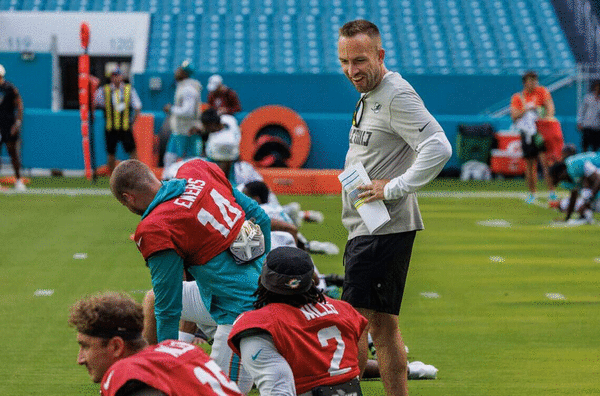
MIAMI — Failure is bad enough. To fail and be mocked adds a special layer of hurt.
The Miami Dolphins’ NFL-worst 25-year streak of having not won a playoff game is a scarlet letter the franchise bears. Less quantifiable but just as true in broad perception is the team’s reputation for a lack of physicality — for being soft. In a violent, macho sport where the combatants wear armor and understand that traumatic brain injury is a job risk, there is not a lot worse than being seen as “soft.”
Jeff Hafley is here to fix both aspects of what this once-proud franchise has become.
The new head coach is here to win a playoff game, eventually, though likely not in this first season of a major rebuild. First and more fundamentally, he is here to toughen up the Dolphins, to flip this team’s reputation and narrative — to infuse a culture shock. Not a lot of men who are first-year NFL head coaches at age 47 have taken on a greater challenge.
As if on cue, for certain we saw tougher, more physical Dolphins in a joint-practice with the Giants on Wednesday as the two teams brawled, but that was dumb-tough, not the kind wanted by Hafley, who called himself “very, very disappointed” by both teams. Smart-tough with discipline is the goal, not the kind of cartoon he-man bravado that gets you kicked out of games.
I enjoyed a long 1-on-1 interview with Hafley recently at training camp, and the chat was affable and light ... until the topic turned to the outside view that the Dolphins, his team now, lacks toughness. The new coach is not an imposing figure at 5-10, partly why his own playing career as a wide receiver didn’t last past Siena University in New York. But bring up the sore subject, and his eyes narrow, the jaw squares. Suddenly he looks like he could be a retired UFC middleweight.
“Let’s be honest. Right, wrong or indifferent, there’s this outside perception that we’re a soft football team — and that eats at my core at everything I believe in about this game,” he says, almost angrily. “This has been a hard, grimy, gritty, physical training camp for a reason. The toughness ... can that continue? One thing I’m going to demand of these coaches is that their players better play harder than the guy across from them. If they don’t that’s not OK with me. If our guys are not playing hard and physical or are not disciplined, I want them taken out of the game. There has to be a new mind-set here. Presnap and postsnap penalties — there is no room for them. It’s selfish and disrespectful.”
For fun I googled, “What NFL team has a reputation for being the most soft?” The Dolphins were the first listed. Reasons cited included criticism for “lacking physical toughness in the trenches, particularly during late-season or outdoor cold-weather games.”
It didn’t help that the Dolphins’ previous coach, Mike McDaniel, had the appearance and demeanor of a jocular pharmacist, while the previous quarterback, Tua Tagovailoa, was prone to concussions and fumbles and, on the rare occasions he scrambled, it was like watching a porcelain vase running on two legs. Fans held their collective breath.
Former Dolphins safety DeShon Elliott once called his ex-team “soft as [bleep]” and called the players not mentally tough. Former All-Pro cornerback Asante Samuel Sr. accused Miami and its leadership of being “sensitive, spineless and soft.” Maybe there are axes to grind there. But it is hard denying that’s the broad reputation burdening the Dolphins, and just as hard to deny that a quarter-century without a playoff win only encourages such a label.
Dolphins defensive tackle Zach Sieler said he does not agree his team is soft, but adds, “If people think that, I guess we’ve got to prove it wrong.”
Sieler, running back De’Von Achane, linebacker Jordyn Brooks and center Aaron Brewer are among the relative few veteran “core pieces” kept. And Miami’s only real offseason spending in free agency was for quarterback Malik Willis, who Hafley says “has a chance to prove everybody wrong and be an everyday starter.”
After the massive roster reboot, Hafley’s Dolphins are the youngest team in the NFL entering the 2026 season with a roster of players averaging 25.2 years old. About three-quarters of the 53-man roster will be guys on one-year contacts, many at near NFL minimum wage, a league record.
That means a good share if not most current players were not alive when the Fins last won a playoff game on Dec. 30, 2000. Many Dolfans as well have literally grown up with this playoff wins drought the norm — raised by losing. (In all major American sports leagues, the only longer current drought is by MLB’s Cincinnati Reds, who have not won a playoff series since 1995.)
It is a jarringly long drone of mediocrity for the franchise of Don Shula and Dan Marino, the franchise of back-to-back Super Bowl wins in 1972-73 including the Perfect Season led by the bull runs of Larry Csonka, the antithesis of “soft.”
The Fins’ youth and roster turnover are among reasons Miami’s 350-1 betting odds to win the Super Bowl (per DraftKings) makes it the second-biggest long shot after Arizona. And the wins over/under of 4 1/2 is tied for lowest.
But these same reasons give Hafley closer to a clean slate with which to build a new culture of toughness. Big chunks of what defined “soft” in the past have been replaced by new and hungry players, many of them engaged in position battles all over the field.
“We’ve infused this thing with a lot of young players. I’m excited about the energy, the physicality, the enthusiasm. It’s gonna be a fun group to watch,” Hafley says. “A lot of guys will be fighting for their lives. Which of those guys are going to resurrect their careers and change their lives? Some coaches might look at this job and go, ‘Holy moly.’ But I’m excited. I want to build a foundation. We’ve practiced hard. Camp has been hard. We want to get over that hump and be what everybody’s been waiting for. It’s not gonna happen overnight. It might be hard early. But what we’re building is gonna be real and it’s gonna sustain. Everyone wants instant gratification and immediate results. But we’re gonna get there.”
The team’s 0-2 start in the preseason underlines it won’t happen overnight; all fans can do is trust that “We’re gonna get there.”
In 2000 then-head coach Dave Wannstedt would lead what turned out to be the last playoff victory in Dolphins history.
In 2001, up the East coast, a kid barely out of his teens would begin a long and winding coaching career. Jeff Hafley was then the new running backs coach at Division III Worcester (Mass.) Polytechnic Institute. The Engineers played in a 2,000-seat stadium. The team’s mascot was “Gompei the Goat.”
“Woostah,” Hafley says with a small smile — the way New Englanders pronounce Worcester.
Wannstedt would resign from the Dolphins in 2004, become head coach at the University of Pittsburgh the next year, and soon after meet and hire one Jeff Hafley, first as a part-time assistant and then as defensive backs coach — his first big break in the profession. They would work five years together, and form a lasting bond. In fact Wannstedt was a guest at a Dolphins practice recently.
“A mentor, friend, father figure — all of the above,” Hafley says of Wannstedt.
Now, Hafley must prove to be the Fins’ best head coach hire since Wannstedt; well, unless you count the Nick Saban drive-by in 2005-06 before Alabama called. Post-Saban, a string of Dolphins misfire hires — Cam Cameron, Tony Sparano, Joe Philbin, Adam Gase, Brian Flores and McDaniel — all failed to end the playoff-win drought. (Didn’t help the Fins spun wheels a combined 13 seasons with high-draft QBs who ultimately didn’t pan out in Ryan Tannehill and Tagovailoa.).
Hafley’s only previous head coach job was at Boston College in 2020-23, but he was happy to leave BC and become the Green Bay Packers’ defensive coordinator for two years before joining Miami. He admits he was not ready to be Boston College’s head man, or ready for the changing demands on the college side of the sport.
“At BC there were a lot of mistakes. How to hire a staff, how to treat a staff. I was in charge of so much, and I wasn’t ready for that. I learned a lot,” he says. “Being a major-college head coach you have more hats to wear than anybody can have any idea about. I don’t know how you have time to be a football coach. That’s why I left. Right now, talking to you, my phone would have already rung twice and I‘d be talking to recruits or a donor or an agent or to a kid on my team who was having a problem with their girlfriend or wanted to transfer. I always wanted to be a college head coach. But it became a different job. I walked away.”
This is college coaching: On Hafley’s wedding day, minutes before the ceremony started, he was on the phone getting the latest update on a prized defensive lineman he was recruiting.
“She knows who I am and how I was wired,” Hafley says now of wife Gina. “But my brother that day was, like, ‘Dude, you better put your phone down, this thing [the wedding] is about to kick off’!”
Appreciate the honesty when Hafley volunteers, of being a rookie NFL head coach: “Am I entirely ready for this job? No. Nobody ever is. You’re gonna get better every year.”
Hafley chose Miami among a half dozen inquiring teams with job openings mostly because Miami had just hired new general manager Jon-Eric Sullivan, also from Green Bay. Sullivan wanted Hafley; the feeling was mutual. Hafley coached 49ers defensive backs from 2016 to 2018 and while there saw what for him is the model, same-page GM/coach dynamic in John Lynch and Kyle Shanahan.
“One of the big reasons I wanted this job was the relationship with Sully,” Hafley says. “It’s very hard in this profession if the GM and head coach aren’t on the same page. One guy pulling in this direction, one guy in the other. It can be adversarial, and that doesn’t work. It can become a survivor thing. Who’s gonna survive, the GM or the head coach? I wanted to do it with someone I was aligned with. And it’s even better when you come in at the same time.”
Hafley is blunt on his coaching style.
“I don’t wanna be friends with these guys, not necessarily even with the staff,” he says. “I have a job to do. I wanna be respected. Look ‘em in the eye and tell ‘em the truth. Whether they like me and think I’m their friend, I don’t care. I’m here to get them better, bring out the best, hold them accountable, and push them.”
Just as he ‘s not looking for a Mr. Popularity sash from players, he isn’t with fans, either. That showed the night of his first NFL draft with the Fins this past spring. He knows very well the easy, popular pick for Miami, locally, would have been to select Miami Hurricanes defensive tackle Reuben Bain Jr. — not Alabama offensive tackle (now guard) Kadyn Proctor.
“I would have maybe a few years ago,” Hafley admits, of making the popular pick. “In key moments when making key decisions, the popular choice and winning the press conference feels good for a week, but then things get real. The best decision for our team was taking Proctor. We were in lockstep that whole draft.”
The Dolphins face a brutally tough schedule this year starting Sept. 13, second hardest in the league. Miami is presently favored in only one of 17 games (home vs. the Jets) according to early betting odds.
I told Hafley that his mentor, Wannstedt, used to have lobster crates put on the walls of the Dolphins locker room to warn players against a “trap game” when Miami was heavily favored.
“At Pitt he’d put mousetraps in all the lockers,” recalled Hafley, adding with a small smile, “Not sure how many trap games we’ll have this year.”
Everybody loves an underdog, right? Dolfans have one right now for sure. Then again, this franchise has sort of been that for the past couple of decades.
Even amid the losing, though, now there will be hope to be found, to be mined like hidden gold. Hope in a complete reboot long overdue. In a team too young to know it isn’t supposed to be any good. In a quarterback out to show the doubters who he really is. In a changed culture bent on physicality — and taking a hard fist to “soft.”
And in a new head coach who feels like the Dolphins’ best hire in a long, long while.
____
©2026 Miami Herald. Visit miamiherald.com. Distributed by Tribune Content Agency, LLC.






Comments