Bears say they will proceed with plans for a stadium in Hammond, Ind.
Published in Football
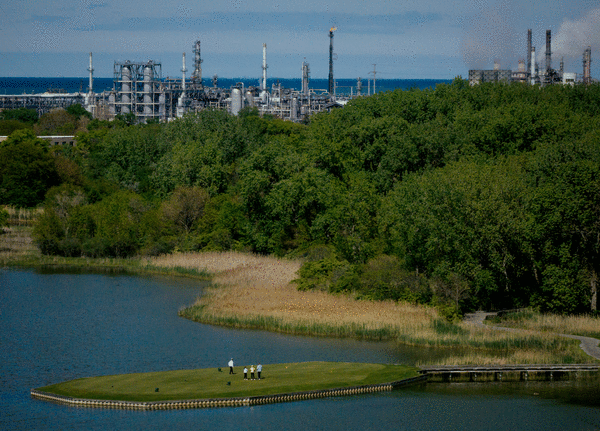
CHICAGO — The Chicago Bears will proceed with plans for a new stadium in Hammond, Ind., the organization announced Friday.
“Yesterday, the Chicago Bears Board of Directors met and voted to advance our stadium development project in Hammond, Indiana, with the exact site to be selected,” the team said in a joint statement from Chairman George H. McCaskey and President and CEO Kevin Warren. “We believe a world-class stadium project in Hammond will transform the region, connecting Northwest Indiana to the South Side of Chicago through the Loop and across neighborhoods and suburbs stretching north of the city. It will bring Chicagoland together and deliver new opportunities to its residents and businesses.”
The board’s decision comes less than a week after the Illinois legislature adjourned, without taking up a last-ditch Senate bill that would have allowed Arlington Heights or Chicago to enter into a public-private ownership deal with the NFL franchise. Such legislation would have given the team a path to build a new stadium without paying property taxes on the facility, bill sponsors said.
Gov. JB Pritzker’s office on Friday criticized the Bears’ behavior in recent negotiations.
“The Bears have built a storied legacy in Illinois for over 100 years but have spent the last six years, and especially the last few months, shifting their position on a stadium location. That has hindered their progress,” Pritzker spokesperson Matt Hill said, homing in on the time period at the end of the General Assembly’s legislative session. “Today appears to be another instance of that after Illinois leaders have been working with the Bears in good faith.”
Both Illinois lawmakers who fronted Bears legislation in the House and Senate said they spoke to Warren Friday and that the Bears’ chief executive clearly still kept the door open to talking with Illinois leaders about stadium issues.
State Sen. Bill Cunningham, a Chicago Democrat who led the Senate in stadium negotiations with the Bears, said in a text to the Chicago Tribune that Warren called him to give him a heads up that the team was going to release a statement about moving forward with Hammond, but that he also “looks forward to continuing discussions with me.”
Cunningham also argued that the statement the Bears put out on Friday was “not fundamentally different” than the one the team released on Feb. 19 when the Indiana legislature passed its bill to aid the team in its potential move to Hammond.
Democratic state Rep. Kam Buckner of Chicago, whose district covers Soldier Field, said Warren also called him earlier Friday and also committed “to continue discussions around their pursuit of a new stadium in Illinois.”
“After reading the statement, it’s worth noting that it is actually less definitive than the one the Bears issued earlier this year,” Buckner, who is also the lead negotiator on Bears stadium discussion in the House, said about the team’s February statement.
“In February, the Bears specifically referenced conducting due diligence on a site near Wolf Lake in Hammond, signaling that they had identified a particular location they were evaluating,” Buckner said. “Today’s statement, by contrast, says only that the project would be in Hammond, with the exact site still to be selected.”
“That’s not a criticism,” Buckner continued. “It’s simply an acknowledgment that the Bears’ own language leaves additional flexibility and does not represent a final decision.”
Still, the Illinois General Assembly’s failure earlier this week to take up the last-minute Seante legislation, which several House lawmakers said was due to a lack of time to study the proposal, immediately raised questions about the fate of the Bears’ future home stadium. The team has an offer from Indiana to construct a taxpayer-financed stadium and surrounding mixed-use entertainment district in Hammond, near Wolf Lake, 20 miles southeast of Chicago.
The Indiana state legislature approved a bill earlier this year that created a framework for the Bears to build a stadium in which the team will invest over $2 billion in constructing the stadium and the state promises to invest $1 billion through various taxes.
Gov. Mike Braun — who signed the bill into law within an hour of its final approval — will handle the remaining business with the Bears and the team’s proposal for Hammond, officials previously said. Braun issued a statement Friday welcoming the team.
“Hoosiers, help me welcome the Chicago Bears to our great state!” the governor said. “We look forward to building a partnership as strong as the ’85 Bears defense, creating opportunities and economic growth that will benefit our state and the Bears organization for decades to come. An NFL franchise in Northwest Indiana will be an economic boost to the entire region like we haven’t seen before.”
In a phone interview following the announcement, Indiana state Rep. Earl Harris Jr., a Democrat from East Chicago, said he could not fully express his joy over the news.
“What this means for the area, what this means for the state as a whole, is extremely exciting,” Harris said.
Harris’ father, Earl Harris Sr., worked to bring the Bears to northwest Indiana during his time in the legislature.
“This is something that was a vision of my father’s in the '90s,” he said. “To see it come to fruition now means so much to me as his son and so much to me as a representative in northwest Indiana.”
Harris said officials are still hammering out next steps with the team.
“Obviously, we will have to finalize the timeline with the Bears, … like when ground will be broken and when things will start moving in terms of Hammond,” he said. “So the announcement is great, but that’s only part of the process. There’ll be more work to come down the line.”
Chicago Mayor Brandon Johnson’s office released a statement downplaying the news on Friday, emphasizing that team officials have said an out-of-state move is not a certainty.
“Over the last several years the Bears have stated their intentions in multiple jurisdictions, today’s announcement is not surprising,” the statement read. “It’s also not surprising that Bears officials have stated this vote does not mean a move to Hammond is a done deal. Without a final site selection, until we see shovels in the ground in Hammond, the City will continue to engage in discussions grounded in the interests of our residents.”
Johnson evaded questions Friday afternoon from reporters who tried to talk to him about the Bears situation at an event at the Chicago Cultural Center honoring the city’s Puerto Rican community.
The team’s announcement, however, could signal the closing lap of a Chicago Bears stadium saga that began in September 2021, when the franchise put in a bid to purchase the former Arlington International Racecourse, a 326-acre property in the northwest suburb of Arlington Heights that had been home to horse racing for generations. That move signaled the team’s first serious step toward leaving Soldier Field, where the Bears have played since 1971 and which underwent a major renovation in 2003.
The team closed on the $197.2 million purchase of the Arlington Park land in February 2023, with the sprawling property that straddles the border of Arlington Heights and Rolling Meadows being seen as having potential for a mixed-use development featuring a domed stadium, hotels, retail space, housing and entertainment venues.
But almost immediately after the purchase closed, the suburban stadium plan became the subject of a property tax dispute in which Cook County officials assessed the land based on the sale price rather than the valuation the previous owner, Churchill Downs, had been taxed on.
While negotiations over property taxes among the Bears, the village of Arlington Heights, and three local school districts — Township High School District 214, High School District 211, and Elementary School District 15 — dragged through 2023 and into 2024, the team in April 2024, one day before the NFL draft, unveiled a dramatic pivot: a $4.7 billion proposal to build a publicly owned, domed stadium on Chicago’s lakefront, just south of Soldier Field.
The plan called for the team to contribute roughly $2.3 billion, while seeking approximately $900 million in public financing through the Illinois Sports Facilities Authority and another $1.5 billion in taxpayer-funded infrastructure improvements around the site.
Johnson stood shoulder to shoulder with Bears President and CEO Kevin Warren at the lakefront stadium announcement, embracing the proposal and declaring Chicago the best home for the franchise. But Gov. JB Pritzker and Democratic legislative leaders were notably absent from the event, and Pritzker quickly described the plan as a nonstarter in Springfield.
The Chicago deal never moved forward in the state Capitol and was quickly shelved as talks progressed between the team and the local government bodies regarding the Arlington Heights site. Then another rival site entered the picture — Indiana.
In late 2025, the Bears expressed interest in moving to Hammond, about 20 miles south of downtown Chicago, as Hammond Mayor Thomas McDermott Jr. proposed building a domed stadium near Wolf Lake, which straddles the Indiana-Illinois border, and described a planned entertainment district — hotels, restaurants and other amenities — as a virtual city-within-a-city he called “Bearsville.”
Indiana lawmakers moved swiftly to make their pitch concrete. Braun, the Republican Indiana governor, championed legislation that established the Northwest Indiana Stadium Authority and authorized the state to commit roughly $1 billion in public funding toward a potential Bears project. The money would be raised through an admissions tax, a new professional sports development district capturing retail, food and beverage taxes near the stadium, and a toll hike on the Indiana Toll Road. The Bears would retain all revenue generated by the dome and could eventually purchase it for one dollar once the 40-year bonds are paid off by taxpayers.
At that time, the Bears responded enthusiastically to Indiana’s gambit. When the Indiana House Ways and Means Committee voted 24-0 in February to advance the legislation, the team issued a statement calling the development “the most meaningful step forward in our stadium planning efforts to date,” and expressing a “vision” to build near Wolf Lake, though questions almost immediately arose about whether the site was feasible.
Still, the move did generate action in Springfield, spurring Illinois lawmakers to advance their own legislative response during the recently concluded spring session.
In late April, the Illinois House passed a so-called megaprojects bill to allow the Bears to enter into special payments in lieu of taxes, or PILOT, agreements with local governments. The House legislation called for allowing large-scale developers, such as the Bears, to freeze their property tax assessments for 25 to 45 years in exchange for the PILOT payments. The Bears were also seeking some $855 million in infrastructure funding.
Unlike Indiana’s package, the Illinois bill did not fund direct stadium construction but did aim to provide the Bears with the financial certainty they said was essential to moving forward at Arlington Park.
While the governor and lawmakers repeatedly insisted the megaprojects proposal wasn’t being put forward solely to benefit the Bears, team officials and lobbyists were in regular communication with top Pritzker administration officials and key legislators throughout the spring session, weighing in on some of the most intricate details of the plan, records the Tribune obtained show.
The House bill also included provisions allowing half of PILOT payments to flow back as property tax relief for homeowners in the surrounding taxing districts and across the state.
But serious problems with the House bill quickly arose. The Bears didn’t fully embrace it, and other lawmakers didn’t either. Lawmakers said they were trying to balance the team’s concerns with public pushback against giving away benefits to a multibillion-dollar sports franchise.
At least one watchdog group expressed concerns that the legislation could poke more holes into the property tax base in the service of very large developers across the state, beyond just the Bears. The legislation then sat in the Senate for several weeks amid concerns about whether its property tax relief provisions would be workable.
As Illinois senators worked on a compromise bill, another wrench got tossed into the works. In early May, Johnson visited Springfield and, seemingly out of nowhere, raised the prospect of resurrecting the lakefront stadium plan and saying Chicago’s 2024 plan never got a fair hearing in the state capitol. Later, Cunningham, the Illinois state senator leading Bears talks in the chamber, said negotiations were slow-going because Johnson’s comments got Chicago-based lawmakers dragging their feet on the Senate compromise bill.
Eventually, the lack of action in the Senate on the House bill resulted in the Senate’s last-minute compromise proposal that didn’t get voted on by the House as time at the end of session ran out.
The vote by the Bears’ board will likely be unpopular with Chicago residents. In a recent poll conducted by Suffolk University in Boston published by the Tribune, 56% of respondents said they would rather see the team move to Arlington Heights, compared with 10% who would prefer Indiana. Another 26% said they didn’t care either way.
———
Chicago Tribune reporters Jeremy Gorner, Olivia Olander and Jake Sheridan contributed.
©2026 Chicago Tribune. Visit chicagotribune.com. Distributed by Tribune Content Agency, LLC.






Comments