Gerry Dulac: Only time will tell the success -- or failure -- of this Steelers draft class
Published in Football
PITTSBURGH — In the post-NFL draft era, the mania of predicting which players will be drafted by what teams has been replaced by the ungovernable excessiveness of evaluating how well teams drafted which players.
Both can be profitless exercises in futility.
The success or failure of the Steelers’ most recent draft, which got off to a bit of an embarrassing start, cannot be accurately gauged. That, as every impatient evaluator should know, will take time.
As an example, recall how hope abounded in 2022 when three of their first four picks — Kenny Pickett, George Pickens and Calvin Austin III — trumpeted the future of the post-Ben Roethlisberger era. Draft grades of A+ were handed out as though it were a first-grade art class.
Four years later, none of the seven picks remain. Pickett has been shipped around so much he should have a FedEx tracking number.
That being said, there is no reason not to evaluate the highs and lows of the Steelers’ three-day activity, done under the judgmental eye of a draft-record crowd of 805,000 on the North Shore — keeping in mind that to do so provides no more accuracy at this premature stage than the groundhog seeing his shadow.
The barometer of any draft usually hinges on the success of the No. 1 pick, an area where the Steelers once hit home runs. Not so much anymore.
Since T.J. Watt was drafted in 2017, the next five No. 1 picks — Terrell Edmunds, Devin Bush, Chase Claypool, Najee Harris and Pickett — never hung around long enough for a second contract. (Claypool was their top pick in 2020, though it was in the second round.) Since 2013, only Watt and Ryan Shazier (2014) were No. 1 picks who made the Pro Bowl.
Armed with five of the top 99 picks last week, the Steelers had a chance to make a considerable splash in the draft. But they failed to use their draft capital to make a move in the first round, though they thought they might have a dance partner at No. 15 with the Tampa Bay Buccaneers. But when the Buccaneers stayed put to draft edge rusher Rueben Bain Jr. and the Philadelphia Eagles gave up two fourth-round picks to the Dallas Cowboys to move ahead of the Steelers, they lost the player they were willing to trade up to get — receiver Makai Lemon.
And they might have compounded their disappointment when the New York Jets gave up a second- and seventh-round selection to move back into the first round to take Indiana’s Omar Cooper Jr., another receiver the Steelers really liked, at No. 30. Worse, the Steelers had even more draft capital than the Jets to make the same move and didn’t — or couldn’t.
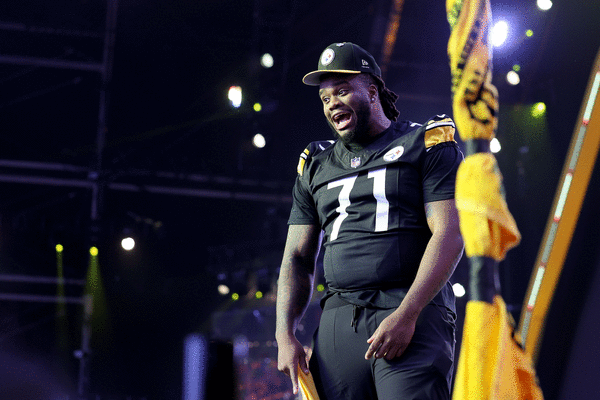
That’s why what they did in the second round — moving up six spots to draft Alabama receiver Germie Bernard — could be a huge factor in determining the draft’s success. If Bernard can be the type of No. 3 receiver the Steelers envisioned with Lemon, that makes the first-round selection of tackle Max Iheanachor even more acceptable. The murmured reaction of 305,000 people on the North Shore to Iheanachor’s selection would suggest it was not a popular way for the Steelers’ draft to begin.
But that’s now, maybe not later.
The other key to the success of the draft is receiver/return specialist Kaden Wetjen, their fourth-round pick. Over the past three years, the Steelers have managed to find Nick Herbig, Mason McCormick and Jack Sawyer in the fourth round. Those picks helped to solidify those draft classes.
Wetjen would appear to be a luxury, if not a reach. He is a punt and kick returner with seven touchdown returns at Iowa. He is also something of a gadget player who runs jet sweeps and reverses. Is that deserving of a fourth-round pick?
Perhaps not. But Wetjen is another piece for Mike McCarthy’s offensive puzzle, an elusive receiver who can be an asset for a crafty play caller such as McCarthy. The Steelers don’t have that type of player. Maybe they do now.
As for Drew Allar, it is impossible to assess the merit of using a third-round pick on the former Penn State quarterback. The Steelers — McCarthy in particular — did not draft him with the sole idea he will be a solid NFL backup. Rather, they are taking a chance he might — might — become their future starter. He certainly has the size and throwing arm for the role, but then, so did another Nittany Lions quarterback, Christian Hackenberg. It is the proverbial roll of the dice.
Actually, the sleeper in the draft could be tight end-turned-fullback Riley Nowakowski, their fifth-round pick. Because of McCarthy’s desire to use a fullback, Nowakowski could end up being the rookie who sees the most playing time. Nonetheless, the Steelers’ failure to draft a pass-catching or in-line tight end was curious, considering they only have two after the departures of Jonnu Smith and Connor Heyward.
The expression that can accurately be used for nearly every question ever asked in the universe — “time will tell” — was probably invented for NFL draft evaluators.
To not exercise such caution with the Steelers’ draft haul would bring new meaning to the term “waste management.”
© 2026 the Pittsburgh Post-Gazette. Visit www.post-gazette.com. Distributed by Tribune Content Agency, LLC.






Comments