Vahe Gregorian: How 2026 NFL draft reflects shift in both Chiefs' stature and strategy
Published in Football
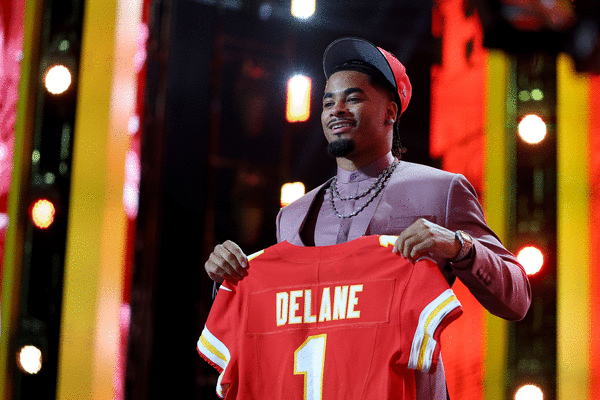
KANSAS CITY, Mo. — No doubt the Kansas City Chiefs entered the 2026 NFL draft with a concealed but zealous focus: applying their best-perched pick since 2013 to LSU cornerback Mansoor Delane, whom they valued enough to trade up from the No. 9 slot to sixth overall.
But they hadn’t exactly envisioned deploying their first four selections, including three in the top 40, on defensive players.
“I don’t think so,” assistant general manager Mike Bradway said Saturday. “I think it’s just how it fell.”
Summed up another way, vice-president of player personnel Ryne Nutt called that “a perfect marriage, so to speak” even as he considered the oddity of how it unfolded.
“This was a weird year,” he said with a smile Monday. “This was a weird draft.”
Weird in the sense that in a few instances “some surprise picks” by others allowed the Chiefs to take players they hadn’t anticipated would remain available per the elaborate draft-board matrix that guides them.
So the Chiefs essentially adhered to the time-honored prime directive of taking the best player available.
Which was a worthy catch-all with so many needs after a shocking 6-11 season followed five Super Bowl berths in the previous six seasons.
Given that the Chiefs didn’t select a seemingly-vital new target for Patrick Mahomes until they made Cyrus Allen the 25th receiver in the draft with the 176th pick overall, the seven-man class in the moment reverberates less as glamorous than as prudent and practical.
As a friend put it the other day, sometimes you just have to eat your vegetables when it comes to that draft.
Not to say you’d make a whole meal of that.
And that takes us to the broader point here: What might be called the meat and potatoes and how the Chiefs envision this all complementing each other even as they will keep maneuvering.
Because there’s an important overarching context to this.
One that reflects a subtle but notable shift in both their stature and approach.
As much as the Chiefs dutifully followed their board, that doesn’t preclude those choices being informed, or at least influenced by, a certain philosophical guiding light as well as pure data.
Nothing is done by rote in such a sophisticated operation, after all, and the results reflect at least some elements of emphasis.
One would be what my colleague Sam McDowell alertly recognized on Thursday night, when the Chiefs used their other first-round pick to choose Clemson defensive tackle Peter Woods at No. 29 overall.
Simply put, signing running back Kenneth Walker III — the Super Bowl MVP for the Seahawks — heralds a reboot of the offense to feature more balance and physicality ... and perhaps less of a crucial call to deploy key resources on another receiver at this stage.
Not to mention alleviate some pressure on Mahomes, in more ways than one, when he comes back from season-ending knee surgery.
No doubt some such dramatic change is in order after the offense finished 15th, 15th and 21st in scoring the last three years.
That’s by no means complete or solved.
But it connects to another reason that on Thursday night coach Andy Reid said “as much as I love the offense” he thought “it was important that we address the defense.”
It was something nuanced that you could appreciate in the subtext of what general manager Brett Veach said that night as he spoke of selecting Woods where the Chiefs did.
“You guys have seen it across the league: Just the depth of defensive line is so important,” he said, citing last season’s Super Bowl participants as examples. “You look at obviously what Seattle did and New England and those teams. I mean they just have a plethora of defensive linemen across the board.”
Also alluding to the offseason addition of 335-pound former Patriot Khyiris Tonga on the D-line, Veach went on to talk about Woods’ strength and power and even ability to pass rush at 300-pounds plus.
Then he spoke about “that old blueprint” of developing the interior lines on the way to stockpiling defensively — especially after losing three defensive backfield starters.
The idea, of course, is to be much more rugged and dynamic defensively.
To not get “stuck on the field” so often on third downs, as Nutt put it, and be more equipped to generate pass rushes without blitzing.
That was an area the Chiefs not only lacked in last year but that also was such a strength in the last two Super Bowl winners — including very much at the Chiefs expense in their 40-22 dismantling by the Philadelphia Eagles in Super Bowl LIX.
All of which are signs of how much the Chiefs seem to understand their need to evolve after so long being the ones to chase or copy.
It was a long time coming, really, after years of sustaining the absurdly unsustainable in a league entirely predicated on creating parity.
Now, though, any phase two to that dynasty seems to hinge on their ability to execute this adaptation.
Something they seem to be pursuing in earnest through the offseason and a draft that at once was “weird” but illuminating.
____
©2026 The Kansas City Star. Visit kansascity.com. Distributed by Tribune Content Agency, LLC.




Comments