Adam Minter: The NFL draft should never be a reason to close schools
Published in Football
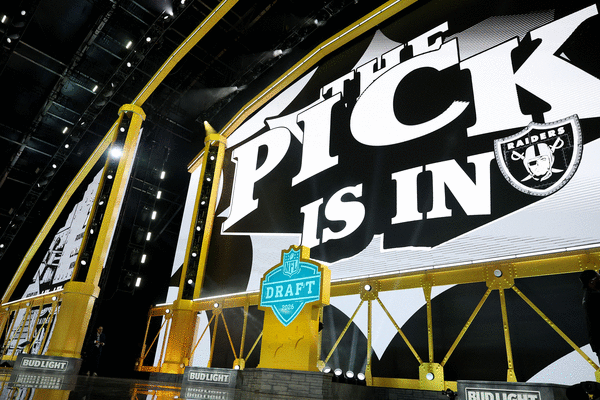
For three days this past week, Pittsburgh closed public school classrooms to make way for the National Football League draft.
School buses and carpools gave way to gridlock, fans and security perimeters, pushing students into remote learning. This is becoming routine. Green Bay shuttered classrooms for the 2025 draft; in 2023, Kansas City followed the same playbook.(1)
These disruptions aren’t just a side effect of the NFL draft experience; in the league’s own telling, they’re part of the fun. “An entire community is going to stop and, for those three days, they’re going to focus on football,” said Jon Barker, the league’s global head of major events production, in a recent NBC News interview. “Closing public schools has just become part of what [the] draft is these days.”
That’s quite the PR spin, considering that the event pushes costs — from shuttered schools to diverted police — onto host cities. What’s billed as a celebration is a stealth tax on the residents who live there.
Of course, that’s not how it’s sold. In Pittsburgh, like other host cities, civic boosters and public officials promote it as a municipal marketing bonanza that brings visitors, spending and attention.
There’s no doubt the draft draws crowds and money. The NFL says 600,000 people — nearly six times the city’s population — attended the 2025 draft in Green Bay.
Those kinds of attention-grabbing figures fuel other cities’ bids and the stirring projections that often accompany them. VisitPittsburgh, the region's tourism authority, projected 500,000 to 700,000 visitors and $120 million to $213 million in economic impact. But those are marketing estimates, not figures that can be independently verified. (VisitPittsburgh did not respond to questions about how the figures were calculated.)
The attendance projections aren’t only unverifiable but likely inflated. NFL Commissioner Roger Goodell claimed 320,000 people attended the draft on Thursday night, a figure that helps build toward the projected 500,000 to 700,000 attendees over three days. But these numbers can be misleading. As recently as last year’s draft, the NFL counted attendees using cameras at entry gates, rather than scanning tickets. A fan who enters more than once is counted each time, and accounting for those repeat entries is, in the words of Barker, “tricky.” (2)
Independent research tells an even more modest story. Economist E. Frank Stephenson of Berry College analyzed hotel occupancy data for drafts since 2015 and found most attendees don’t stay overnight. Many are locals or day-trippers whose spending is redirected from other nearby restaurants or retailers, not new money. Stephenson concludes that the increase in hotel rooms rented during the draft is just a “small fraction” of the claimed attendance and that the economic bonuses for the host city are far smaller than advertised.
Meanwhile, the costs get even less scrutiny. The NFL picks up some expenses (it doesn’t disclose how much), but the public picks up a share too. State, county and city governments along with VisitPittsburgh (funded in part by hotel taxes) contributed at least $18.9 million, according to local news site Pittsburgh’s Public Source.
Those expenses might be worth it if the sales taxes generated by the visitors covered the outlays. But Pittsburgh City Controller Rachael Heisler recently told TribLive, a regional news site for Western Pennsylvania, that the event isn’t expected to fill that gap in her jurisdiction. “The reality is the draft is going to be a financial expense for the city,” she concluded. “It’s a drain on resources.”
Then there are the indirect losses. What economic cost does Pittsburgh suffer when parents stay home because they don’t have childcare options during the draft? What are the financial impacts on retailers and restaurants that are shut out by road closures and security perimeters? What local priorities are police delaying while they train for the draft?
These factors are real for the families and communities that feel them — but they don’t fall on the NFL.
It’s the same dynamic that has defined the publicly financed stadium debate for decades, repackaged as a traveling football circus. The NFL brings the glitz; the public later gets the tab.
Cities have grown wiser to these tradeoffs, and even the world’s most profitable sports league now faces greater resistance when it and its teams seek public subsidies. While the NFL draft is smaller and cheaper than a stadium, it deserves the same skepticism.
Fortunately, there’s an easy solution: stop traveling.
For decades the NFL draft was held in New York City. It doesn’t need to return there, but it should have a permanent home. It could be another city, or perhaps even a purpose-built draft campus (partnered with the Hall of Fame in Canton, Ohio?).
The NFL won’t go willingly. The traveling draft helps the league attract sponsorships, engage local fanbases and generate novelty for a large television audience.
But a permanent site has its own advantages. Just ask the National Basketball Association. It has held its NBA draft at the Barclays Center in Brooklyn, not far from NBA headquarters, since 2013. Among other benefits, the fixed site gives the event a consistent look and feel and provides easy access to global media interested in covering the event.
Were the NFL to do the same, it could gain control over a venue and enable the development of traditions around it. Most important, it could avoid another subsidy fight.
A celebration that depends on shifting costs onto everyone else isn’t much of a celebration at all. It’s time for the NFL to pick up the tab.
———
(1) Detroit maintained normal, in-school operations when it hosted the 2024 draft.
(2) True, someone who comes back for a second or third day will still have a greater economic impact than someone who only goes once, but that doesn’t change the fact that the headline number counts visits, not unique people.
———
This column reflects the personal views of the author and does not necessarily reflect the opinion of the editorial board or Bloomberg LP and its owners.
Adam Minter is a Bloomberg Opinion columnist covering the business of sports. He is the author, most recently, of “Secondhand: Travels in the New Global Garage Sale."
©2026 Bloomberg L.P. Visit bloomberg.com/opinion. Distributed by Tribune Content Agency, LLC.






Comments