2026 NFL draft Big Board: Eddie Brown's top 100 prospects as free agency reshapes team needs
Published in Football
Let’s start with the part that will make positional-value purists reach for the emergency alarm: my top four prospects in the 2026 NFL draft all play non-premium positions.
A running back. A linebacker. A safety. A guard. I’m not sorry, because sometimes the cleanest tape, the clearest impact and the safest projection do not come wrapped in quarterback logic or edge-rusher inflation.
I’ve submitted my top 100 to The Huddle Report for four straight years and rank in the top 20 for accuracy over that span.
I know Analytics Twitter will likely treat this like a tax audit. The dude who owns a “Never Draft a Running Back Early” mug will likely scream blasphemy.
The truth is value matters, but so does being undeniably good.
In this update
— Jeremiyah Love remains No. 1
— Sonny Styles, Arvell Reese and Kenyon Sadiq validated elite traits at the combine
— Free agency and trade fallout are reshaping positional urgency
— This class is deeper than it is top-heavy
— Offensive line, defensive line, defensive back and wide receiver remain the strength of the board
Offseason shuffle
Free agency is in full swing, trades are flying, depth charts are getting flipped, and draft needs are changing by the hour.
One minute you’re mapping a first-round tackle run, the next the Vikings are taking a low-risk swing on Kyler Murray.
The Raiders-Ravens deal for Maxx Crosby was the rare blockbuster that somehow became a boomerang after Baltimore backed out with medical concerns.
That’s the backdrop for this board. March roster-building is the draft’s silent narrator.
A team that just paid a premium for a veteran corner is suddenly less desperate at that position. A surprise edge signing can push tackles up the board. A whiffed trade can create a “we need help now” urgency that forces a club to draft for need even when it swears it won’t.
A work in progress
This is my first attempt at ranking the top 100 prospects in the 2026 NFL draft after previously ranking the top 50 after the college football regular season and right before the NFL scouting combine.
Let’s be honest: the pecking order is still written in pencil, and the eraser is getting a workout. I had to whittle this list down from 135 players.
I’m still in the process of gathering intel, and pro days will add another data point (and another round of “Wow, that 40 looked fast on my phone” discourse). I could care less about the staged workouts at this point. I’m primarily interested in measurements and health checks.
At this point, though, this is how I view the upper portion of the talent pool: the top-end doesn’t hit like some recent classes, but the middle of this board has teeth. The kind that keeps GMs from panic-trading their future on the clock.
The offensive line, defensive line (including edge rushers), defensive backfield and wide receiver groups are the strongest position clusters, with enough starter-caliber options to last deep into Day 2 if a team remains patient (and if the owner doesn’t treat Thursday night like it’s a personal stress test).
How I build this board
— Tape over hype
— Measurements and medicals matter more than workout theater
— Rankings are based on player quality, projection and pro translation
My updated 2026 NFL draft Big Board (Top 100)
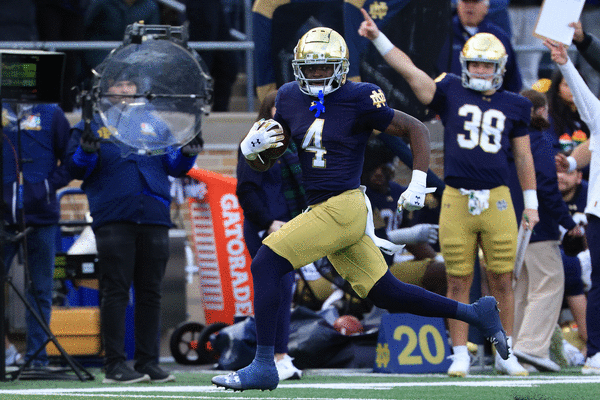
1. Jeremiyah Love, RB, Notre Dame, Jr.
Love is a patient, balanced runner with true “tilt-the-defense” juice: he presses the hole, makes one cut and can turn routine carries into explosives. When he gets daylight, the play can be over before the safety finishes his bad decision. He’s built for volume (6-foot, 214 pounds) and versatility with three-down traits (vision, finish, receiving upside). The only real debate is how much an NFL team is willing to pay for a difference-making back early.
2. Sonny Styles, LB, Ohio State, Sr.
Styles delivered one of the most outrageous athletic profiles scouts have seen in years at the Combine. At 6-foot-5 and 244 pounds, he ran a 4.46-second 40-yard dash with a 1.56 split, then posted a 43 1/2-inch vertical and an 11-foot-2 broad jump. In other words: edge rusher size, linebacker tenacity, safety explosiveness and the kind of testing numbers that make defensive coordinators develop overactive imaginations.
3. Caleb Downs, S, Ohio State, Jr.
Downs plays like he’s on the headset with the coordinator. He’s a glue-piece safety who raises a defense’s floor immediately. He was the heart and soul of a Buckeyes defense that led the nation in points (9.3) and yards allowed (219.1) per game, and he finished ninth in the Heisman voting. Downs plays fast, thinks faster, and hits like he’s trying to invoice the ballcarrier. Combine week brought public rumor mill chaos about his knee; reporting also noted his family and some insiders pushed back hard on it as misinformation. Either way, teams will do their own due diligence.
4. Olaivavega Ioane, G, Penn State, Jr.
Ioane was one of the few bright spots for the Nittany Lions last season, earning second-team AP All-American recognition. He’s a phone-booth mauler who wins with raw power, leverage and heavy hands. He’s the kind of interior presence that changes your run game personality, while featuring impressive movement skills for a man his size (6-4, 330).
5. Arvell Reese, LB, Ohio State, Jr.
The 6-foot-4, 243-pound uber-athletic Reese is a modern defensive problem-solver: long, explosive, versatile, and productive enough to justify the hype. He is a trigger-and-hit linebacker with real downhill violence and range when he reads it right. He’ll be loved in aggressive fronts that let him attack, and his long-term value hinges on coverage discipline and block-shedding consistency. The questions are about polish and role definition, not talent.
6. Rueben Bain Jr., Edge, Miami, Jr.
The 6-foot-3, 275-pound Bain wins with power, leverage, technique and a mean streak that shows up snap after snap. He is a power-first edge who compresses pockets with force and plays the run like it’s personal. The lack of ideal length is real, and it will scare off some teams. But the résumé, disruption, and polish are also real.
7. Fernando Mendoza, QB, Indiana, Jr.
Mendoza wins with size, command, accuracy, red-zone efficiency and grown-man composure. The questions are real — middle-of-field volume, under-center experience, and whether his game has enough improv juice when structure collapses — but the résumé is too strong to shrug off.
8. David Bailey, Edge, Texas Tech, Sr.
Bailey tied for first in the FBS with 14 1/2 sacks, and was second with 19 1/2 tackles for loss. He is a get-off merchant who stresses tackles immediately and can live in the backfield when he wins early. The selling point is simple: he gets to quarterbacks, and he does it a lot. The questions are early-down sturdiness and whether he develops a deeper rush plan when speed alone isn’t enough.
9. Carnell Tate, WR, Ohio State, Jr.
Tate showed immense growth in his technical skills last season, especially his route running, which transformed him from a vertical threat to a more complete receiver who can threaten a defense at all three levels. He is polished and professional: clean routes, strong hands and consistent body control on money downs. His official 4.53 40 created noise because some evaluators reportedly had him faster on handheld timing, but the only official number is the official number. Tate’s tape says he is fast enough. He’s a week-to-week separator who should translate as a high-volume NFL target.
10. Francis Mauigoa, T, Miami, Jr.
Mauigoa, a former five-star recruit, is big (6-6, 335) and powerful with an attitude that shows up on every finish. There are scouts who believe he’d be even better on the interior, but he’s talented enough to stay at tackle. Mauigoa anchored one of the nation’s better offensive lines in his final year with the Hurricanes and put together the kind of pass-protection season that gets line coaches misty-eyed. Speed and counter rushers will test his feet and timing, but the baseline traits scream long-term starter, whether he stays at tackle or eventually slides inside.
11. Mansoor Delane, CB, LSU, Sr.
Delane doesn’t have elite size (5-11, 187) or deep speed, but he’s sticky, instinctual and can play multiple positions in the secondary. He wasn’t a one-year wonder who came out of nowhere in Baton Rouge. He played real football early at Virginia Tech, then upgraded competition and still looked like a Sunday player in the SEC.
12. Spencer Fano, T, Utah, Jr.
Fano is a technician with calm feet and consistent hands. He rarely panics, and rarely loses cleanly. His ceiling debate comes down to length/anchor vs. NFL power, but his floor is high because the pass-pro foundation is real. Whether he sticks at tackle or eventually slides inside may depend on the team.
13. Makai Lemon, WR, USC, Jr.
Lemon is a sudden separator built for the slot: quick wins, quick acceleration, quick YAC. He’s a motion-and-space weapon more than a boundary bully, and his NFL value will come from how creatively a staff manufactures touches. Lemon already wins like a pro. He varies tempo, understands leverage, and wastes very little movement in and out of breaks. He’s explosive, but he isn’t just going to run by everybody.
14. Kenyon Sadiq, TE, Oregon, Jr.
A 4.39 40 at 241 pounds is cartoon stuff for the position, and the jump numbers only reinforce it. Sadiq is a legitimate field-stretcher who can line up attached, in the slot, split out wide, or in the backfield, which gives play-callers real flexibility. Plus, he has legit upside as a run-blocker in the pros. The questions are about size, hands consistency, and whether his production always matched the traits.
15. Dillon Thieneman, S, Oregon, Jr.
Thieneman is a do-it-all safety with verified NFL athleticism, real ball production and enough versatility to be a coordinator’s favorite toy. The only real question is where you want him living — deep, down or in motion. The answer is usually: yes.
16. Monroe Freeling, T, Georgia, Jr.
Freeling features rare lateral movement skills for a tackle his size (6-7, 315). His combine numbers were elite enough to produce a near-perfect 9.99 Relative Athletic Score. He needs polish, but Freeling is a classic traits-plus-SEC-production tackle prospect: long, explosive, and athletic enough to make coaches believe they can unlock something big.
17. Kadyn Proctor, T, Alabama, Jr.
Proctor is a mountain with real upside: when he’s square and engaged, he swallows defenders. The NFL will test his conditioning and lateral quickness, but the raw size/power profile gives him a starter’s runway. It’s nearly impossible to find 360-pound athletes who are as powerful, explosive and surprisingly agile as he is (he was No. 2 on Bruce Feldman’s “Freaks List" in 2025).
18. Jordyn Tyson, WR, Arizona State, Jr.
Tyson has developed into a route-technician and has the ability to make plays at all three levels. He has vertical juice, real ball skills and the kind of alignment flexibility NFL offenses covet. Because he did not test at the Combine and because injury history is already part of the profile, team doctors are going to have a louder voice than usual in his final grade.
19. Jermod McCoy, CB, Tennessee, Jr.
McCoy earned first-team All-SEC recognition in 2024 with four interceptions for the Vols after transferring from Oregon State before tearing his ACL during an offseason training session last January. His tape showed elite ball skills with fluid athleticism and explosive closing speed. If the medicals check out and the movement looks right at his pro day (March 31), McCoy’s the type of talent who usually goes in the top half of the first round.
20. T.J. Parker, Edge, Clemson, Jr.
Parker’s bull rush is devastating and he’s already a solid run defender. While last season didn’t live up to an eye-popping sophomore year where he had 11 sacks and six forced fumbles, his size (6-3 1/2, 263), advanced pass-rush repertoire, and ability to convert speed to power places him firmly in the first-round discussion.
21. Denzel Boston, WR, Washington, Jr.
Boston (6-3, 212) is a big-bodied, strong-handed, red-zone-friendly outside receiver with real production and better route nuance than a lot of receivers built like him. He wins downfield and in contested situations with strong tracking. The NFL question is separation consistency on intermediate routes, but the boundary/red-zone role is obvious.
22. Jacob Rodriguez, LB, Texas Tech, Sr.
Rodriguez is chaos with shoulder pads. The Butkus Award winner authored one of the wildest stat lines you’ll ever see from a linebacker last season: 128 tackles, 11 tackles for loss, seven forced fumbles, four interceptions, two fumble recoveries, a sack and six pass breakups in 14 games. He will be a 24-year-old rookie, but Rodriguez is a turnover-hunting, highly instinctive enforcer with monster production, elite 2025 PFF grades and he answered all big athletic questions at the combine.
23. Peter Woods, DT, Clemson, Jr.
Woods is a power interior who can dent protections and change run fits with heavy hands. He needs a more diversified pass-rush plan to unlock his full potential, but he already possesses a premium combination of strength and athleticism for his size (6-2, 298) — he was No. 5 on Bruce Feldman’s 2025 “Freaks List” — and has flashed disruptive capabilities. Consistency snap-to-snap is the key, but the traits say he can be a pocket-collapsing presence in an NFL rotation.
24. Keldric Faulk, Edge, Auburn, Jr.
Faulk looks like an NFL edge rusher the second he steps off the bus. He is long, explosive and built like the type of prospect a team usually chases in Round 2. He flashes high-end tools, and his draft slot will hinge on whether he shows a repeatable rush plan and scouts believe he can consistently finish. If an NFL D-Line coach can turn his flashes into a consistent counter-based plan, he’s the kind of edge who quietly wrecks protections without needing 15 sacks to prove it.
25. Avieon Terrell, CB, Clemson, Jr.
Terrell is a much better run defender than his brother A.J. — former first-round pick of the Falcons — despite being a bit undersized (5-10 3/4, 186). He wins with instincts and competitiveness — sticky in space, disruptive at the catch point — and he’s mastered the “Peanut Punch” with eight forced fumbles the last two seasons. He also had three sacks last year.
26. Caleb Lomu, T, Utah, So.
Lomu is a high-upside left tackle prospect with real athleticism, clean pass-protection production, and the kind of awareness coaches can work with. The concerns are strength, polish and whether his current body can consistently hold up against NFL power and speed.
27. KC Concepcion, WR, Texas A&M, Jr.
Concepcion was named the winner of the 2025 Paul Hornung Award. The award honors the most versatile player in the country. The NC State transfer finished the season with 12 total touchdowns, and became the first A&M player in the modern era to score via reception, rush and punt return in the same year. He’s a space creator, but he’ll need help versus physical press. Still, as a slot weapon/return threat he brings immediate value.
28. Akheem Mesidor, Edge, Miami, Sr.
Mesidor had 9 1/2 sacks in two years at West Virginia before joining the Hurricanes in 2022. He’s an older prospect (he turns 25 in April), but he’s been highly productive for two different programs, including 12 1/2 sacks and 17 1/2 tackles for loss last season. Mesidor is a productive, polished, hard-nosed edge rusher whose tape is built on actual pass-rush craft instead of empty athletic fantasy.
29. Chris Johnson, CB, San Diego State, Sr.
Johnson is a smooth, instinctive outside corner who pairs sticky coverage with real ball production. He wins with patience, press ability, and enough athletic juice to erase mistakes. When a corner dominates his conference, makes All-America teams, then rips off a 4.40 in Indianapolis, NFL teams tend to pay attention.
30. Omar Cooper Jr., WR, Indiana, Jr.
Cooper is the kind of receiver who keeps turning “nice complementary target” into “why is he open again?” He’s not built on gimmicks. He’s built on route detail, strength through contact, and finishing plays in the red zone — the exact stuff NFL staffs trust when the playbook shrinks on third down.
31. Colton Hood, CB, Tennessee, So.
After transferring from Colorado, Hood helped the Volunteers fill the void created by the absence of Jermod McCoy, earning second-team All-SEC recognition. He’s a fiery, aggressive press corner who features the size (6-0, 193), speed and physicality to make plays in a man-heavy scheme.
32. Emmanuel McNeil-Warren, S, Toledo, Sr.
McNeil-Warren is an explosive, rangy defender with sound tackling technique, and a violent finisher. He features exceptional length and size (6-3, 201) for the safety position, and has an undeniable nose for the football. He produced five interceptions and nine forced fumbles in four years with the Rockets. He may have to throttle down his aggressiveness a bit in the pros, especially against dynamic running backs. If a team is comfortable with his deep-range ceiling, he goes early. If not, he’s still the kind of Day 2 safety who starts fast because he’s built for modern sub-packages.
33. Caleb Banks, DT, Florida, Sr.
Banks looks like a prototype at 6-foot-6, 327 pounds with 35-inch arms, and he backed up the frame at the combine with a 5.05-second 40 and 32-inch vertical. That is rare movement for a man built like a loading dock, especially considering he reportedly did it on a broken foot he suffered the night before. Banks underwent surgery, and is expected to be cleared in time to participate in training camp with his future NFL team. Still, the break marks his third foot injury and second surgery in the last year. Banks is a classic projection-versus-production debate wrapped in a premium NFL body. The concerns are durability, consistency, and whether the disruption turns into enough finishing. The ceiling is obvious.
34. Cashius Howell, Edge, Texas A&M, Sr.
Howell is an explosive, productive, high-energy edge rusher who wins with burst, hands, counters and pure bad intentions. He produced 9 1/2 sacks and 10 1/2 tackles for loss in his final season at Bowling Green before joining the Aggies in 2024. After making the leap from the MAC to the SEC, he earned the conference’s Defensive Player of the Year with 11 1/2 sacks last season (tied for seventh in the FBS) and 14 tackles for loss. Howell’s short arms will absolutely scare some teams off, but the résumé says pressure, the tape says pressure, and the honors say everybody who watched him came away convinced.
35. Blake Miller, T, Clemson, Sr.
Miller is the rare four-year ironman tackle prospect who checks the NFL’s favorite boxes in permanent marker: size, length, anchor, awareness, durability — and good enough feet to survive on an island. He’s been the Tigers’ right tackle forever, and he plays like a guy who’s seen every stunt, every twist, every disguised pressure a coordinator can cook up. Miller may not be elite athletically, but he’s the type who sticks because he’s rarely the weak link.
36. Kayden McDonald, DT, Ohio State, Jr.
McDonald is a stout run defender who can hold the point and keep your linebackers clean. He was a game-wrecker for one of the best defenses in the country, earning consensus All-American honors. Anchored by the 6-2, 326-pound devourer of double-teams, Ohio State’s run defense was seventh in rushing yards allowed per game (89.36) and tied for seventh in yards allowed per carry (2.94). If you need someone to stop teams from living in second-and-4, he’s your guy.
37. Christen Miller, DT, Georgia, Jr.
The 6-foot-4, 321-pound Miller sheds blocks with ease. He unloads brute force upon an offensive line, and at very least will free up other defenders to make plays. Miller will be an impactful run defender on day one, but you don’t have to be high on ayahuasca to envision him eventually becoming a disruptive pass-rusher in the pros despite only producing four sacks in three seasons with the Bulldogs.
38. Gabe Jacas, Edge, Illinois, Sr.
Jacas has a masters in leverage. He’s ruggedly strong and wins with effort and brute physicality. He may not be a bendy sack artist, but he’s a dependable edge-setter whose strength and motor allow him to collapse the pocket.
39. C.J. Allen, LB, Georgia, Jr.
Allen is a rangy, modern linebacker who can run and cover enough to stay on the field in nickel. He’ll need to keep improving taking on blocks, but the speed and pursuit profile translate. He’s rugged, high-IQ and SEC-proven. The résumé says starter and the tape says tone-setter. Allen will eventually wear the green dot.
40. D’Angelo Ponds, CB, Indiana, Jr.
Ponds is small (5-9, 170), but he plays bigger with the tenacity of an old-school middle linebacker. He was a standout during the playoffs, helping lead the Hoosiers to a 16-0 season and the program’s first National Championship. He earned Defensive MVP honors in both the Rose Bowl and Peach Bowl. Ponds is rarely out of position in zone or man coverage, and features elite instincts and awareness. He has quick feet and ball skills. Size will dictate usage, but he can be a high-impact nickel/zone-match defender.
41. Dani Dennis-Sutton, Edge, Penn State, Sr.
Dennis-Sutton is a classic edge export from the Nittany Lions: big, long, violent hands and a built-in motor. He looks like a base end (6-6, 256), plays like a power rusher, and tested like a guy who can actually survive in space when the NFL asks him to do more than just squeeze the C-gap.
42. Anthony Hill Jr., LB, Texas, Jr.
Do you know how talented you have to be to step in as a starter on an SEC defense as a freshman? Hill is a rare athlete at linebacker with true range and matchup value. He can be a modern defensive weapon. His biggest growth area is controlled aggression — playing fast without playing reckless.
43. Jadarian Price, RB, Notre Dame, Jr.
Price is the classic “if he weren’t sharing a backfield, he’d be a household name” prospect. He is a pro-style runner with pro-style habits: patient, balanced, efficient, and fast enough to punish angles. He’s still developing as a receiver, and in pass protection, but there’s three-down potential here — and the combine made sure teams didn’t have an athletic excuse to ignore him. Price will contribute immediately on special teams as an impact kick returner. He was the first player in the storied history of the Irish with multiple 100-yard kickoff return TDs in a single season.
44. Eli Stowers, TE, Vanderbilt, Sr.
Stowers’ background as a quarterback shows in his route awareness and understanding of defensive coverage. The Commodores frequently used last year’s John Mackey Award-winner detached from the formation, where he worked seams and intermediate routes. Stowers is a modern NFL tight end: matchup-driven, explosive and production-proven. His performance at the combine likely added helium to his draft stock — a 4.51 40 paired with a tight end vertical jump record (45 1/2 inches). You’re drafting him to create stress — not to be your sixth offensive lineman. If you use him like a weapon, he’ll play like one.
45. Germie Bernard, WR, Alabama, Sr.
Bernard is the type of receiver NFL staffs love because he’s already usable in multiple roles: outside, slot, motion, even occasional backfield touches. He’s not a pure burner — he wins with timing, leverage and yards-after-contact attitude.
46. Chris Brazzell II, WR, Tennessee, Jr.
Brazzell has the frame, the vertical chops and the 2025 breakout production to be drafted as a real outside weapon. If the releases and the full-route polish catch up to the size/speed combo, watch out. He plays with a smooth, fluid style that allows him to separate consistently in intermediate areas of the field. The Vols frequently targeted him on deep crossers and vertical routes, where his stride length and ball tracking stood out. He must improve his ability to handle physical press coverage.
47. Ty Simpson, QB, Alabama, Jr.
Simpson only has 15 collegiate starts to go off of, but the small sample size shows he is a poised, accurate, mechanically clean QB who wins with processing, rhythm and pocket control more than raw star-power traits. However, the list of QBs taken in the first round with fewer than 20 collegiate starts in the past decade is uninspiring to say the least: Trey Lance (17), Mac Jones (17), Kyler Murray (17), Dwayne Haskins (14), Anthony Richardson (13) and Mitchell Trubisky (13). He’s a high-variance bet with a realistic starter path if the game slows down.
48. Keith Abney II, CB, Arizona State, Jr.
Abney is a former high school wide receiver with elite ball skills. There’s size limitations (5-10, 187) against large “X” receivers, but he’s an excellent processor in zone and sticky in man.
49. Emmanuel Pregnon, G, Oregon, Sr.
Pregnon is a previously unranked recruit who played for the Wyoming Cowboys (2020-2022) and USC Trojans (2023-2024) before joining the Ducks. The two-time All-Big Ten honoree hasn’t allowed a sack in three seasons, and only allowed two hurries last year. He’s also a “people mover” in the run game, using his size (6-4, 314) and heavy hands to uproot defenders.
50. Kyle Louis, LB, Pittsburgh, Jr.
Louis brings the athletic profile teams want at linebacker. He’s a space eraser who plays fast, closes faster and has enough blitz juice to show up on third down. His range shows up chasing runs to the perimeter, and he’s comfortable tackling in space — an increasingly valuable trait in today’s league. He can be late disengaging from blocks when climbing linemen get to him cleanly, and that will be tested heavily in the NFL.
51. Chris Bell, WR, Louisville, Sr.
Bell is a vertical receiver with tracking ability and explosive-play upside. He is a playmaker with size (6-2, 220), elite ball skills and the ability to morph into a pinball after the catch. He reminds me of Eagles’ All-Pro receiver A.J. Brown. Bell suffered a torn ACL in the Cardinals’ 38-6 loss at SMU on Nov. 22. He earned All-ACC first team honors after finishing the season with 72 receptions for 917 yards and six TDs. Reports are that the tear is believed to be clean, which could help in his recovery. Despite the injury, I’d be mildly surprised if he makes it out of the second round.
52. Keionte Scott, CB, Miami, Sr.
Scott is a nickel defender with edge-rusher wiring — the rare defensive back who can cover the slot, blitz like a linebacker and flip a game with one mistake throw. He’s built for modern defenses: positionless, aggressive and disruptive. He is the kind of “five-tool” secondary piece coordinators use to keep quarterbacks guessing. Before joining the Hurricanes last season, Scott spent three years at Auburn, where he led the SEC in punt return average (14.8) in 2023.
53. Antonio Williams, WR, Clemson, Jr.
Williams is a crafty separator with strong route tempo and reliable hands. He is a high-volume slot option with NFL separation skills, real ball toughness, and verified speed. A receiver who can live on pivots, option routes and zone beaters — and still finish in traffic.
54. Max Iheanachor, T, Arizona State, Sr.
Iheanachor is a big (6-6, 321), athletic, ascending tackle prospect whose stock is built on size, agility, and the promise of what happens when a relatively new football player keeps improving. He’s farther along protecting the edge than he is creating displacement in the run game. If his footwork and hand timing catch up, he can start; if not, he’s still a worthy developmental project.
55. Lee Hunter, DT, Texas Tech, Sr.
Hunter had a good showing in Mobile and tested poorly in Indy. The former four-star recruit originally redshirted at Auburn (2021) before becoming a multi-year starter at UCF (2022-2024) and transferring to Lubbock last year. The 6-foot-3, 318-pound “space-eater” is one of the premier run-stuffers in this draft class, anchoring a Red Raiders’ run defense that ranked first nationally. Despite his size, Hunter features a potent first step, even if his 3.71 RAS suggests otherwise.
56. Zion Young, Edge, Missouri, Sr.
The 6-foot-5, 262-pound Young set career highs in pressures (48), tackles for loss (15), sacks (6 1/2) and forced fumbles (two) last season. The Michigan St. transfer lacks elite get-off, but he’s relentless in pursuit of the ball, features a powerful bull rush and can play multiple positions on the defensive line. Young was a standout performer at the Senior Bowl, earning Defensive MVP honor in the actual game.
57. Zachariah Branch, WR, Georgia, Jr.
Branch is a twitchy, explosive, space-destroying playmaker who wins with speed, suddenness and return-game electricity. The weaknesses are real — size, catch consistency and a role-specific projection — but so is the stress he puts on a defense every time he touches the ball.
58. Brandon Cisse, CB, South Carolina, Jr.
Cisse’s stock received a boost after transferring from N.C. State and holding his own in the SEC. The former track athlete doesn’t have a hard time keeping pace with wide receivers downfield. While his speed is impressive — Cisse earned the nickname “Glitch” from his new teammates — it’s the 6-foot, 189-pound corner’s physicality and versatility that should set him apart during the draft process and cause teams to overlook his rougher edges.
59. R Mason Thomas, Edge, Oklahoma, Sr.
Thomas flashes real edge bend and pressure ability when he gets a clean runway, which could be a nightmare for taller tackles. Early-down strength and run defense are the swing skills, but he’s a viable rotational rusher with the upside to be much more.
60. Zane Durant, DT, Penn State, Sr.
Durant is an interior speed merchant in the best way: first step, disruption and backfield production. The combine backed the identity: a defensive tackle running a 4.75 40 with an elite 10-yard split is a “disruptor” indicator. The ceiling swings on whether he can add functional strength and become more consistent against doubles without losing the explosiveness that makes him special.
61. Gracen Halton, DT, Oklahoma, Sr.
Halton is a disruptive, athletic interior defender who can win fast and finish plays — especially when he’s allowed to attack. If the pass-rush plan keeps evolving, Halton is the type of prospect who will outplay his draft slot.
62. Mike Washington Jr., RB, Arkansas, Sr.
Washington is the rare back who looks like a between-the-tackles bruiser until you check the stopwatch and realize he’s also a breakaway threat with track speed at 220-plus pounds. He aced the combine with a 4.33 40 and a 1.51 10-yard split (fastest among RBs; tied for eighth overall among all positions). Washington spent three years at Buffalo and transferred to New Mexico St. before finally joining the Razorbacks last season. He earned second-team All-SEC recognition and ranked ninth in the FBS with 6.4 yards per carry. He’s improved at each stop.
63. Deion Burks, WR, Oklahoma, Sr.
Burks is compact (5-9 3/4, 180), sudden, and — after Indianapolis — verified as a rare explosive athlete with legit field-stretching juice. He’s most dangerous when you let him work from the slot, motion him, and force DBs to play with their hips already compromised.
64. Darrell Jackson Jr., DT, Florida State, Sr.
Jackson is a massive interior body who can eat space and anchor when he plays with leverage. His measurables jump off the page: almost 6-foot-6, 315 pounds, 34 3/4-inch arms and 11-inch hands. He flashes enough quickness to play like a disruptor instead of a statue. When Jackson lands his hands first, guards stop moving forward and start holding on for balance. He can play through blocks, and dent the pocket with power. The pressures are there, but he isn’t always a clean finisher. Big-bodied rushers can win early and still leave plays alive if the counter plan isn’t consistent. (This is the next step from “disruptive” to “dominant,” and why his sack totals aren’t the headline.)
65. Gennings Dunker, G, Iowa, Sr.
Dunker is a powerful, nasty, Iowa-forged O-lineman who wins with brute force and leverage. The cleanest projection is as a starting right guard with emergency tackle value, though a team that believes in the tackle tape could still give him a shot outside. Plus, his mullet is magnificent.
66. Malachi Fields, WR, Notre Dame, Sr.
Fields may not be the class’ twitchiest separator, but he’s exactly the kind of big target quarterbacks keep asking for when the windows get tight.
67. Chase Bisontis, G, Texas A&M, Jr.
Bisontis played tackle and guard in college, but his short arms and temperament means he’ll find a home in the pros on the interior. He likes contact, he likes finishing and he rarely looks panicked when defenders start running games up front. Bisontis’ pass-protection profile doesn’t need a publicist, but his ceiling depends on how much nastier and more consistent the run-blocking becomes.
68. Logan Jones, C, Iowa, Sr.
Jones is the kind of prospect O-line coaches treat like found money: NFL-ready technique, nasty demeanor and rare athletic testing for the position. The Hawkeyes started the same five offensive linemen every game and gave up only 18 sacks in 13 games in 2025, winning the Joe Moore Award with all five earning All-Big Ten honors and three earning All-America recognition. The awards stack (Rimington + unanimous All-American) plus the combine (4.90) will make Jones extremely hard to pass on once the board hits the top-75 range.
69. Derrick Moore, Edge, Michigan, Sr.
Moore’s power and hand usage creates pressure, and he has the ability to control the edge against the run. The Wolverines frequently used him in heavy defensive fronts where he set the edge effectively. His senior year leap to double-digit sacks suggests he’s honing his craft as a finisher. The next level is building a deeper repertoire of counter moves in case his powerful bull rush gets stalled.
70. Connor Lew, C, Auburn, Jr.
Lew is wired like a line-of-scrimmage air-traffic controller, which is why scouts talk about him like a plug-and-play pivot if the medicals check out. He’s a team captain recovering from a torn ACL suffered last October. He’s smart, tough, technically sound and already comfortable driving the operation. If the ACL checks out and the movement returns, he’s the kind of pick that upgrades an offense.
71. Romello Height, Edge, Texas Tech, Sr.
Height is a modern front-seven tool: quick, disruptive and flexible. He isn’t a traditional edge who wins by bullying tackles. He’s a defender who can rush, cover and stress protections from different launch points. He finished with 10 sacks and 11 1/2 tackles for loss last season after transferring from Georgia Tech. He also spent time at Auburn (2020-21) and USC (2022-23).
72. Elijah Sarratt, WR, Indiana, Sr.
Sarratt is a tough, reliable target who wins in traffic and understands zone spacing. He’s not a separator by nature, but he’s a chain-mover that quarterbacks trust. He wins with body control, late hands, strength at the catch point and an absurd nose for the end zone. The teams that value touchdown production, catch-point wins, and size-adjusted ball skills are going to be higher on Sarratt than teams hunting pure separation.
73. Chandler Rivers, CB, Duke, Sr.
Rivers is a smart, physical, ball-aware corner who wins with anticipation and competitiveness. His fastest path to playing time is as a starting nickel (with spot outside snaps in zone-heavy structures). He’s quick enough to stay attached in man coverage, and the Blue Devils trusted him in space against spread looks. Bigger slot receivers and tight ends will stress his frame (5-9 1/2, 185), so fit matters. The upside is a multi-year starter inside who also becomes a special teams and leadership staple.
74. Jaishawn Barham, Edge, Michigan, Sr.
Barham is ideally suited for the modern NFL. He’s a hybrid who can rush, cover and tackle in space. Some teams will view the Maryland transfer as neither a true edge or a classic MIKE, which will push him into a scheme-fit conversation. He’s best when a defense embraces the hybrid label and uses him aggressively.
75. A.J. Haulcy, S, LSU, Sr.
Haulcy is a physical, productive safety with real ball skills. The kind of defender who makes your defense tougher and your quarterbacks in practice more careful. He can play deep enough to survive rotations, but his money will be made closer to the action.
76. Treydan Stukes, S, Arizona, Sr.
Stukes is a rangy, explosive, turnover-producing team captain with a veteran brain and a walk-on edge. He’s a back-end defender who can create mistakes instead of just cleaning them up. The sixth-year senior missed the first two games last year due to an ACL injury from 2024, then came back and immediately became the leader of a secondary that finished No. 1 nationally in team pass efficiency defense (97.20) and No. 2 in interceptions (22). At 190 pounds, teams will test him in the run game and in matchups versus bigger tight ends. If he’s going to live as a true box safety, he’ll need to keep proving he can finish through contact.
77. Jalen Farmer, G, Kentucky, Jr.
The Florida transfer has heavy hands, a real anchor, and a mean streak he happily admits. The question is whether Farmer’s athletic flashes get paired with consistent technique so he’s more than a power-scheme brawler with occasional balance issues. He has legit reach for a guard (34 1/4-inch arms) and moldable athleticism (9.68 RAS).
78. Jake Golday, LB, Cincinnati, Sr.
Golday has size at 6-foot-4, 240 pounds, tested like a real athlete in Indianapolis and plays with the sort of downhill violence that makes inside runs feel like a bad idea.
79. Chris McClellan, DT, Missouri, Sr.
McClellan wins the way NFL interior defenders are taught to win: hands first, leverage second, violence always. He plays with real knockback power, and he’s comfortable doing the thankless work (holding the point, eating combo blocks) and flashing as a finisher when protection slides away from him.
80. Malachi Lawrence, Edge, UCF, Sr.
Lawrence is an explosive, high-motor edge with three-year sack consistency and verified athletic traits. At the next level, he’ll need to keep adding functional power so tackles can’t simply sit on speed and widen him past the pocket.
81. Garrett Nussmeier, QB, LSU, Sr.
Nussmeier is a live-arm, high-variance passer who will challenge windows and generate both “wow” throws and regret throws. If the medicals check out and teams believe the processing can become more disciplined, he has starter traits. He’ll rise if teams buy the 2024 tape as the real baseline and the 2025 season as an injury-driven outlier — especially after a strong Senior Bowl showing.
82. Nicholas Singleton, RB, Penn State, Sr.
Singleton arrived in Happy Valley as five-star recruit and one of the top running back prospects in the country after winning the 2021 Gatorade National Player of the Year. He features home-run speed and legitimate three-down upside. When he’s decisive, he runs with real intent — one cut, downhill, and gone. The best reps look like an NFL starter. The worst reps look like he’s still hunting the perfect play instead of taking the profitable one. If he develops patience and his vision sharpens, he could end up as one of the better values of the draft. If not, he’ll still be an asset on third downs and as a kick returner.
83. Brenen Thompson, WR, Mississippi State, Sr.
Thompson is the definition of stress. Stress on cushion. Stress on angles. Stress on defensive play-callers who don’t want to spin a safety just to survive one receiver’s speed. He’s small (5-9, 164), he’s fast (4.26 40 in Indy), and he forces the game to be played on a wider field.
84. Max Klare, TE, Ohio State, Jr.
The Purdue tape sells “featured target.” The year at Ohio State showcases “role discipline” in a crowded offense. Klare fits the profile of a modern receiving tight end. He’s not yet a consistent inline blocker, and he’ll need more functional strength to hold up against NFL edge defenders. Early on, his value is as a red-zone target who can create matchup problems.
85. Domonique Orange, DT, Iowa State, Sr.
The NFL sell is simple for the “Big Citrus”: elite run defender, two-down tone-setter, odd-front friendly. How much pass rush do you actually get? Orange might not rack up sacks, but he’ll make the entire defensive front harder to play against.
86. Caleb Tiernan, T, Northwestern, Sr.
Tiernan is a high-floor trench pick: multi-year starter, All-Big Ten caliber and a pass protector with real receipts. If a team is comfortable with the length, he’s a tackle. If not, he’s a guard, and still a problem for defensive coordinators.
87. Jalon Kilgore, S, South Carolina, Jr.
Kilgore is a modern defensive back with old-school edge. He wins with size, range, versatility and real ball production, and his combine workout backed up the movement skills on tape. Some teams will see a full-time safety, others a nickel, and others a hybrid chess piece.
88. Tacario Davis, CB, Washington, Sr.
Davis’ length alone changes throwing windows, and he can bully smaller receivers at the line. The Huskies used him in boundary matchups where he used his size (6-4, 194) to squeeze routes and contest catches. The concern is hip fluidity. Quick separators can stress him if they force rapid direction changes.
89. Keylan Rutledge, G, Georgia Tech, Sr.
Rutledge is a tone-setter with real pass-pro chops and a run-game temperament that shows up every snap. Senior Bowl usage at guard and center is a loud hint about how teams are viewing him: potential starter inside with versatility.
90. Genesis Smith, S, Arizona, Jr.
Smith is a range-and-react safety with corner-like movement skills. When he’s playing fast and decisive, he looks like a “robber” who erases crossers and punishes QBs for late throws. The tradeoff: he’s aggressive, and aggressive safeties can rack up tackles and missed tackles depending on angles and finish. Smith flashed legit explosion at Indy: 42.5-inch vertical and a 10’8” broad jump.
91. Malik Muhammad, CB, Texas, Jr.
Muhammad is fluid and technically promising, especially in off-man and match coverage. The Longhorns used him in a variety of coverages, and his ability to stay in phase downfield shows real NFL promise. The next step is adding strength and being more consistent as a tackler.
92. Ted Hurst, WR, Georgia State, Sr.
The small-school receiver’s traits checked out at Indy with an elite 9.92 RAS. Hurst looks like an NFL receiver on the hoof: size, speed, production and catch-point toughness. The league will argue about competition and role, but the traits-and-tape combo says he’s more than a sleeper. Hurst is a vertical speed bet with real field-stretching ability. He needs more route nuance and press answers.
93. Josiah Trotter, LB, Missouri, So.
Trotter is a downhill, heavy-handed tone-setter with real pedigree. He plays with a calm, veteran feel. He diagnoses quickly, takes efficient angles and rarely wastes movement. The Tigers used him in multiple roles, and he consistently got to the ball on time. The key NFL question is taking on blocks —guards will test him in the run game, and he’ll need to add strength and improve hand usage to avoid getting swallowed. Trotter’s ceiling rises if the coverage side becomes more consistent, but his floor is already an NFL run defender with the right temperament.
94. Bud Clark, S, TCU, Sr.
Clark is a rangy, ball-hawking safety with verified athleticism and a long trail of quarterbacks who learned the hard way. The sixth-year senior produced 15 interceptions in his last four seasons, including two returned for scores.
95. Bryce Lance, WR, North Dakota State, Sr.
The combine confirmed why teams are intrigued: Lance isn’t just “fast for FCS.” He’s fast, explosive and springy for anybody. Even with the workout, teams will still ask the same question: can he win with the same timing and separation against NFL defensive backs week after week?
96. Davison Igbinosun, CB, Ohio State, Sr.
Igbinosun was a three-year starter in Columbus, gaining big-game exposure after transferring from Ole Miss. He’s comfortable challenging releases and playing through the receiver at the catch point. He wins with size (6-2, 189) and physicality. Igbinosun is tough, strong and doesn’t shy away from support against the run. The NFL will test his hand discipline. If he gets too reliant on contact, the flags will fly.
97. Keyron Crawford, Edge, Auburn, Sr.
Crawford is a tools-and-effort edge with flashes of speed-to-power and edge setting. He needs a clearer rush plan to be more than rotational depth, but the motor gives him a chance. Crawford started playing football in his senior year of high school. He’s still developing his instincts and technique, but he’s grown exponentially in his last two seasons.
98. Zakee Wheatley, S, Penn State, Sr.
Wheatley is big (6-3, 203), sturdy and assignment-sound. He flashes enough ball production to make you forget he’s built like a box safety. He’s a modern big nickel/rotating safety with real range when the picture is clean, and the toughness to live in traffic.
99. Justin Joly, TE, NC State, Sr.
Joly’s calling card is winning routes like a receiver and finishing like a power forward in the red zone. He understands spacing, sells stems, and has a feel for when to throttle down versus zone.
100. Sam Hecht, C, Kansas State, Sr.
Hecht is a smart, assignment-sound center who handles stunts and communication well. His game is built on leverage and precision while his athleticism pops when he’s activated in space. If the strength catches up to the polish, he’s a long-term starter. If it doesn’t, he’s still the kind of interior lineman coaches keep active because he won’t beat himself.
©2026 The San Diego Union-Tribune. Visit sandiegouniontribune.com. Distributed by Tribune Content Agency, LLC.






Comments