What does LaMelo Ball's arrival on the Timberwolves mean for Rudy Gobert?
Published in Basketball
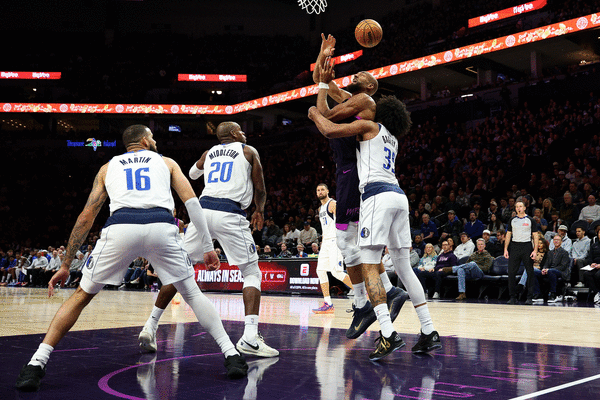
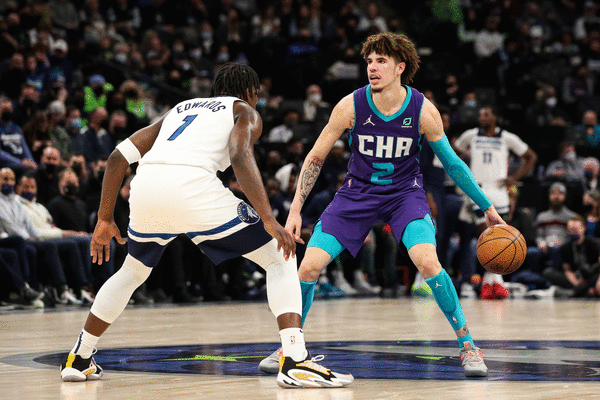


MINNEAPOLIS — Except for a few gaps in time, Rudy Gobert has been on the same team as Mike Conley since 2019.
The Jazz traded for Conley when Gobert was winning Defensive Player of the Year awards in Utah, and then the Wolves traded for Conley about six months after acquiring Gobert in 2022.
Conley experienced the unique transition a point guard had to go through when playing with Gobert.
“The first year, it’s such a work in progress for both sides,” Conley said in 2023. “And the second year, you let go of a little bit of that frustration of certain things that don’t work.”
The Wolves got a taste of what that looked like with a point guard who didn’t adapt to the nuances of Gobert’s game in D’Angelo Russell.
Russell had a memorable quote from his short time playing with Gobert, after a Wolves loss in Charlotte on Nov. 25, 2022: “He catch the ball, he’ll score.”
Even as the Wolves started Donte DiVincenzo over Conley last season, the Wolves still had a roster of players around Gobert who knew him and grew accustomed to playing with him.
LaMelo Ball joining the team represents a big shift in dynamics for Gobert as he enters his age 34 season. How Ball and Gobert develop a chemistry could mean a lot for the bottom line of this Wolves season, and it will likely have reverberations on both ends of the floor.
Will Ball and Gobert’s chemistry be more like Gobert and Conley, or will it venture down the Russell-Gobert path?
As long as Chris Finch has coached Gobert with the Wolves, he has preached the importance of involving Gobert in the offense, and not just as a high-level screen setter. The Wolves ignoring Gobert means defenses can ignore him too, and the Wolves have paid a price for that in some of their postseason losses, especially two seasons ago to Oklahoma City.
“I do feel like we have a blueprint for what fits Rudy most comfortably,” Finch said. “He had a lot of consistent offensive success in Utah in smaller lineups.”
That’s the direction the Wolves appear to be headed this season with a lack of power forward depth (assuming LeBron James doesn’t come to Minnesota). The Wolves should have better spacing on offense without two-big man lineups they have had to navigate the last three seasons.
“I can now envision lineup constructs that get him back to being — he’s always been a great roller — with better space around him and things he does more naturally,” Finch said. “I know he’s excited as well and looking forward to establishing an early chemistry with LaMelo.”
Just how quickly that comes, if at all, is the main question.
Playing with Gobert on offense is an acquired taste, given his limitations in catching the ball wherever his teammates throw it. It is preferable for Gobert to get the ball in certain, comfortable spots.
For instance, a bounce pass has to reach him above the waist instead of below in order to optimize his chance to catch it. You could see teammates adjust to that over the years. Jaden McDaniels and Kyle Anderson became adept at that. The process was slower for Anthony Edwards.
But on the plus side for the Wolves, there may be no more willing passer than Ball, who could utilize Gobert as a rolling lob threat while capitalizing on the space Gobert’s screening will bring. Establishing that chemistry early and often will help unlock the Wolves offense.
Finch has bragged about Gobert being a top 10 defense unto himself. The rim protection he provides is enough to to rank top 10 in defensive efficiency just in how he protects the paint.
But there’s also an acclimation process to playing with Gobert on defense that’s different than how other teams defend.
“The way I play defense is a totally different system,” Gobert said in 2024. “It takes time for them to accept the change of ways of playing defense and understanding the way I can maximize our team defensively, and also for me the same way. It’s a reminder to get out of my comfort zone too.”
Ayo Dosunmu went through an adjustment period last season when he came from the Bulls, who asked their perimeter defenders to contain the ball more, to the Wolves, who asked him to be more aggressive because of the backstop Gobert provides.
This season will be unlike any other for Gobert on defense with the Wolves, since he won’t have another big man, like Karl-Anthony Towns, Naz Reid or Julius Randle, playing alongside him. Barring other major moves to address power forward, there’s a front court size deficit the Wolves will have to compensate for now that wasn’t there in their previous defensive schemes.
Does that mean the Wolves will be more conservative in their defense, and keep Gobert near the paint as much as possible? It’s not their preferred method of defense, but it might be what they lean into with this personnel.
Ball’s Charlotte teams were typically worse on defense when he was on the floor than when he wasn’t, and teams may try to pick on him defensively in late-game situations. Can the Wolves help him use his size at 6-foot-7 as an advantage in these situations, combined with Gobert’s size in the paint?
For the Wolves defense to again be very good to elite, it will require a step up in activity level for Edwards. Theoretically, the addition of Ball will allow for this, since one of Edwards’ biggest issues defensively last season was his energy level. He would spend so much energy on offense running the show with the ball in his hands a lot that he’d let his defensive intensity lag.
“It’s not negotiable for his defense to come back a little more,” Finch said recently, while saying he understood why Edwards’ defense took a hit. “It was probably an unfair burden for Anthony,” Finch said. “And I thought he navigated it as best as he possibly could.”
The Wolves have been good in recent years at incorporating players who were not viewed as positive or neutral defenders (like Towns, Reid and Randle) into their scheme without much of a problem. Gobert and Jaden McDaniels can fix a lot of issues and cover a lot of ground.
But this will be a different challenge with Ball in the backcourt and the Wolves undersized at power forward. They could lean into defensive-first lineups by deploying someone like Jaylen Clark as an undersized four, but when it comes down to it, the Wolves may be asking more of Gobert on defense than they have so far in his five years here.
©2026 The Minnesota Star Tribune. Visit startribune.com. Distributed by Tribune Content Agency, LLC





Comments