Mike Vorel: Mariners must trade a starting pitcher for an impact position player
Published in Baseball
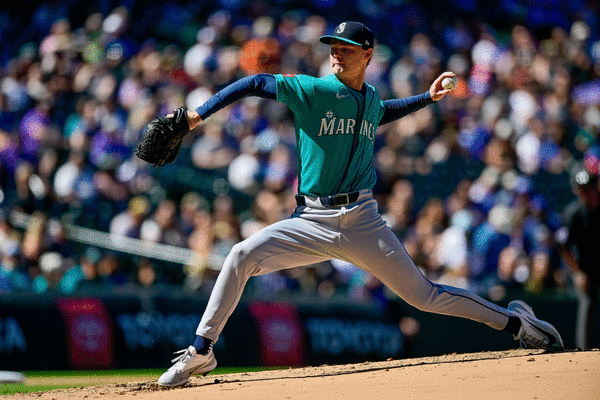
SEATTLE — On Sept. 28, Mariners president of baseball operations Jerry Dipoto faced a semicircle of media members, recorders and cameras inside T-Mobile Park’s press box. On the wall behind him, Dipoto was flanked by life-size photographs of Ichiro, Edgar Martinez and Julio Rodríguez — not-so-subtle reminders of this franchise’s past and present firepower.
But ironically, the 2026 Mariners lacked big bats — ranking 27th out of 30 MLB teams in OPS (.693), 28th in runs (664), 28th in hits (1,263) and 29th in batting average (.233).
They did have a problematic overflow of starting pitchers.
With six starters and five traditional slots, plus prized prospect Kade Anderson dominating Double-A, they vacillated between a six-man rotation and a piggyback approach — struggling to communicate or commit to either strategy. And despite dealing Luis Castillo at the trade deadline, a logjam remains in Seattle’s big league rotation.
Surrounded by a few of his franchise’s best position players, Dipoto said Sept. 28: “Our starting pitching is our starting pitching. We will have a homegrown starting rotation. Whether we have six of them or five of them remains to be seen.”
Here’s the thing, though: they have eight of them. Not six. Not five.
Which presents an obvious opportunity.
The Mariners would be wise to trade a starting pitcher this month for a position player who can positively impact their offense and defense. Because along with the above offensive issues, Seattle’s defense was among MLB’s worst as well.
It might be 28-year-old George Kirby, whose rare control (not to mention two years of remaining club control) make him an attractive target. It might be 27-year-old Emerson Hancock, who finally developed into a dependable starter in 2026. It might be 28-year-old Bryce Miller, whose Dr. Jekyll/Mr. Hyde first and second halves make him a difficult pitcher to project. It might even be (gulp) opening-day starter and clubhouse leader Logan Gilbert, who’s entering his final season before free agency.
I get it: it’s scary to deal from a strength, particularly considering the inevitability of pitching injuries. It’s also uncomfortable to part with a productive player to whom fans have become emotionally attached. If Seattle’s injury luck runs out, or if young pitchers such as Anderson and 20-year-old Ryan Sloan (MLB’s No. 11 overall prospect) don’t pan out, mining the Mariners’ big league pitching reservoir could backfire.
But counterpoint: scared money don’t make money.
Translation: no risk, no reward.
Besides, the bigger risk — by far — is declining to address your most worrisome weaknesses. It’s failing to replace your most productive hitter, Randy Arozarena, who will undoubtedly sign a sizable free agent contract elsewhere. Considering Seattle already had one of baseball’s most flawed offenses, asking unproven prospects such as Colt Emerson, Michael Arroyo and Lázaro Montes to replace Arozarena’s production is an unfair recipe for failure.
Obviously, Mariners fans would prefer to add without simultaneously subtracting. Signing a premier free agent such as Chicago Cubs outfielder Seiya Suzuki would fill existing holes without poking new ones. In a perfect world, the Mariners would operate that way.
But given recent history, how confident are you that the Mariners will win any free-agent bidding war?
I’m not talking about Rob Refsnyder, Donovan Solano, A.J. Pollock and Tommy La Stella — discount last gasps disguised as lineup upgrades. I’m not even talking about the bullpen, which also needs reinforcements, because it’s more feasible to accomplish that via free agency. I’m talking about meaningful improvements/investments at third base, shortstop or in the outfield.
Given Seattle’s annually frustrating spending ceiling, the admittedly meager free-agent market, the Mariners’ multiple needs, the current core’s precarious winning window and the looming MLB lockout Dec. 2, the arrow points one way:
It’s time for Dipoto — “Trader Jerry” — to do his thing.
“Will we move a starter? Not certainly. Could we? We could,” Dipoto told The Seattle Times at MLB’s GM meetings in Las Vegas this week. “We want to make our team better and more complete. And if (that’s) the best way to access upgrades for our offense or upgrades that improve our defense and our offense collectively, then we have to be open-minded to it.”
Let’s face it: unless Seattle surprises everybody by signing an impact position player, trading a starting pitcher is unquestionably the best way to upgrade the offense and defense.
It’s not a bulletproof blueprint. If you deal an established starter, you’re applying more pressure on everyone else. You’re depending on Hancock’s ascension to be sustainable, or Sloan to be ready to contribute down the stretch, or 25-year-old Logan Evans to be viable after recovering from Tommy John surgery. You’re betting the baseball gods won’t rock your rotation with incessant injuries.
But how many MLB teams have even five starting pitchers they feel confident in? Not many, which is why a ready-made starter is Seattle’s most attractive trade chip. The Mariners’ pitching depth, even if they deal a starter, would still be a comparable strength.
And what if your starting pitchers stay healthy? Eight of them won’t help the Mariners win a World Series in 2027. Another capable position player (or two) absolutely could.
Dipoto and general manager Justin Hollander owe it to first-year manager Jason Kanzler, the Mariners fan base and the current roster to do everything possible to put them in position to succeed. Considering catcher Cal Raleigh and this rotation aren’t getting younger, the priority is to win a pennant in 2027, not 2032.
It’s risky to weaken an established strength to strengthen a weakness.
But be bold, not scared. It’s riskier to stand still.
©2026 The Seattle Times. Visit seattletimes.com. Distributed by Tribune Content Agency, LLC.





Comments