Rockies unveil Todd Helton statue outside Coors Field honoring 'the captain of this franchise'
Published in Baseball
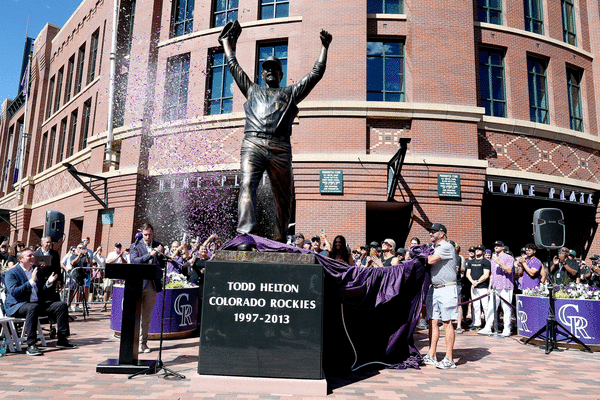
DENVER — Colorado’s most joyous baseball moment is immortalized in bronze.
The Rockies unveiled the Todd Helton statue on Saturday at 20th and Blake outside Coors Field, a freeze-frame of the Hall of Famer celebrating at first base after catching the final out that sent the club to its lone World Series in 2007.
Helton, who was enshrined in Cooperstown in 2024 after being voted in on his sixth year on the ballot, had his youngest daughter, Gentry Grace, pull the purple curtain down off his statue about three hours before Saturday’s first pitch against the Mariners. Purple and white confetti rained on the first baseman and his family as the tough Tennessean was visibly choked up with emotion.
As Helton explained, the topper on his legacy — first cemented by his number retirement in 2014, then his call to the Hall, and now this 17-foot tall, 1,000-pound monument outside the stadium where he starred — had his mind caught between the sublime present and the distant past. In the latter, his late father and former Twins minor league catcher Jerry Helton molded young Todd into the all-fields, line-drive power hitter Colorado came to love.
“I get choked up a little bit when I start thinking about my dad and how he would be, what he would be thinking and how he would be acting and how proud he would be (about the statue),” Helton said. “… He always thought that I never got enough credit for my playing, and I don’t think he could ever say that anymore. Making the Hall of Fame and now having a statue outside of a stadium — that is the ultimate honor.”
As a young kid growing up in Knoxville, Helton would fool around in the yard pretending to be Hall of Fame southpaw Jim Kaat, the first baseball player he ever knew. He would repeatedly watch a VHS tape of Twins legend Rod Carew breaking down opposite-field hitting. And he would hit in the garage off a batting tee his dad made from a washing machine hose.
Helton grew up in a humble home. He never saw a professional game until he played in one. Hence why the whirlwind of the last few years, first making it to Cooperstown and now this, a 1.5-times scaled statue of himself that is about 13 feet tall without the base, can be hard for even Helton to believe.
His statue completes the triumvirate of bronze figures that now guards Coors Field’s main entrance, along with the statue of outfielder Larry Walker that was revealed in August and “The Player” statue that has stood outside the stadium since its opening in 1995. Like the latter two statues, Helton’s homage was designed by renowned Loveland sculptors George and Mark Lundeen.
Helton’s statue is a take on the most iconic freeze-frame in Colorado history, a Denver Post photo captured by photographer John Leyba. On a check-swing by the Diamondbacks’ Eric Byrnes against right-hander Manny Corpas, shortstop Troy Tulowitzki fielded a slow chopper to his right, then hummed the throw across the diamond to get the final out as Byrnes slid headfirst through first base.
Helton stretched to catch the throw and then looked to the sky with the ball in his glove and his left hand a fist, screaming in exaltation. The statue captures that play a few seconds after that moment, with Helton standing a little taller than he is in Leyba’s photograph.
“It was all about being able to see him better, because he’s so high up there, so we wanted people to see his face,” Mark Lundeen explained. “The statue is about half a second after (Leyba’s photo) when he came back up out of that stretch, and that’s the one we went with. And another reason we didn’t stretch him all the way out is because that base would’ve been 10 feet long instead of (7.66 feet).”
‘He was untouchable’
Helton, 53, played all 17 of his big league seasons for the Rockies. His No. 17 was retired in 2014, the year after his career ended, to become the first Colorado player to have his number retired. Walker’s No. 33 joined Helton up on the right-center field facade in 2021, shortly after Walker became the first Colorado player inducted into the Hall of Fame.
Walker was one of many notable Rockies faces in attendance for Saturday’s unveiling, which was attended by a throng of over 500 people who pressed up against the metal barricades set up in a circle beyond the statue. Fans crowded the pavement to witness history; kids sat on shoulders, grown men stood on benches across Blake Street, and those who couldn’t find a spot watched from across 20th Street and from a few balconies in adjacent McGregor Square.
It was a moment that underscored the Rockies’ resonance, even considering the franchise’s struggles over the past three-plus decades.
Besides Walker, other past greats such as Charlie Blackmon and Vinny Castilla were also in attendance, as was Colorado’s original general manager Bob Gebhard, the man who drafted Helton No. 8 overall out of Tennessee in 1995. The entire Rockies’ current roster, coaching staff and grounds crew also came out to watch, and Dinger was there, too.
Walker, whom many agree was the most physically talented player the Rockies have ever had, called Helton “the captain of this franchise.”
“He was untouchable,” Walker said. “There’s some players you can trade away and be OK with (like I was to the Cardinals). If Todd would have ever gotten traded away, I’m not sure the city would forgive anybody for doing that. He’s the backbone of this franchise. He showed that today, and that’s why that statue is standing right there.”
But as former Rockies manager Clint Hurdle tells it, a Helton trade nearly happened in the winter of 2006, a few months before the start of the magical Rocktober season. Hurdle says the Rockies were in discussions to trade Helton to the Red Sox, who ended up sweeping Colorado in the 2007 World Series.
Had that happened, Helton’s bat likely still would have carried him to the Hall of Fame. But he might not have a statue in LoDo.
“Todd got to the point where he told (the Rockies front office), ‘You do what you’ve got to do, but I just want you to know, anywhere else, it’ll never mean close to what it does to go to the playoffs here,' ” Hurdle recalled. “So for that all to come full circle was amazing — (the final out of the NLCS) could’ve been a flyball to center. It could’ve been a punchout.
“It wasn’t. It was Helton receiving the throw, and the entire city felt the energy of that moment through him. There’s only a handful of guys in the game of history of baseball where you can flip over a baseball card with that kind of history with one team — I think of (the Orioles) Brooks Robinson, of (the Tigers) Al Kaline, of (the Royals) George Brett, and Helton. That’s pretty good company.”
A former college QB at Tennessee who was replaced by Peyton Manning there in 1994, Helton made the right call in eventually choosing baseball. Helton admitted Saturday that he didn’t really like football, especially when he got to college. When he got drafted, he was on the negotiation list for the Hamilton Tiger-Cats of the Canadian Football League, but chose to sign with Colorado instead for an $892,000 bonus.
“I always was a baseball player in my heart,” Helton said. “(In college), I felt like I was missing out on getting better at baseball and wasting my time playing football.”
From his big league debut in ’97 to his final game in 2013, Helton finished as the Rockies’ career leader in games (2,246), hits (2,519), homers (369), WAR (61.8), runs (1,401), total bases (4,292), RBIs (1,406), walks (1,335) and extra-base hits (998). The doubles machine was also tops in that category with 592, ranking 20th in baseball history.
The five-time All-Star, four-time Silver Slugger, and three-time Gold Glover was also second in Rockies history in on-base percentage (.414), third in OPS (.953), and tied for third in batting average (.316).
His 2000 season was his peak, when he claimed the National League slash-line triple crown with a .372/.463/.698 and 1.162 OPS, plus an NL-best 8.9 WAR and MLB-best 59 doubles and 147 RBIs, while flirting with batting .400 late into the season. He is one of just two players in baseball history with at least 2,500 hits, 550 doubles, 350 homers and a career average of .315 or higher. The other is Cardinals legend and fellow Hall of Famer Stan Musial.
Helping with the rebuild
Several ex-Rockies in attendance for Saturday’s unveiling described Helton’s indelible impact on their careers, especially a couple of guys who were younger players during the first baseman’s tenure.
Charlie Blackmon, whose first three partial seasons in the majors overlapped with the final three seasons of Helton’s career, described No. 17 as a “larger than life” clubhouse presence.
“It was hard not to be a fan,” Blackmon said. “It was hard to be a teammate. It was hard to consider myself an equal to him — not that I should have — but in order to move on and just play the game, I kind of had to get over him as Todd Helton.”
Clint Barmes, who was a rookie in 2003 when Helton was still in his prime, came down from his house in Mead on Saturday because of the effect Helton had on him as a shortstop.
“He took me under his wing when I first came up and he was huge for my career,” Barmes said. “Being a young shortstop who at that time made a lot of errors, he pretty much saved my career having him at first base. He told me, ‘I can’t do anything about a throw over my head. So if you are feeling rushed on a play, throw it at my feet. If it gets here, I’ll catch it, and if it doesn’t, I’ll pick it.’ And he did, so many times.”
For Walker, seeing his statue a few feet from Helton’s made him a bit dreamy, even as the Rockies are on the cusp of a fourth straight 100-loss season.
“(Winning a World Series) will happen here one day,” Walker said. “Hopefully, that happens while I’m still (alive). I’ll be here watching that parade. And that parade will be going by our statues.”
Helton, who has been a special assistant to the GM for the Rockies since 2022, says he wants to get more involved in that role to contribute to Colorado’s rebuild going forward.
“The only problem I deal with is purpose,” Helton said. “My purpose was always to be a baseball player. I’ve found another purpose is being a dad. But I need to get back into helping these young kids with the Rockies a little bit more. Hopefully, I can dive back into that and put my hands around that. With the Hall of Fame and everything else, I kind of got sidetracked a little bit from it. I look forward to jumping back into that.”
Helton spent much of Saturday’s ceremony peering up at his statue, both before and after its unveiling. Following the ceremony, he took dozens of photos with Rockies staff, ex-players and other organizational figures. But he emphasized that when he looks at himself molded in bronze, he doesn’t see a Colorado baseball icon.
“When I look at this statue, I don’t see a perfect career,” Helton said. “I see a journey. I see a kid who got an opportunity. I see teammates who believed in me. I see coaches who challenged me. I see trainers who kept me going. And I see Rockies fans who supported me all along the way.”
©2026 MediaNews Group, Inc. Visit at denverpost.com. Distributed by Tribune Content Agency, LLC.





Comments