Mickey Harrington was the Phillies' Moonlight Graham. He never got his Field of Dreams.
Published in Baseball
PHILADELPHIA — Mickey Harrington played with major leaguers, played against major leaguers, played for major leaguers and even roomed with major leaguers. But him? Harrington was stuck in the minor leagues in 1963 after signing six years earlier with the Phillies.
Harrington served two years in the Army and could have played professional basketball after being drafted by the New York Knicks. He picked baseball, believing it was his best chance at a career. And then Harrington watched every season as his teammates left the minors for the majors while he stayed behind.
Finally, he got his chance. The Phillies called up Harrington in July of 1963, flying him from Hawaii where he was playing for a Triple-A team. The 28-year-old was a big-leaguer.
Harrington sat on the bench for eight games before manager Gene Mauch used him as a pinch runner on July 10, 1963. Roy Sievers singled to start the eighth inning against the San Francisco Giants at Connie Mack Stadium and Harrington stepped onto the grass at 21st and Lehigh.
The inning ended two batters later when Clay Dalrymple grounded into a double play. Harrington had reached second on a single by Don Hoak before Don Demeter hit a grounder to first. A newspaper account blamed Harrington for “reckless baserunning” as he was tagged after making a wide turn around third base.
Mauch, the fiery manager they called the “Little General,” immediately lifted Harrington from the game and replaced him with Frank Torre. Two days later, the Phillies dropped Harrington back to the minor leagues.
He was a professional ballplayer for 10 seasons but his only experience in Major League Baseball was being used once as a pinch runner. He didn’t play the field, score a run or step into the batter’s box. Harrington, who died in 2017, finally became a big-league player. But his career only lasted a few minutes.
“Deep down, I could read between the lines even though he didn’t say much about it,” said son-in-law Ken Knopp. “I know it hurt him. He felt at some point that he was beating his head against the wall. I know it hurt his feelings. But he never really said that much about it. It was frustrating for him. He couldn’t break in.”
Field of Dreams
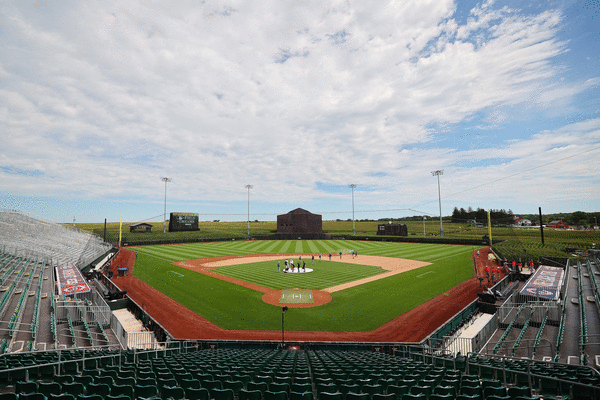
The Phillies will play Thursday against the Minnesota Twins in Dyersville, Iowa, the setting for "Field of Dreams," the 1989 Hollywood film where a cast of legendary players appear as ghosts on a baseball diamond built by a farmer in the middle of a cornfield.
A thread of the movie was focused on Moonlight Graham, a longtime minor-league player who played one inning in the majors as a defensive substitute in 1905 but never had a chance to hit.
“It was like coming this close to your dreams, and then having them brush past you like strangers in the crowd,” the older Graham character, played by Burt Lancaster, says in the film. “At the time, you don’t think much of it. We just don’t recognize life’s most significant moments while they’re happening. Back then I thought, ‘Well, there’ll be other days.’ I didn’t realize that that was the only day.”
The Iowa diamond brought the ghosts of “Shoeless” Joe Jackson, Mel Ott, Gil Hodges and other deceased greats out of the cornfield and gave their careers a second life. Graham — wearing an old New York Giants jersey — finally got his chance to bat and hit a sacrifice fly. Jackson asked the farmer if the field was heaven. No, it was Iowa.
It was magic and the film, which is routinely ranked among the top sports movies ever made, was nominated for Best Picture at the 1990 Academy Awards.
Harrington’s big-league career was a flash just like Moonlight Graham’s. But the man who grew up in Hattiesburg, Miss., never got to hit on a field of dreams.
“It was a thrill to get there,” Harrington told the Clarion-Ledger of Jackson, Miss., in 2003. “But it was a letdown not getting to bat. It would have been nice to bat one time.”
Playing with legends
Harrington hoped to return to Hawaii after being dropped back to the minors but was instead sent to Little Rock, Ark., where Dick Allen was playing as the team’s first Black player. For Harrington, it was another encounter with the type of players who played on that cornfield.
He roomed with Chuck Tanner, hit against Tommy Lasorda and played against Sparky Anderson, all future managers. Willie Mays, Willie McCovey and Orlando Cepeda were on the Giants when Harrington passed through as a pinch runner.
Harrington spent most of his first season in 1957 with Miami, where the Phillies had a Triple-A club. He was being teased in the clubhouse for being from Mississippi when an older pitcher asked him where he was from. Hattiesburg, Harrington said. The pitcher grew up 90 minutes away in Mobile, Ala. It was 50-year-old Satchel Paige, another legend for Harrington to cross paths with.
“Satchel Paige stood up,” Knopp said. “‘Hey, y’all leave him alone. He’s my neighbor.’ They became good friends. Satchel Paige took up for him. That’s a pretty good way to be introduced to Satchel Paige.”
Harrington was hitting .298 with the Hawaii Islanders in 1963 when the Phillies called him to the majors. He batted .305 over the previous four Triple-A seasons and won a Silver Glove Award — the minor-league version of the Gold Glove given to the best fielders — in 1961 for his work in the outfield.
Harrington performed in the minors like a prospect, but his only chance at the majors was that Wednesday night at Connie Mack Stadium.
Maybe Harrington’s modesty, Knopp said, caused him to be overlooked. Or maybe those two years in the Army delayed his career enough to keep him stuck in baseball purgatory. Or perhaps he should’ve played basketball.
“In baseball vernacular, they call it a cup of coffee,” Knopp said. “I never understood it. He was a great ballplayer.”
Harrington retired after the 1966 season, returned to Hattiesburg, and worked at his father’s sporting goods store. His first daughter, Heather, was born when he was playing and his second daughter, Hope, was born just after he retired. Harrington filed a patent in 1973 for a batting tee and built a home on a plot of land owned by his father-in-law. He was always using his hands. Harrington turned a shack into a three-bedroom home with two fireplaces and a big living room.
“It’s all cypress wood on the outside,” Knopp said. “He did all the woodwork, carpentry work all by himself. It’s a beautiful house. It’s an amazing house.”
He was soon hired as an assistant coach on the basketball and baseball staffs at Southern Mississippi University, where he played before being drafted by the Army.
Harrington was an all-American basketball player in high school and was a four-year starter in college. He had chances to play at bigger schools but his dad, Smokie, urged him to stay home at Southern Miss. He lived a few minutes from campus after his playing career and became a fabric of the university.
The school president tabbed him in the 1980s to build a 220-acre equestrian center with bleachers for 2,500 people. He had a barn moved to the facility and rallied a group of college students to build the center using supplies that Harrington received through donations.
The farmer in Iowa built a baseball diamond that brought ghosts of the past. Harrington built a rodeo ring that led to his daughter meeting her husband.
“They were literally screwing down the seats on the bleachers an hour before the first performance started,” Knopp said.
His major league career was just a few minutes but there were always reminders of a guy who spent a decade as a professional athlete. He biked 20 miles a day, even when his knees were shot and he could hardly walk. He competed in the Senior Olympics and was back on his bike just months after a truck hit him in his 70s and broke his neck, shoulder and ribs. And his hands — the ones big enough to palm a basketball — were a marvel.
“He would have handshake competitions,” his daughter Heather said. “If he didn’t see his nephews in a while, he would put out his hands and his hand would just swallow their hands. They would try not to flinch, but he would tighten down on them. Finally, they’d go ‘OK, Uncle Mike. I give, I give.’ He was a cool human being.”
‘He would’ve got a hit’
Harrington didn’t talk much about his career but Knopp could often find an opening as the two sipped hot chocolate in the winter and ate Klondike bars while watching football in Harrington’s living room.
There was the time he was playing on the baseball team at his Army base and had to tell the general he couldn’t make the trip for that weekend’s game. His captain said Harrington — who was an excellent typist and worked as a clerk — had to finish inputting reports. The base’s general managed the baseball team and said he would handle it.
“Mickey was sitting at his desk, typing away, and he heard the phone ring in the captain’s office,” Knopp said. “He just heard, ‘Yes, sir. Yes, sir. Yes, sir.’ He hung the phone up, went over to Mickey, and said, ‘Mickey, it’s OK. You can go.’”
He told his son-in-law how fans booed him during the Civil Rights Movement whenever the ballpark’s public address announcer said he was from Mississippi. Harrington told them to stop telling the fans where he was from. And there was that time his teammate in the minors blockaded the umpires in their dressing room before the game started.
“The national anthem is over and there are no umpires,” Knopp said. “Finally, someone heard the umpires banging on the door. They moved everything out of the way and they got out. The umpire knew who did it and didn’t say a word. He walked over to Mickey’s dugout, pointed to this guy, and said, ‘You’re out of the game.’”
Harrington told a reporter in 2003 how he never understood why the Phillies used him as a pinch runner since he was a “6-foot-4 and 205 pounds.”
“Maybe that’s why the Phillies never won any ballgames back then,” he cracked. (They actually went 87-75 in 1963.)
But Heather said she always sensed her dad was at peace with how things went. He never seemed bitter or longed for a chance. At his funeral in 2017, Harrington’s nephew Larry said in a eulogy that Uncle Mike stayed positive. He always moved forward and simply believed “it didn’t happen so it didn’t happen.”
Heather agreed. That was her dad. He spent just a few minutes on a field of dreams at 21st and Lehigh. And he was OK with it.
“From the time I was very young I heard how talented he was. But never from him. He never said a word about it,” she said. “He was an incredible person. He made you want to do better. He made you want to live better. He made you want to push harder.”
But what would have happened if Harrington got the chance to hit like Moonlight Graham did that night on that cornfield in Iowa?
“He would’ve got a hit,” Heather said. “Absolutely. Oh, for sure.”
____
©2026 The Philadelphia Inquirer. Visit inquirer.com. Distributed by Tribune Content Agency, LLC.



Comments